

Battery competence cluster AQua
Quality offensive for better batteries
Batteries "Made in Germany" should be powerful, long-lasting and safe and available at an affordable price: among other things, this should be made possible by advanced approaches to quality assurance and analytics during production, which are now being developed and tested at the Karlsruhe Institute of Technology (KIT). The work in the AQua battery research cluster is being carried out in close cooperation with research partners in the "Battery Research Factory" initiated by the Federal Ministry of Education and Research (BMBF).
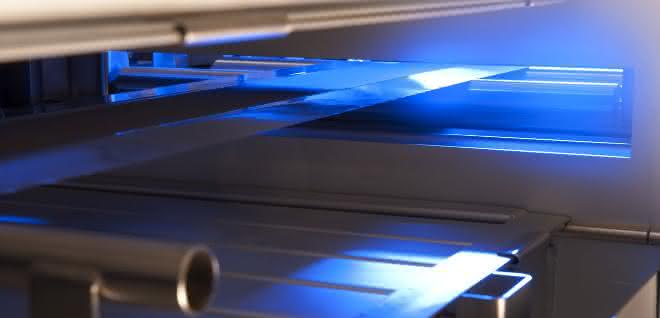
Ensuring maximum quality at minimum cost - this is what scientists want to achieve in a new research platform that has been launched at KIT as part of the battery competence cluster AQua (which stands for: Analytics/Quality Assurance). To this end, they are first looking at every production step, from the starting materials to the finished cell, in order to identify possible sources of error. The aim is then to optimize and automate the handling of errors during ongoing production so that consistently high quality can be guaranteed in the end. "Every step in production has to be right. Everything is coordinated and every error can have an impact on the subsequent performance of the cells," says Professor Helmut Ehrenberg from the Institute for Applied Materials (IAM-ESS) at KIT, who is coordinating the research work. "The performance of analytics and quality assurance therefore has a significant influence on the quality, safety and costs of a cell." The researchers are developing their solutions using integrated production control methods and implementing them into the entire process chain.
Research into automatic fault detection
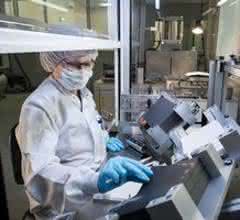
In order to identify critical errors in the production process as early as possible and to interpret them correctly, the scientists in the AQua projects work according to the principle of Failure Mode and Effects Analysis (FMEA), among other things. "We introduce errors in a targeted and controlled manner in order to precisely quantify the relationship between a malfunction and the effects on the cells," explains Dr. Lea de Biasi, one of the researchers in the project. "If we now define specific performance criteria as quality targets, we can set tolerance limits for all relevant process steps." These are then used directly in the production process. To this end, AQua is also developing methods with which critical influencing variables - such as the homogeneity of the electrode coating or the residual moisture of the components at the start of cell construction - can be recorded in real time. During automatic defect detection, intermediate products are automatically inspected immediately after the respective process step and defective pieces are sorted out. "It is also possible to draw conclusions about the causes of defects," says de Biasi. "This allows us to eliminate process faults at an early stage and avoid further costs due to rejects."
Data infrastructure for rapid research transfer
The new research platform is complemented by an accompanying project coordinated at KIT by Dr. Michael Selzer from the Institute for Applied Materials - Computational Materials Science (IAM-CMS). Among other things, this involves the exchange of the platform with the other battery competence clusters of the "Battery Research Factory" and cooperation with industry. However, the focus is on setting up a data infrastructure: "The experiments and large-scale simulations in the AQua project generate large amounts of data that need to be evaluated using specific data analysis methods via standardized workflows," says Selzer. "With the data infrastructure, we are creating sustainable access to this research data and analysis tools." Professor Britta Nestler from the IAM-CMS, who is a key supporter of the project as an expert in microstructure simulation, emphasizes that this is a decisive contribution to quality assurance and also to the transfer of research in battery production. "In AQua, we want to develop a comprehensive and cross-process understanding of how the interaction of materials, production steps and electrochemical characteristics affects the structures and properties of the battery."


You might also be interested in
VDE study on electrical engineering
More retirements than graduations
According to a VDE analysis, more than 30,000 electrical engineers will retire by 2029 without enough graduates to replace them. This is due to falling student numbers and high drop-out rates.
 read more...
Giving lightweight construction a profile
Pultrusion: A process that forms fibers under tension
Pultrusion is developing from a niche process into a key process for lightweight construction and sustainable fiber composite structures. The Fraunhofer IWU shows applications from energy to mobility.
read more...Green hydrogen directly from the sun and water
A start-up project at the Karlsruhe Institute of Technology (KIT) aims to fundamentally simplify the production of green hydrogen: Mass-produced photoreactor panels are to be used to produce hydrogen directly from sunlight and water - without...
read more...Fraunhofer shows industrial future between AI, data and new materials
At Hannover Messe 2026, the Fraunhofer-Gesellschaft will be presenting solutions for a resilient industry: from AI and data rooms to hydrogen technologies and material and recycling innovations.
read more...The bottleneck is in the system
Is the transformation of the industry failing due to "German Angst"?
A recent ISF study examines what is slowing down change in German industrial companies. According to the results of the study, the causes of innovation bottlenecks often lie in internal structures and a lack of strategic orientation.
read more...Why a data-secure Germany needs joint implementation
Is 2026 a key year for a data-secure and networked Germany? Michael Fritz from the Fraunhofer Cluster CCIT explains why the coming year will be crucial for secure data spaces, common technical standards and Germany's digital future.
read more...Biodegradable label makes transportation conditions traceable
Researchers are developing a smart, compostable label that measures temperature and humidity and detects when limit values are exceeded.
read more...AI support for the circular economy
An assistance system developed at Fraunhofer IPK is used to identify, sort and assess the quality of disused household appliances, thus contributing to recycling and waste avoidance with the help of artificial intelligence.
read more...VDW Research Institute honors industrial projects
At EMO Hannover 2025, the VDW Research Institute will be honoring projects for increasing the efficiency of forging hammers and safe protective devices for grinding machines. Practical research for Industry 4.0, occupational safety and automation
read more...