
Video surveillance in logistics
1,000 eyes see more
The company Herbert Voigt is considered one of the pioneers in the field of video surveillance. Together with Divis, the freight forwarder developed solutions for general cargo handling, warehouse logistics and personnel access control.
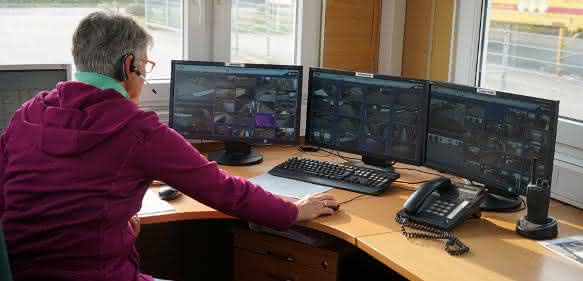
Knowing everything that happens: Voigt comes pretty close to this vision. This at least applies to what happens on the company's own premises, including the transshipment and logistics halls. The basis for this are the more than 1,000 surveillance cameras that the Neumünster-based freight forwarder has installed indoors and outdoors on loading gates, building walls and masts.
Each camera produces images around the clock and sends them to a local database. The huge amounts of information are analyzed and structured by the Cargovis system solution, which, like the cameras, comes from Divis.
One solution for three areas
Cargovis is used at Voigt in general cargo handling, in warehouse logistics and for personnel access control - in various forms: In the transshipment hall, the cameras are always assigned to the hall scanners that are currently in the field of vision of the high-resolution optics. In this way, each barcode scan or consignment number is linked to current video recordings of the goods. The connection between scanner and camera is established by scanning a barcode attached to the respective hall door. The employee only has to perform this action once at the start of their activities in the work area. After this, all scanned consignments are automatically assigned to the relevant camera.
The new Voigt transshipment hall planned for 2018 will have fully automatic control of the "right" camera group in each case. Each barcode scanner will be located separately and assigned to the camera group in the respective hall section. Without any further intervention by the employee, the camera "with a view" of the respective goods is assigned to each scan and its images are linked to the consignment number. "We expect the fully automated version to bring further productivity gains," says Katharina Warlies, who is responsible for insurance and real estate management at Voigt. "In goods handling alone, we use Cargovis to search for consignments several times a day," says the trained forwarding agent.
Search terminals for drivers
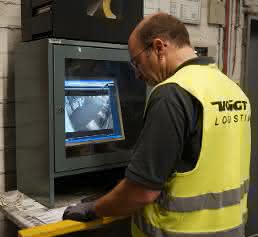
A typical use case is goods that cannot be found in outgoing goods. This happens, for example, when only the term "goods" is entered in the consignment note instead of an exact consignment name. "If you can't imagine anything about the shipment, it's all the more difficult to find it," says Warlies. "With Cargovis, our drivers can literally get a picture of the shipment."
In fact, Voigt's drivers can search Cargovis independently. Search terminals have been set up in the hall for this purpose, where they simply have to enter the relevant consignment number. As soon as the image of the goods appears on the monitor, the drivers can continue their real search - usually with rapid success. "The functions of Cargovis at the search terminals in the hall are severely restricted for data protection reasons," emphasizes Warlies. For example, it is not possible to forward or print the images. The same applies to the live view function, which shows the current warehouse situation. This makes operating the terminals all the easier. "The employees in the warehouse are pleased that they can now work independently, while their colleagues in the office are noticeably relieved," says Warlies.
However, the technology not only makes searching easier, it also makes it easier to provide evidence to customers, recipients and cooperation partners. "If goods are missing somewhere in the supply chain, you quickly come under suspicion as a freight forwarder," says Warlies. With seamless video surveillance, you can now prove at any time the extent to which certain consignments have reached and left your own warehouse. "With Cargovis, colleagues can prove the quality of their work at any time and quickly clear up any unjustified accusations."
Use in the logistics warehouse
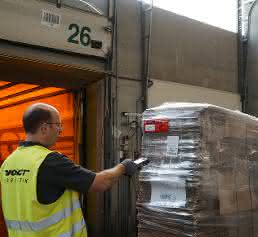
At Voigt, this works not only in the handling warehouses, but also in the logistics warehouses, where a simplified version of Cargovis is used. There, the cameras are not linked to the hall scanners, especially as there are naturally fewer goods movements in this business area. Nevertheless, the system delivers fast search results here too, because at Voigt the product groups are assigned to specific rack aisles. This allows the search to focus on the images from the relevant camera. "The time limit is determined by the entries on the packing slips, which are routinely time-stamped by the employees," explains Holger Matzen, who is responsible for one of Voigt's logistics locations. They have also come up with a trick so that each outgoing pallet can be viewed from all sides during a later search. "Immediately before loading, the employee turns the pallet truck and pallet once around its own axis so that the camera mounted on the gate captures all four sides of the goods," says Matzen.
The third area in which Cargovis is used relates to passenger access control. This is part of the AEO certification that Voigt has had since 2013. As part of this, the customs authorities require that every entry and exit or access to the site is fully documented and archived for ten years. For this purpose, Voigt has installed a Dormakaba access control system at all sites, which is connected to Cargovis via an interface.
Before entering, each visitor receives an access card with a six-digit code and RFID chip, which can be used to open certain doors depending on their authorization. Each time a door is opened, the solution generates a data record with a time stamp, visitor code and location so that the corresponding image from the relevant camera can later be found for each process. "This allows us to provide the customs authorities with not only the names but also photos of the visitors on request," explains Katharina Warlies. as


You might also be interested in
Basler acquires 76% of Indian image processor
Basler, supplier of image processing components for computer vision solutions, has acquired 76% of the Indian sales partner Alpha TechSys Automation.
 read more...
Process monitoring and fault detection
Cameras ensure quality during laser melting
Powder bed-based laser melting (PBF-LB/M) opens up new possibilities in additive manufacturing. Modern camera systems provide crucial process data to further increase quality and efficiency.
read more...Vision Sensor is three times faster than its predecessor
The 'CS-62' vision sensor from di-soric is around three times faster than its predecessor, the 'CS-60'. In combination with the 'nVision-i 25.1' software, it enables image processing solutions that were previously reserved for smart cameras.
read more...Thermal imaging cameras for quality control
Automated thermal imaging cameras are often suitable for quality control applications where temperature plays a role. However, while there are various solutions on the market for slow processes, it is challenging to select a camera that reliably...
read more...Easy entry into industrial VGA thermography
Reliable temperature measurement is a prerequisite for the success of many industrial processes. Berlin-based manufacturer Optris presents the Xi 640 infrared camera, a new member of its Compact Line, which enables non-contact temperature...
read more...Powder bed-based laser melting optimized
Aconity3D has set itself the goal of optimizing the stability of the manufacturing method of powder bed-based laser melting and thereby promoting its use in a wide range of industries. By using high-speed industrial cameras from SVS-Vistek, the...
read more...INDUSTRIAL Production Products of the year...
2nd place, category handling, assembly and production logistics: SICK
safeVisionary2 is the first 3D time-of-flight camera with Performance Level c safety certification. It enables safe three-dimensional environmental detection and won 2nd place in the competition for Product of the Year 2024 in the handling, assembly...
read more...Nomination Products of the Year 2024
SICK: Camera systems safeVisionary2
safeVisionary2 is the first 3D time-of-flight camera with Performance Level c safety certification. It enables safe three-dimensional environmental detection and has been nominated in the 2024 Product of the Year competition in the handling,...
read more...AI vision brings additional opportunities
The seamless integration of AI into the consumer sector has helped to improve our quality of life and make interactions with technology more efficient. In industry, AI vision with machine learning opens up new possibilities that are not covered by...
read more...