

TU Dresden launches upcycling project
A second life for metal components
In the project "2nd Life Metal Components: A Pathfinding Project for Upcycling", researchers at the Technische Universität Dresden (TUD) are developing innovative production processes for the recycling and reuse of metal components.
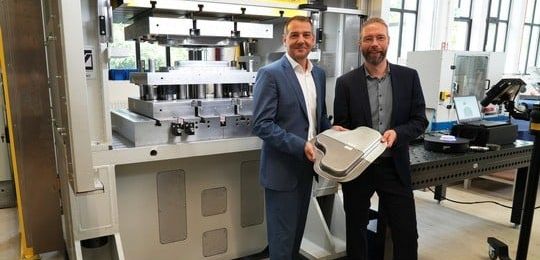
The eight-year project is headed by Prof. Alexander Brosius and Prof. Andrés Fabián Lasagni from the Institute of Production Engineering. It is being funded by the Werner Siemens Foundation with 13 million euros. In future, the project will offer a 25-strong team a broad field of research.
As the demand for metals in industrialized nations continues to rise, so too do anthropogenic stocks. This means that more and more metals remain in infrastructures and buildings for long periods of time. Due to the scarcity of resources, conventional recycling methods - especially energy-intensive melting - are no longer justifiable. The "2nd Life Metal Components" project aims to avoid these processes by directly reusing existing metal parts through upcycling and manufacturing new products from them.
Secondary use saves considerable energy and resources
The secondary use of existing raw material stocks is known as urban mining. These processes can significantly reduce energy consumption and conserve valuable resources. "Our approach makes it possible to save 90 percent of the energy normally required," emphasizes Prof. Brosius. "This project will set new standards in urban mining through the sustainable reuse of metals." Laser-based technologies are used to improve the properties of the recycled metals and produce tailored blanks with specific properties for certain applications. This innovative approach is intended to improve ecological and economic efficiency in sectors such as the automotive industry, promote the circular economy and support sustainability goals.
"Laser-based functionalization is another key to the success of this project," explains Prof. Lasagni. "It allows us to characterize both the surface and bulk properties of the metals, to precisely adjust them to enable their reuse and to specifically improve their properties for new applications."


You might also be interested in
VDE study on electrical engineering
More retirements than graduations
According to a VDE analysis, more than 30,000 electrical engineers will retire by 2029 without enough graduates to replace them. This is due to falling student numbers and high drop-out rates.
 read more...
Giving lightweight construction a profile
Pultrusion: A process that forms fibers under tension
Pultrusion is developing from a niche process into a key process for lightweight construction and sustainable fiber composite structures. The Fraunhofer IWU shows applications from energy to mobility.
read more...Green hydrogen directly from the sun and water
A start-up project at the Karlsruhe Institute of Technology (KIT) aims to fundamentally simplify the production of green hydrogen: Mass-produced photoreactor panels are to be used to produce hydrogen directly from sunlight and water - without...
read more...Fraunhofer shows industrial future between AI, data and new materials
At Hannover Messe 2026, the Fraunhofer-Gesellschaft will be presenting solutions for a resilient industry: from AI and data rooms to hydrogen technologies and material and recycling innovations.
read more...The bottleneck is in the system
Is the transformation of the industry failing due to "German Angst"?
A recent ISF study examines what is slowing down change in German industrial companies. According to the results of the study, the causes of innovation bottlenecks often lie in internal structures and a lack of strategic orientation.
read more...Why a data-secure Germany needs joint implementation
Is 2026 a key year for a data-secure and networked Germany? Michael Fritz from the Fraunhofer Cluster CCIT explains why the coming year will be crucial for secure data spaces, common technical standards and Germany's digital future.
read more...Biodegradable label makes transportation conditions traceable
Researchers are developing a smart, compostable label that measures temperature and humidity and detects when limit values are exceeded.
read more...AI support for the circular economy
An assistance system developed at Fraunhofer IPK is used to identify, sort and assess the quality of disused household appliances, thus contributing to recycling and waste avoidance with the help of artificial intelligence.
read more...VDW Research Institute honors industrial projects
At EMO Hannover 2025, the VDW Research Institute will be honoring projects for increasing the efficiency of forging hammers and safe protective devices for grinding machines. Practical research for Industry 4.0, occupational safety and automation
read more...