

Acoustic inline quality control
Recognize the sound of flawless machining
Hufschmied Zerspanungssysteme has developed a new technology for in-process quality control in machining under the name SonicShark.
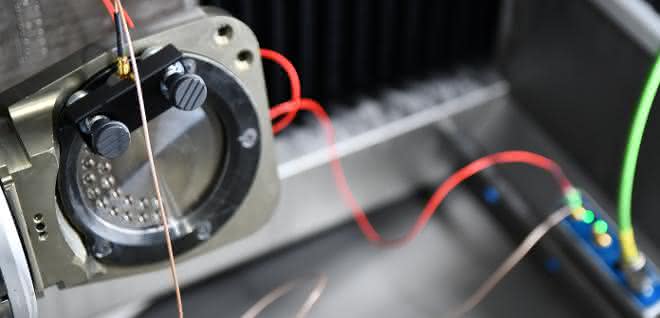
With the help of structure-borne sound sensors and adaptive AI, the system detects anomalies in production processes, identifies material inhomogeneities and "hears" the onset of tool wear. Thanks to inline monitoring during machining, SonicShark saves time and costs in quality assurance and enables more efficient tool use and predictive maintenance. By using SonicShark for process monitoring, it is possible to improve component quality, shorten process times, utilize machines for longer and make efficient use of resources such as personnel and machine time.
Highly experienced operators of CNC milling centers can often tell whether a problem is looming in the machining process by the sounds they hear. Hufschmied is now using the differences in sound during machining for an innovative expert system. SonicShark detects acoustic deviations from the target state and indicates defects in the production process at an early stage. Depending on the size of the workpiece, one or more structure-borne sound sensors are attached to the workpiece for inline quality control.
A small computer next to the CNC machine collects the sensor data. The system is trained on the reference acoustics of a machining operation under optimum conditions - in future, the manufacturer Hufschmied will supply sensor target signals as a reference for its own tools. The software creates a sensor database and compares the target data with the actual data. The result of the comparison is displayed on a screen and the machine operator is warned if there are deviations in the frequencies above or below specified threshold values.
Recognize wear
In its research into "noise", Hufschmied's development department has discovered that every aspect of the machining situation allows conclusions to be drawn via its own frequency bands: Tool condition, drive, clamping and milling strategy report when conditions change through deviations in the noise.
Up to now, tools have usually been qualified in tool life tests and replaced after a set time for safety reasons, regardless of their actual condition. If these rigid, often over-cautious specifications are replaced by inline quality control, this not only saves tool costs, but also time for tool changes and space in the magazine for sister tools. In addition, real-time monitoring reduces rejects produced by machining with a prematurely worn tool.
Recognize material defects
An estimated 25 to 30 percent of manufacturing costs are incurred in quality assurance and testing. The innovative SonicShark expert system opens up great savings potential here. By combining various sensor databases with machine data and optical quality control, it is possible to detect imperfections or defects in the component <1 mm and transfer them to the quality assurance department with the corresponding coordinates.
Analyzing the noise also allows conclusions to be drawn about the condition of the machine. The SonicShark sensor system can therefore be used as a basis for predictive maintenance as well as for digital process analysis and process optimization.
The acoustic inline quality control system developed by Hufschmied has already been used in two MAI Carbon cooperation projects: in collaboration between Hufschmied Zerspanungssysteme GmbH, BMW Group, University of Augsburg, Alexander Thamm GmbH, inno-focus businessconsulting gmbh and VisCheck GmbH, the MAI ILQ2020 project developed options for cross-company process control. Inline quality control was also a central aspect of the MAI FastMove project to promote HSC machining in CFRP machining.


You might also be interested in
Predictive maintenance in retrofit
Predictive maintenance pays off. This is because early detection of impending failures means that systems can be serviced in a targeted manner before production downtime occurs. But how complex is it to integrate such a maintenance concept into an...
 read more...
Maintenance instead of replacement
The circular economy starts with the machinery
Sustainability in industry starts with machines, says our guest author from Deguma: How maintenance, modernization and the 5R strategy save resources, energy and CO₂.
read more...3D printing for unplanned requirements
The material fails and the machine suddenly stops? Then you need to take the right measures to be able to resume production quickly. Material failure in the form of faulty components or material wear in the frame are a risk for any production.
read more...High demands in terms of safety, application and robustness
Demanding work in the electrical trade and energy supply as well as smooth processes in production require innovative and customized measurement technology that scores points for safety, ease of use and resilience.
read more...Car meets e-bike: riding with lubrication-free polymer bearings
Studies show that the proportion of pedestrian and bicycle traffic is increasing in urban areas. With the JetBike, JetBike GmbH from Braunschweig presents a mixture of e-bike and car and relies on lubrication-free polymer bearings from Igus.
read more...Hydraulic hub for more efficient servicing
Bosch Rexroth presents a digital toolbox for service and maintenance. With a comprehensive range of digital services, the Hydraulic Hub simplifies and accelerates the service and maintenance of hydraulic products and increases machine availability.
read more...Arnold Umformtechnik expands after-sales...
Faster help with VR glasses
Arnold Umformtechnik is expanding the after-sales service for its machines to include digital remote services. The focus is on data security, simple operation and clear processes.
read more...147,000 euros per hour: high costs for German companies due to unplanned downtime
According to the "Value of Reliability" study, 67% of industrial companies in Germany experience unplanned downtime at least once a month. This costs the German economy 147,000 euros per hour. Nevertheless, reactive maintenance concepts are not...
read more...Maintenance starts with a maintenance planner
Legal requirements stipulate that machines and systems must be serviced regularly. The maintenance work serves to ensure occupational safety and economic efficiency.
read more...