
Copper in additive manufacturing
Copper heat sinks from the 3D printer
Together with the copper semi-finished product manufacturer KME, the Fraunhofer IMWS is researching the use of additive manufacturing technologies for highly thermally conductive components made of copper and copper alloys. The aim is to open up new market segments in the field of cooling elements for power electronics.
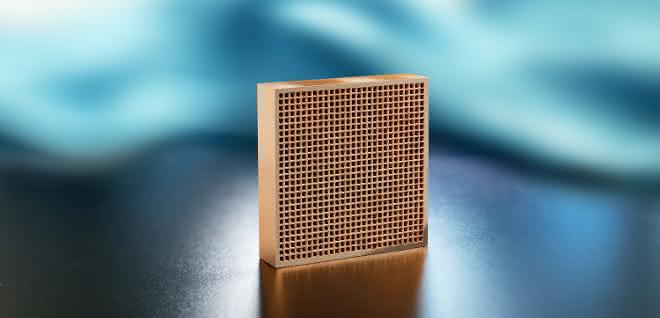
Shorter process steps, faster production times, short-term changes, lower material consumption, increased functionality and therefore reduced costs - the Fraunhofer Institute for Microstructure of Materials and Systems IMWS lists these properties of additive manufacturing and also announces a new research project. Together with the copper semi-finished product manufacturer KME, the use of additive manufacturing technologies for highly thermally conductive components is to be researched in a new project. Copper is a material with a very high thermal conductivity that is only surpassed by silver. As silver is only used as a material for individual special cases due to its high price, the project partners in the joint project "Technology and material development for the additive manufacturing of complex, highly thermally conductive copper components - CuAdd" are focusing on copper and its alloys. Research into additive manufacturing methods with copper is a market with future prospects.
Copper in additive manufacturing
The project evaluates additive manufacturing processes for metallic components, including fused deposition modeling (FDM), binder jetting (BJ), nano particle jetting (NPJ) and laser powder bed fusion (LPBF). With these technologies, the components are generated layer by layer. The copper grades Cu-ETP, Cu-OFE and Cu-HCP and the copper alloys CuCrZr and CuNi2SiCr are used as starting materials. They are tested and the compatibility of different polymer systems such as PLA (polylactic acids) and PA (polyamides) with copper systems is tested at the same time. Differences in further processing exist in the process-dependent material feed and the processing temperature.
Laser powder bed fusion favored method
The researchers' preferred method is laser powder bed fusion (LPBF): here, the material is applied in powder form in a thin layer on a base plate. The powdered material is completely melted in a defined manner using laser radiation at temperatures above 1000 °C and forms a solid layer of material. The plate is then lowered and powder is applied again. This cycle is repeated until all layers have been melted and the component is finished.
The project also examines which powder or powder mixture is suitable for which application in terms of its components. Factors such as particle size, flowability and porosity play an important role if the desired properties such as high thermal conductivity or high electrical conductivity of the components are to be achieved. As a result, the researchers want to use additive manufacturing processes to produce a prototype with a geometrically complex structure that can be used as a high-performance heat sink, for example.
According to documents from the Fraunhofer IMWS


You might also be interested in
VDE study on electrical engineering
More retirements than graduations
According to a VDE analysis, more than 30,000 electrical engineers will retire by 2029 without enough graduates to replace them. This is due to falling student numbers and high drop-out rates.
 read more...
Giving lightweight construction a profile
Pultrusion: A process that forms fibers under tension
Pultrusion is developing from a niche process into a key process for lightweight construction and sustainable fiber composite structures. The Fraunhofer IWU shows applications from energy to mobility.
read more...Green hydrogen directly from the sun and water
A start-up project at the Karlsruhe Institute of Technology (KIT) aims to fundamentally simplify the production of green hydrogen: Mass-produced photoreactor panels are to be used to produce hydrogen directly from sunlight and water - without...
read more...Fraunhofer shows industrial future between AI, data and new materials
At Hannover Messe 2026, the Fraunhofer-Gesellschaft will be presenting solutions for a resilient industry: from AI and data rooms to hydrogen technologies and material and recycling innovations.
read more...The bottleneck is in the system
Is the transformation of the industry failing due to "German Angst"?
A recent ISF study examines what is slowing down change in German industrial companies. According to the results of the study, the causes of innovation bottlenecks often lie in internal structures and a lack of strategic orientation.
read more...Why a data-secure Germany needs joint implementation
Is 2026 a key year for a data-secure and networked Germany? Michael Fritz from the Fraunhofer Cluster CCIT explains why the coming year will be crucial for secure data spaces, common technical standards and Germany's digital future.
read more...Biodegradable label makes transportation conditions traceable
Researchers are developing a smart, compostable label that measures temperature and humidity and detects when limit values are exceeded.
read more...AI support for the circular economy
An assistance system developed at Fraunhofer IPK is used to identify, sort and assess the quality of disused household appliances, thus contributing to recycling and waste avoidance with the help of artificial intelligence.
read more...VDW Research Institute honors industrial projects
At EMO Hannover 2025, the VDW Research Institute will be honoring projects for increasing the efficiency of forging hammers and safe protective devices for grinding machines. Practical research for Industry 4.0, occupational safety and automation
read more...