

Conveying and sorting technology
The best all-round care in Europe
Beumer installed the complete conveying, picking and sorting technology in the new European logistics center of the car spare parts dealer Inter Cars near Warsaw. A warehouse control system (WCS) was also installed to control the material flow.
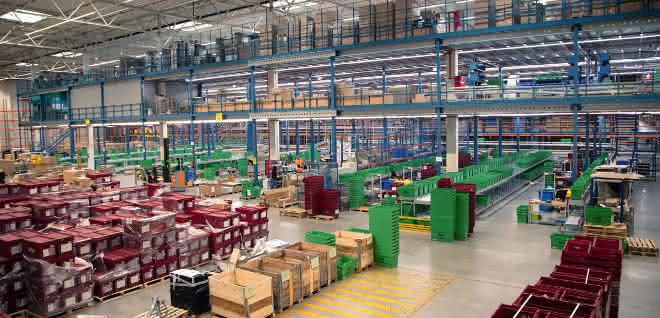
"With Inter Cars, we were able to successfully complete one of the most important projects for us in Poland," summarizes Sandra Lückmann. She is Business Development Manager at Beumer in Beckum, Germany, and is responsible for the successful completion of this order. "As a system integrator, we planned and installed the entire conveying, picking and sorting technology in the spare parts retailer's new European logistics center, including our WCS, which controls incoming goods, quality assurance, the picking area, order picking and outgoing goods."
Spare parts dealer with potential
In Central and Eastern Europe, Inter Cars is one of the largest dealers of spare parts for cars, vans and trucks. The company has several hundred branches and subsidiaries - in addition to its headquarters in Poland, also in the Baltic States and the Balkans. It also has a nationwide network of around a thousand workshops. The previous logistics center in Czosnów, Poland, supplied smaller distribution centers throughout Europe, which in turn supplied the workshops and customers. However, this was not designed for the increasing number of parts to be stored and shipped.
For this reason, those responsible decided to build a new automated European center in Zakroczym, around 30 kilometers from Warsaw. The in-house logistics service provider ILS was commissioned as the general contractor - "and that's where we came in as a system provider of intralogistics solutions," reports Sandra Lückmann. "ILS called our Polish branch at the end of 2013. At that time, the project was still in the design phase. The only thing that was clear was how many parts were to be sorted and in what time frame."
Up to seven million products
Beumer received the order in January 2015, installation began in September 2015, followed by the ramp-up phase in September and completion in December. Inter Cars closed the previous logistics center at the end of 2016, and the new European center went into full operation in May 2017. "Seven million items such as spark plugs, brake discs, V-belts and batteries are currently stored here, as well as bulky parts such as exhausts and hoods - everything to do with cars," explains Lückmann.
The complex consists of four halls, the largest of which measures just under 40,000 square meters and is around ten meters high. It is equipped with a four-storey shelving system. The other halls each have an area of around 5,000 square meters. This is where, for example, tires or hazardous goods such as oils and paints, which have to be stored separately for fire safety reasons, are stored.
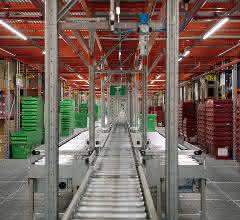
The products are divided into different clusters according to size and weight - similar to clothing sizes - according to S, M, XL and XXL. "To save time during order picking, this is done in two stages," explains Lückmann. An employee takes a defined number of containers, stacks them on a trolley and moves them through the aisles of the rack. He collects all the components indicated by his handheld reader. He removes the S and M parts from the shelf in batches - in other words, he combines several orders into one order. He then places the containers on the roller conveyor, which automatically transports them to the packing sorter.
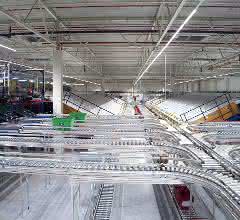
"Our WCS distributes the incoming containers to one of three infeed areas according to their contents," explains Lückmann. The conveyor technology transports them to the work stations where employees remove the goods from the bins. They identify each item using a matrix camera and place it on the sorter. The conveyor system returns empty containers to the feed area. "We supplied our BS7 belt tray sorter for this sorting process," reports Lückmann. This system processes a throughput of around 14,000 parts per hour without pre-sorting and up to 27,500 parts per hour with the aforementioned pre-sorting.
End points ensure gentle sorting
Energy and data transfer with the BS7 is contactless. This avoids mechanical friction losses and therefore also wear. Compared to other crossbelt sorters, it consists of 50 percent fewer components, which reduces maintenance costs by around 80 percent compared to conventional crossbelt sorters. This also reduces energy consumption during production and operation.
The distance between the individual conveyor elements is reduced to a minimum in the Beumer systems. The use of the belt tray makes it possible to use narrower, closely spaced end points. This means that the sorter takes up less hall space. "The special feature of our BS7 is its 361 specially developed end positions, which handle the very different spare parts gently," says Lückmann. This is because everything has to be sorted and discharged in such a way that no packaging is destroyed. To achieve this, the end stations are divided into two parts. If the spare part weighs up to 1.4 kilograms, the WCS classifies it as "light" and up to six kilograms as "heavy". This means that the parts are fed to the responsible employee in such a way that he places the heavy products in the container or box before the light ones when compiling the order.
"It's different with the XL goods from the main warehouse," says Lückmann. "These are so large that only one spare part fits into a container or box at a time." This is why they are put together according to order and sent directly to the consolidation area via the conveyor system. This also applies to goods from the other halls, such as tires and hazardous goods. Together with the goods from the packing sorter, the orders put together in containers or cartons are weighed and compared with the target weight, sealed, labeled and strapped. The conveyor technology transports them to the connected outgoing goods sorter, which can divide the consolidated orders into 50 destinations according to the dispatch location in the outgoing goods area at a rate of 2,500 containers per hour.
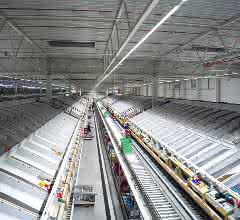
And what happens if the spare parts don't work for the recipient or they don't need them after all? "They go back to the logistics center in Zakroczym," explains Lückmann. Employees there check the returns: is the part damaged, was it just not wanted or was it the wrong choice? If it is still in perfect condition, it goes back to the warehouse. In all these processes, the WCS controls the entire material flow for the entire distribution center - from goods receipt to goods issue. It receives the orders from the operator's warehouse management system.
Residential Service
This is not the end of the project for Beumer. In order to be able to concentrate fully on its main business, ILS has opted for Residential Service, a special part of Customer Support. "With this service, our employees are on site around the clock and take responsibility for the availability of the plants and systems," reports Jaroslaw Gorczynski, General Technical Director, Poland. "Because this must always be optimally coordinated over the entire operating period so that the processes run seamlessly."
The team has its own control room, and even during the planning phase, the colleagues' workstations were arranged in such a way that they can reach potentially critical areas as quickly as possible.
Among other things, the employees take care of preventive maintenance. "This enables us to avoid unplanned machine downtime, which can be very expensive for our customers," explains Gorczynski. The team carries out inspections and maintenance on the systems at set intervals. The employees also check the safety equipment as well as the electrical components and automation technology. If necessary, they carry out necessary repairs due to unscheduled component failures. The team inspects technical installations and maintains them regularly at agreed intervals. The contract with Beumer runs for five years until 2022. as


You might also be interested in
Modular storage concept
Gebhardt will be presenting the new Gebhardt Upstream at its LogiMat trade fair stand. The proven software solutions, warehouse technology solutions and conveyor technologies such as Galileo IoT, StoreWare and SpeedSorter can also be seen there.
 read more...
Flexible I/O and safety modules
To speed up commissioning and increase throughput in intralogistics systems, a system solution provider also uses decentralized I/O and safety modules.
read more...Fast shipping from the toy manufacturer
Dematic has automated the returns and shipping logistics at toy manufacturer Haba. The intralogistics specialist has installed a space-saving Dematic pocket sorting system at the distribution center in Bad Rodach, where it supports the efficient...
read more...Data analytics for sorting technology
Collect, analyze and optimize data
System provider Beumer is presenting an intelligent data analytics solution that can be used to examine large volumes of data that are generated during sorter operation, for example, and visualize the results.
read more...Digitalization in the material flow
Gebhardt: Smart sorter for logistics 4.0
Gebhardt is launching a fully automated, horizontal and smart sorting system onto the market. The SpeedSorter has a modular design with digital components and is suitable for various conveyed goods.
read more...Sorters take over order-related picking
Sorters play a crucial role in controlling and diverting the flow of goods. With the Omni Sorter and the Sphere Sorter, Trapo offers two solutions that help to keep supply chains running smoothly.
read more...Dispatch center in South Korea
Avancon installs sorter for Samsung smartphones
Together with the South Korean system integrator Asetec, a specialist in electronic control systems, pick-to-light systems and communication with higher-level BUS/IT systems, Avancon has installed a distribution and sorting system for the Samsung...
read more...High-performance sorter from Interroll
Crossbelt sorter processes 20,000 pieces per hour
With the Crossbelt Sorter MX 025H, Interroll is expanding its portfolio of automatic sorting solutions with a new high-performance system that can process up to 20,000 conveyed goods per hour.
read more...E-commerce: sorting system gets shoes on their way
Ferag is equipping the MyBox Logistics distribution center in Kielce, Poland, with a Denisort sorting line. It will sort 8,600 units - mainly shoes and fashion items - per hour.
read more...