

Industry 4.0 in intralogistics
Smart concepts for intralogistics
More and more applications and processes in intralogistics are based on the use of AI and the smart factory concept. Material handling expert Remmert summarizes the points that companies need to address on the way to the smart factory.
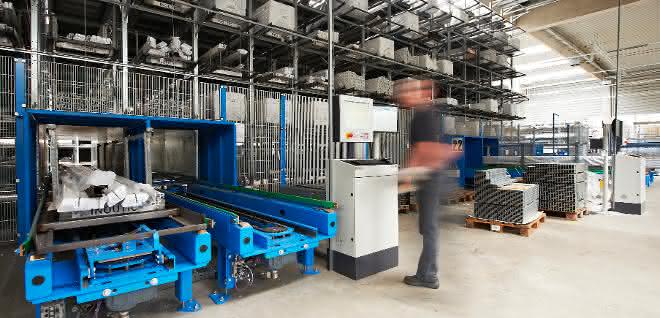
Redesigning the relationship between man and machine
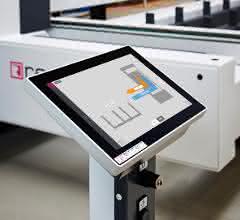
The smart factory of tomorrow is defined by a high degree of automation that allows many operations to be carried out without human intervention. In this concept, humans are by no means superfluous, but rather take on new tasks in the role of operator. However, monitoring control work and intervention require a different level of qualification. It is therefore advisable to develop and use software that is as intuitive as possible, including a user interface that is easy for staff to learn. For example, material flow expert Remmert has developed Smart Control, a solution for the intelligent control and operation of its Flex modules for process automation. In addition to a modern software architecture, the system scores points with its integrated management of users and authorizations as well as extensive service functionality and the provision of status information for handling material and warehouse data.
In a networked intralogistics system, the rule of thumb is: the bigger, the more complex. With this in mind, the user interface of the software used must have an understandable, modular and transparent design. Programmers and designers are well advised to rely on strong visual language, for example in the form of pictograms. In addition, trained lean managers who specialize in systematically converting processes and increasing effectiveness in all areas should be employed.
Question the actual benefits of AI and machine learning
AI and machine learning (ML) will play a central role in intralogistics in the future. Nevertheless, every potential user should first question whether a smart solution is superior to a classic algorithm. For one thing, an AI- or ML-based tool requires time-consuming training. Secondly, decisions made by an AI system may be difficult to understand. From a technical perspective, such a solution does not make autonomous decisions, but draws on the programmed pool of activities. The added value must be weighed up and evaluated in each individual case.
Strategically combining existing and new systems
A key success factor for the implementation of a smart factory is the transformation process, in particular the parallel use of new and existing systems. The decisive factor here is that the machines can be modularly expanded and combined, as is the case with the Remmert Flex family, for example. The use of these modular automation solutions offers flexibility and future-proofing for users in order to be able to react to individual requirements. As a rule, old machines are gradually replaced by new models with networking options. Here too, it is important to involve employees at an early stage and familiarize them with the possibilities.
Intensifying the creative search for use cases
As a solution provider, Remmert is involved in the further development of existing technical solutions and is in contact with cooperation partners and research institutions. These include the Adam (Autonomously Adapting Machines) project in cooperation with the University of Hamburg, which aims to enable machines to adapt autonomously to unknown environmental parameters, and the OWL Bielefeld Regional Innovation Network. Hands-on workshops will provide the opportunity to discuss application options. The two-way exchange with potential users also generates valuable input for practical applications.
The development of Sortflex, a flexible and fully automated solution for sorting individual laser-cut finished parts, also underwent a field test with users before its market launch, allowing it to be adapted and optimized to meet specific requirements.
"Twenty years of experience in the digitalization of processes and Industry 4.0 have shown that software and highly efficient interfaces have always played a very important role and will continue to do so," explains Ralf Kruse, Head of Data Technology at Remmert. "This has been particularly evident in the development of our automation solutions: both with Laserflex, where the challenge was to provide a software connection to processing machines from a wide range of manufacturers, and with Sortflex, which can also be used regardless of the manufacturer. We will continue on our chosen path and continue to focus on providing users of our technologies with innovative solution concepts that are extremely user-friendly." as


You might also be interested in
"We are clearly different from the competition"
The IT company 21unity offers a range of hardware and software services, as well as traditional services. Andreas Mühlbauer spoke to Managing Director Anja I. Gondolf about the company's appearance at the Hannover Messe, its services and future...
 read more...
Think digital, act local
When it comes to industrial damping technology, on-site advice is often very valuable for engineers and designers.
read more...Plagiarius 2024 negative prize
On January 26, 2024, the Plagiarius campaign awarded its dreaded "Plagiarius" negative prize for the 48th time to manufacturers and retailers of particularly brazen counterfeits and fakes.
read more...Spindel Full Service records second-best...
Maintenance as an economic success factor
Spindel Full Service, the spindle repair specialist from Baden-Württemberg, can look back on its second-best financial year in its history - with 15% growth compared to the previous year. And the further forecast also looks good.
read more...Thyssenkrupp and Novelis cooperate
Platform for the circular economy
With a platform for the circular economy in the automotive industry, the two companies Thyssenkrupp Materials Services and Novelis want to set new standards for the recycling of used materials. The open platform will enable access to larger...
read more...How production can benefit from AI
Together with AI technology, IIoT networking makes it possible to better control machine parameters and optimize quality with predictive quality. Downtimes and set-up times can also be further minimized. Cloud platforms also make these technologies...
read more...Marco Ghirardello takes the lead
Fanuc has appointed Marco Ghirardello (48) as the new President and CEO of Fanuc Europe. Ghirardello succeeds Shinichi Tanzawa, who has led the company since 2016 and will take on a new role at Fanuc's headquarters in Japan.
read more...Efficient robot monitoring
Microchips are installed almost everywhere - whether in smartphones, washing machines or cars. With increasing digitalization, the demand for semiconductors has been growing rapidly in all areas of the economy for years.
read more...Everything on one platform
Functional and powerful tools are essential for professional work on the construction site, in the workshop or when carrying out repairs.
read more...