

Order picking
Optimization through multi-order picking
Order picking. In order to remain competitive, logistics service providers and retailers have switched to automated order picking in their warehouses with pick-to-cart, pick-to-light or voice picking. There are a few factors to consider before implementation.
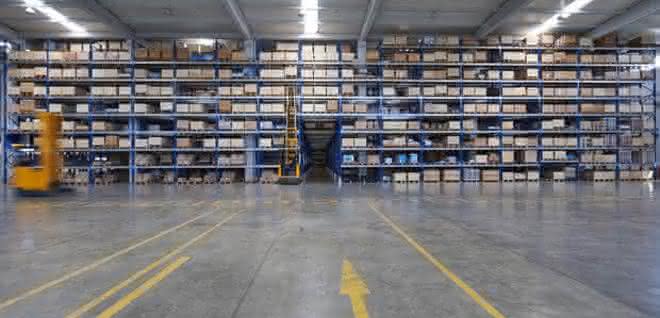
Jeffrey Verberne, Logistics Business Consultant at Zetes, describes how companies can implement a multi-order picking solution and how to avoid potential obstacles.
Which method is optimal for order picking depends on several factors: Product range, quantities at peak times, resources, size of the warehouse, number of customer orders and desired delivery times.
Identify method for order picking
Without analyzing these factors and identifying key bottlenecks in logistics, any investment in an automated solution will not achieve optimal efficiency.
It is also important to decide which method for order picking and which underlying technology offers the most advantages: whether each order should be picked individually or several orders together, pick-to-cart, pick-to-light, pick-by-voice or another option.
Static and dynamic order picking
In order to determine the optimum method for order picking, a distinction must be made between dynamic and static order picking. With dynamic order picking, users have a fixed position and all ordered items are made available to them within reach - for example in a robotized warehouse. Dynamic order picking offers an important advantage: all routes are eliminated.
With static order picking, each employee goes to the respective warehouse location for all ordered items. The routes are covered either on foot or with an order picking trolley or forklift truck.

Within static order picking, a distinction is also made between single-order picking and multi-order picking. If most orders have a high number of SKUs (Stock Keeping Units), the travel times between items are often short. Single-order picking is probably the best solution here. However, if each order only contains a small number of items, multi-order picking can be much more time-saving. It may also be necessary to pick several orders within a specified time window for customers or for a specific shipping service. This is known as wave picking. Finally, large distribution centers can be divided into zones where employees perform order picking based on zone-specific SKUs.
Calculate and minimize routes
Efficiency can vary depending on whether single-order picking or multi-order picking is selected. With multi-order picking, the main objective is usually to minimize the routes for all picking personnel. For this purpose, all items for certain orders are picked on a single route (multi-order picking), or the total quantity of a certain SKU is picked for several customers at the same time (batch picking).
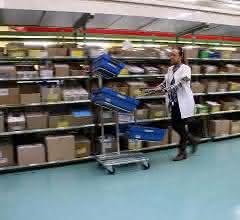
With these two options, all picked items must also be assigned to the correct customer. This requires an intelligent method. Preferably, this step is done during order picking using check numbers or color coding and a separate trolley or shipping carton for each order. If splitting the items after picking takes too long or is too error-prone, the potential efficiency gain is lost or the reliability of deliveries is compromised. How much efficiency can be increased by multi-order picking depends on the product range, the number of SKUs per order, the number of pickers and the size of the warehouse (like other methods) and must therefore always be assessed on a case-by-case basis.
Analyze processes and business logic
In order to assess the benefits and savings of multi-order picking, the order processing and order picking processes must each be analyzed.
The following questions provide information: What are the current distances that the order pickers have to cover and how many packs per hour do they pick on average?
Is the product range or part of the product range suitable for multi-order picking by item or by order, and does this method fit into the time window specified for order picking?
With many small individual orders, it is often not worth implementing multi-order picking due to the expected short delivery times (delivery often on the same day). However, the order flows of logistics service providers and retail companies with larger warehouses and dozens of order pickers are large enough that an investment in multi-order picking usually pays for itself within a short time. In this context, it is important to consider whether the existing ERP and/or WCS/WMS system has the necessary functions to support multi-order picking. If the existing systems do not have the corresponding functions, an additional business logic layer must be introduced to calculate the quantities and adapt to a voice dialog.
How does this work in practice?
A.S. Watson, the group behind Kruidvat, Trekpleister, ICI PARIS XL, Pour Vous and Prijsmepper and market leader in the Dutch healthcare and cosmetics market, is an example of how companies can increase their efficiency by up to 38% by implementing multi-order picking. Coen Mulder, Functional Control Supply Chain Development at A.S. Watson, explains: "We have been working with voice picking in our warehouse here in Heteren for several years. Our system is based on the ZetesMedea solution. Our order processing is divided into three streams: All products in the current range, products on special offer and e-commerce orders."
"We worked with single-order picking for a while. This meant that all picking staff were on the move throughout the warehouse. We sat down with Zetes to think together about how we could minimize the distances. We came to the conclusion that we could increase our efficiency by around 16 percent if we combined orders. To do this, we needed the support of quantity calculations in order to take the most suitable means of transportation (pallets or containers). After an in-depth analysis of the processes, we then implemented multi-order picking together."
Jacqueline van Oostrum, Supply Chain and Logistics Project Manager at A.S. Watson, adds: "Together with the aforementioned quantity calculations for our order transport equipment and the expansion of the voice dialog for batch picking, we also added several pallet trucks. We ultimately achieved the maximum possible improvement through a combination of adjustments to our software and equipment settings. The commitment of all employees was also an important factor."
"In addition to minimizing distances, multi-order picking allows us to save additional time, for example because staff no longer have to stand around and wait in the warehouse aisles unnecessarily. Looking back on this project, we can see that our implementation of multi-order picking for the current range has exceeded all expectations with its impressive 38% improvement in efficiency. The average number of packages picked per hour in this order stream has increased from 90 to 125. In view of this success, we have also introduced multi-order picking for some of the products in the special offer. Our aim is to achieve similar improvements in this second order stream," concludes Jacqueline van Oostrum. as


You might also be interested in
Robotics and autonomous order picking
Locus Robotics acquires Nexera Robotics and expands autonomous warehouse logistics
Locus Robotics takes over Nexera Robotics and may have taken a decisive step towards truly universal warehouse automation. A new gripping technology should now make possible what was previously considered difficult to automate.
 read more...
How bridging steps, stairs and catwalks are changing processes in production and logistics
At Logimat 2026, Munk Günzburger Steigtechnik will be showcasing modular bridging steps, stairs, platform and walkway systems for production, warehousing and logistics. With online configurators, distances can be efficiently shortened, processes...
read more...Highly automated warehouse for...
SSI Schaefer implements highly automated warehouse for CERP in France
SSI Schaefer and CERP are building a highly automated logistics center for pharmaceutical logistics in Wissous with shuttle storage, A-Frame, robotics and WAMAS software.
read more...Start of construction for new production hall
Mayr Antriebstechnik invests in its home base and internationally
Mayr Antriebstechnik strengthens location and international logistics: Construction of a new hall in Mauerstetten - parallel expansion of the plant in Poland as a logistics hub.
read more...Conveyor systems that adapt
Modern conveyor systems must reliably transport different product sizes, shapes and materials. The new modular product system from Kipp offers flexible, modular solutions for this: Adjustable side guides ensure precise alignment and gentle...
read more...Focus on sustainability and AI at the trade fair
With more than 120,000 square meters of exhibition space, LogiMAT 2025 will once again occupy all ten halls of the Stuttgart exhibition grounds. From March 11 to 13, global players, medium-sized companies and start-ups will provide an overview of...
read more...Workstation system for shipping and logistics
With Sintro Packing, Karl is launching a workstation system that is designed to meet the specific requirements of shipping and logistics. It is characterized by modular adaptability and ergonomic efficiency.
read more...Deutsche Messe announces Robotics Award
On the occasion of Hannover Messe 2025, Deutsche Messe is once again presenting the Robotics Award after a break of several years. Prizes will be awarded for robot-supported automation and logistics solutions. Companies and institutions from Germany...
read more...Micro motors as the driving force behind intralogistics
Suitable transport structures in intralogistics are a prerequisite in all industries in order to withstand competitive pressure in the future. The basis for this is comprehensive automation, which would be inconceivable without an armada of powerful...
read more...