

Loading and unloading of floor rollers
Docking station holds trolley in place
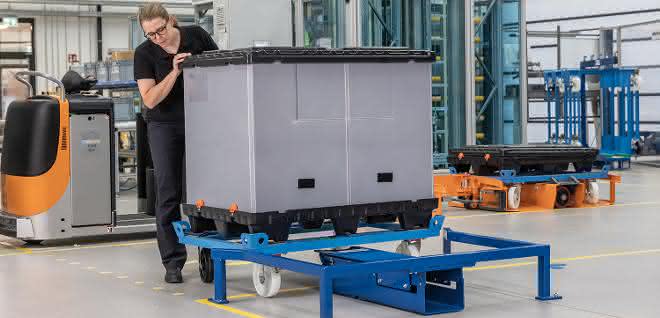
Trolleys are ideal for transporting loads within a company. However, the flexibility and maneuverability of trolleys is also their biggest disadvantage. All it takes is a light touch with the industrial truck - and the trolley rolls away. This is why MWB has developed a docking station.
There are basically six methods of immobilizing a floor roller. The simplest is to simply hold it down. This is also by far the worst method. The worker would be exposed to too great a risk. Even if it has to be done quickly - don't do it that way!
The next technique is to use the hold-open devices. This is a method that is rarely used in practice; after all, it means a significant amount of extra time for the staff. Especially as the brakes are often located on diagonally opposite castors and you would have to walk around the chassis. The delicate levers are also sometimes difficult to operate and therefore unpopular.
Option number three is to leave the trolley in the tugger train for the loading process. This keeps the trolley securely in position. In addition, there is no need to move it elsewhere. However, both of these advantages have disadvantages elsewhere. On the one hand, the downtimes of the shuttle and driver are extended. On the other hand, the chassis are deprived of their buffer function.
Floor rails, magnets or ...
Floor rails are the fourth alternative. They block at least two of the four directions. Their major drawback is the lateral forces that are exerted on the floor roller with each loading process. As a result, the wheels can break and cause personal injury and damage to property. Another systemic weakness is the additional human energy required by some brands. Pushing up onto some rails requires unnecessary effort - especially with a heavy load. On top of this, threading into the specified track can sometimes turn into a game of patience.
Magnets offer an additional, fifth option. They can be attached to standard safety barriers, for example. This gives the trolley stability on at least one side. The advantages of this approach are obvious. On the one hand, a physical barrier is created between the forklift zone and the tugger train area. This in turn optimizes the safety of employees. On the other hand, there is no need to spend time positioning the dolly. However, there is a downside to this aspect. This variable positioning deprives the forklift driver of the repeatability of driving maneuvers. The attraction force of the magnets is also crucial. If it is too weak, it is difficult to control the chassis; if it is too strong, the personnel have to use too much energy to move the floor rollers.
... the trolley docking station
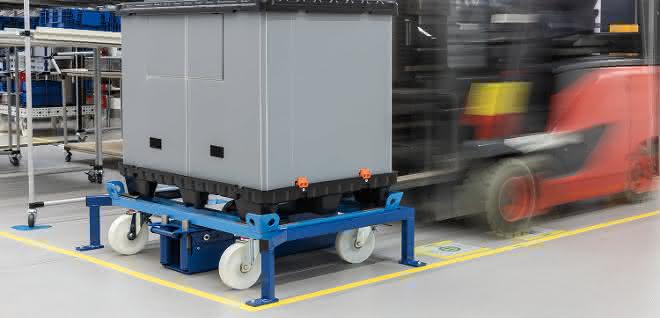
That leaves the sixth and final method: the trolley docking station from MWB. Here, a powerful mechanism fixes the mobile conveyor aid in place. For its part, the product is firmly anchored to the floor. It thus creates a safety barrier and separates pedestrians from forklift traffic.
The solution allows roller coasters to be loaded and unloaded easily - without the need for a second employee. This saves money and minimizes the risk of injury. The manufacturer also points out that the trolley docking station speeds up the loading process. This is because the trolley coasters are always in the same place again and again. Firstly, this helps employees to develop healthy routines and simplifies processes. Secondly, the trolley docking station is therefore useful when loading driverless transport vehicles.
The installation of several such stations has proven to be useful. This creates an important buffer zone. It enables the driver of the tugger train to get started as soon as he arrives at the supermarket. He can then swap empty bins for full ones autonomously - without having to rely on interaction with the forklift driver. This decoupling of processes helps to use resources more sustainably. as


You might also be interested in
Micro motors as the driving force behind intralogistics
Suitable transport structures in intralogistics are a prerequisite in all industries in order to withstand competitive pressure in the future. The basis for this is comprehensive automation, which would be inconceivable without an armada of powerful...
 read more...
E-scooter with customizable damping
The startup Scuddy has significantly improved the flexibility, performance, customizability and ergonomics of its second-generation foldable e-scooter of the same name - thanks in part to damping technology from ACE.
read more...Electric multidirectional counterbalanced...
360-degree steering on three wheels
Hubtex has given its FluX electric multidirectional counterbalanced truck an update: The new generation for the three-ton capacity class.
read more...New FLUX: 360-degree steering on 3 wheels
HUBTEX presents the new generation of the FLUX 30 electric multidirectional counterbalanced truck (load capacity 3 t). The innovative 2-in-1 stacker is both a front and sideloader. With its patented 360-degree HX steering, it transports both long...
read more...Norelem supports VDI Racing Camp
Mastering the challenges of e-mobility
Promoting young talent has been a priority at Norelem for many years: the company supports young talents with components and the necessary know-how and provides schools with illustrative material.
read more...igus:bike honored with German Design Award 2023
A wide, angular frame made of plastic, black wheels with Y-spokes: The futuristic look of the bicycle designed by Dutch bicycle developer mtrl with motion plastics from Igus can look forward to the prestigious German Design Award 2023.
read more...Floating garbage trap cleans up the Rhine
Every day, a ton of garbage flows down the Rhine. To catch some of it, the Cologne-based Krake association has now inaugurated a floating garbage trap. One of the sponsors of the so-called Rhine octopus is the plastics specialist Igus.
read more...Torwegge presents FlexO rollers
Visitors to the FMB - Supplier Fair for Mechanical Engineering can once again look forward to a new product at the Torwegge stand this year: the FlexO rollers.
read more...Igus partner Mura's project is making progress
Recovering crude oil from plastic: This is the goal that the British company Mura Technology is pursuing with the HydroPRS process. Igus has been supporting the project as an investor since 2020. The first HydroPRS plant for the chemical recycling...
read more...