

Automated conveyor system for office chairs
No more traffic jams!
The internationally active office furniture manufacturer Sedus Stoll in Waldshut-Tiengen has installed a roller conveyor system for office chairs at its Dogern site as part of a modernization programme. The concept for this comes from FAB Fördertechnik.
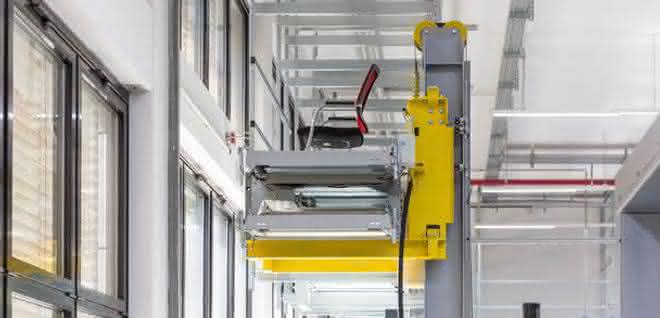
Sedus has restructured the production and assembly areas to increase productivity. The aim was to make the final assembly of the office chairs as efficient as possible and to ensure automated transportation to the dispatch area. A new conveyor system was to be designed for this purpose. The goods to be transported - office chairs on special wooden carrier boards - proved to be a challenge, as did the specifications: In two-shift operation, around 2,000 to 2,500 chairs are to be assembled and prepared for dispatch every day at peak times. The conveyor system between the assembly hall and the dispatch area had to be suspended from the ceiling and not installed on the floor. And finally, under no circumstances should there be a backlog of chairs from the dispatch area, which would lead to waiting times for the assembly staff.
The chairs are transported safely and efficiently through the assembly hall to dispatch using a roller conveyor system that connects 19 workstations in assembly and two workstations in dispatch. In total, the system consists of around one kilometer of roller conveyors, 19 lifting stations, three vertical conveyors and two S-conveyors. The roller conveyor system runs along the entire length of the assembly hall in two double conveyor levels. The lower double conveyor level close to the floor connects the assembly stations. It consists of an upper level for transporting the chairs on carrier plates from the individual assembly stations. The conveyor level directly below is used to feed empty carrier plates.
The upper double conveyor level at a height of around 3.40 meters is suspended from the hall ceiling. It includes an upper conveyor level for transporting the fully assembled chairs towards the dispatch hall. The conveyor level directly below is used to return empty carrier plates. Naturally, a fall protection system is installed to protect against falling parts. Along the entire assembly conveyor line, three vertical conveyors connect the lower and upper double conveyor levels, thus ensuring transportation between the assembly hall and the dispatch area in both directions.
Each of the 19 loading stations in the assembly hall is equipped with a lifting station. Workers roll the fully assembled chairs onto the waiting carrier plates at floor level. This is done ergonomically and without great effort thanks to the beveled run-up profiles of the lifting station. When the worker presses the release button on the lifting station, the loaded panel is lifted 60 centimetres and tilted slightly so that the load rolls onto the downstream roller conveyor. From there, the chairs with carrier plate are transported to the vertical conveyor assigned to the area. This then takes over the transport unit, lifts it to 3.20 meters and transfers it to the upper conveyor section for transport to the dispatch area.
The conveyor line between the assembly and dispatch halls is suspended from the ceiling at the top only. This ensures that the floor area is completely free for internal goods traffic with industrial trucks. The chairs on the carrier plates are transported to the dispatch hall on the upper conveyor section. Once there, the transport unit must be lowered again to a level of 50 centimetres. This is done with an S-conveyor, which picks up the carrier plate with the chair and transfers it to the conveyor line. The design of the S-conveyor is based on paternoster technology and, compared to a vertical conveyor, enables the transport units to be picked up and dropped off continuously and simultaneously.
Two different packing areas are provided in the dispatch department. The transport units are discharged either to the right or left onto the conveyor line of the respective packing area. From there, the chairs are manually removed by the dispatch staff. The empty carrier plates are transported via a second S-conveyor back to the upper level and via this to the assembly area. pb


You might also be interested in
Plagiarius 2024 negative prize
On January 26, 2024, the Plagiarius campaign awarded its dreaded "Plagiarius" negative prize for the 48th time to manufacturers and retailers of particularly brazen counterfeits and fakes.
 read more...
Ivalua honors winners of the Generative AI...
AI-supported "add-ons" for buyers within 48 hours
Ivalua, provider of cloud-based spend management solutions, announced the winners and innovations of the first Generative AI Innovation Cup. The competition took place in December 2023. It was open to all Ivalua partners and employees - more than...
read more...Efaflex celebrates 50 years of high-speed...
The emphasis is on "fast"
Since day one, Efaflex has wanted to use new technologies as early as possible and drive progress in the industry. This year, the family business is celebrating its 50th anniversary under the motto "Fast Forward".
read more...Security of supply even during power outages
In the winter of 2022, Germany was worried about energy shortages. The drugstore retailer dm did not paint any horror scenarios, but nevertheless saw the possibility of controlled, temporary, regional power cuts (brownouts).
read more...Safety technology in mechanical engineering
Modules with new functions
Euchner's product highlights at EMO 2023 include the communication-capable solenoid interlocks.
read more...Transforming the paper industry towards climate neutrality
Together with partners from industry and research, Voith is developing a project for the optimization of energy and material flows in paper production. The aim of the research project is to develop a digital framework that enables effective process...
read more...Up to 95 percent less flue gas thanks to direct extraction
The requirements for occupational safety measures and safety technology are also constantly increasing in welding technology. The Technical Rules for Hazardous Substances (TRGS) stipulate that welding fumes and harmful substances must be extracted...
read more...Competitive advantages with large machines
Whether 3D-printed components for machines and systems, prototypes or aids for design: additive manufacturing is almost indispensable for modern companies in mechanical and plant engineering and automation if they want to play in the premier league.
read more...Transport technology from the modular system
Many transport tasks can be realized with the help of linear technology. Pre-configured solutions are available to simplify the interaction between the linear unit, motor, gearbox and controller. This minimizes the effort required for research and...
read more...