

Siemens technology
AGVs transport Porsche bodies to final assembly
Siemens implemented the conveyor technology for the final assembly of the Porsche Taycan. AGVs transport the car bodies from one production station to the next, while heavy-duty and rotating-lifting hangers enable ergonomic working.
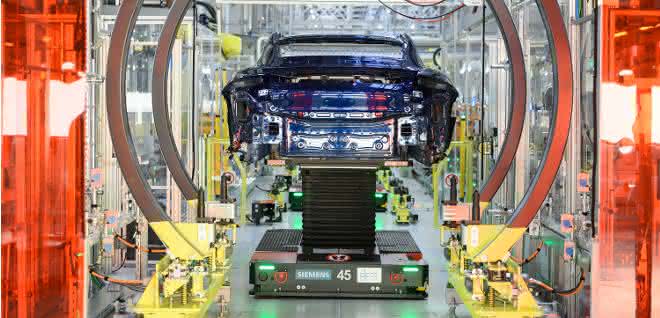
In just four and a half months, Siemens set up the complete conveyor technology for the final assembly of the first all-electric Porsche, the Taycan. This halved the time from installation to production of the first vehicle compared to similar projects. As the final assembly could only be built at height due to structural restrictions, a production concept was created in which every level is used for production. The Taycan factory at the headquarters in Stuttgart-Zuffenhausen was opened in September 2019.
For maximum flexibility, the sports car manufacturer has abandoned the traditional assembly line: On the so-called Flexi-Line, driverless transport systems (DTS) equipped with Siemens technology transport the car bodies from one production station to the next. The cycle length can be adapted to requirements, for example to stop an AGV for automated tasks and then accelerate to the next station. The conveyor technology solutions from Siemens connect the individual workstations and transport the car bodies.
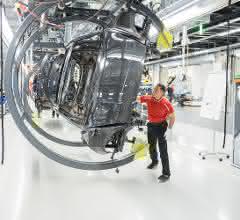
In addition to the AGVs and door conveyor technology, heavy-duty and rotating lift hangers are used. These enable ergonomic working, as the bodies can be rotated 110 degrees in both directions so that employees can reach all areas of the vehicle in the best possible way.
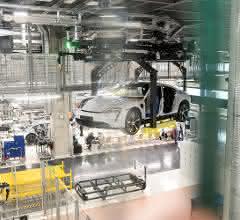
Thanks to efficient project management, it was possible to construct the plant in parallel with the other trades and the ongoing operation of the sports car production facility. Final assembly was implemented throughout on the basis of the Totally Integrated Automation (TIA) Portal engineering framework, automated with the Simatic control portfolio and equipped with drive technology from Siemens. as


You might also be interested in
Siemens stellt Cloud-PLM als Service zur Verfügung
Siemens Digital Industries Software hat die Software Teamcenter X angekündigt: eine neue PLM-Lösung (Product Lifecycle Management), die als Service zur Verfügung gestellt wird.
 read more...
Armin Schnettler ist neuer VDE-Präsident
Prof. Dr. Armin Schnettler (57) ist neuer-VDE Präsident. Der CEO New Energy Business bei Siemens Energy setzt den Schwerpunkt seiner Präsidentschaft auf Safety, Security und Sustainability.
read more...Skizzieren im CAD mit KI
Von Siemens Digital Industries Software kommt eine neue Lösung zur Erfassung von Konzepten in 2D. Mit dem Softwaretool NX Sketch können Benutzer nun im CAD skizzieren, ohne Parameter, Entwurfsabsicht und Zusammenhänge im Voraus definieren zu müssen.
read more...Plagiarius 2024 negative prize
On January 26, 2024, the Plagiarius campaign awarded its dreaded "Plagiarius" negative prize for the 48th time to manufacturers and retailers of particularly brazen counterfeits and fakes.
read more...Ivalua honors winners of the Generative AI...
AI-supported "add-ons" for buyers within 48 hours
Ivalua, provider of cloud-based spend management solutions, announced the winners and innovations of the first Generative AI Innovation Cup. The competition took place in December 2023. It was open to all Ivalua partners and employees - more than...
read more...Efaflex celebrates 50 years of high-speed...
The emphasis is on "fast"
Since day one, Efaflex has wanted to use new technologies as early as possible and drive progress in the industry. This year, the family business is celebrating its 50th anniversary under the motto "Fast Forward".
read more...Security of supply even during power outages
In the winter of 2022, Germany was worried about energy shortages. The drugstore retailer dm did not paint any horror scenarios, but nevertheless saw the possibility of controlled, temporary, regional power cuts (brownouts).
read more...Safety technology in mechanical engineering
Modules with new functions
Euchner's product highlights at EMO 2023 include the communication-capable solenoid interlocks.
read more...Transforming the paper industry towards climate neutrality
Together with partners from industry and research, Voith is developing a project for the optimization of energy and material flows in paper production. The aim of the research project is to develop a digital framework that enables effective process...
read more...