
IT Operation Analytics
Performance at the end points
Maschinenfabrik Gustav Eirich manufactures equipment for mixing and fine grinding technology. The company even has its own technical center. There, interested parties can test the machines with their raw materials and try out mixing and preparation processes. Ceramic bodies, glass mixtures or iron ore - there is hardly anything that the Eirich machines cannot handle. In terms of IT, the company relies on the Operations Analytics solution from Nexthink.
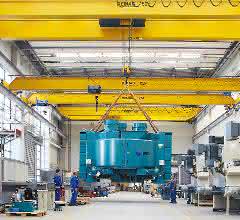
The worldwide locations and branches of the Eirich Group are connected to Hardheimer Maschinenfabrik Gustav Eirich as foreign companies within the Group, but are autonomous in terms of their IT. However, the IT in Hardheim advises colleagues at the locations around the globe. The core processes are those relating to the company network and encompass all IT infrastructure. IT at the Hardheim site is divided into three areas. As one of these, the IT sub-division Networks takes care of the entire infrastructure. The network professionals headed by Markus Stäudinger look after around 700 end devices, usually Windows PCs, as well as the virtualized workstations and servers.
Inexplicable slowness
However, one thing kept giving the IT professionals a headache: "There were end devices and certain positions and departments in the company where users complained a lot about the lack of performance of their equipment. However, we in IT couldn't really identify these performance bottlenecks," says Stäudinger. "There were applications where colleagues reported very slow response times, long loading times and delays when typing. You could also see this on site - only when we looked at the network in IT did everything look normal." Main memory not really utilized, processor apparently in normal operation - and yet nothing is happening? "We in IT were hardly able to get to the bottom of the cause of the error with the previous resources, or only with considerable effort," says Stäudinger.
This was not only nerve-wracking for IT support, who had to search for errors like needles in a haystack due to the lack of a suitable tool, but also for the employees in the specialist departments, who are dependent on functional tools. "Time and again, there were eternal waiting times, for example for queries in the ERP system - so that important reports were not completed on time," reports the IT expert. "Starting programs was also often problematic: Users were stuck for minutes without being able to do anything - and there was no identifiable reason for the sluggish performance."
In the past, if there were any IT problems, Eirich mainly examined the networks, checked ports and scrutinized individual computers one by one, often on site - always in the vague hope that log files would be available to provide the relevant information. However, this was often not the case.
Decisive step in the problem analysis
In spring 2016, Stäudinger had finally had enough. "If you have many years of professional experience in IT and the helpdesk, you know one thing for sure: the problem reports that come in are often just the tip of the iceberg. If you add to the articulated complaints those users who don't even get in touch because they have given up and accept the faulty behavior of their device as a given, then the need for action is simply there." So he convinced the company's top management of the need for a tool that would tackle exactly where the problems had previously occurred but were not conclusively traceable: at the IT endpoint.
IT partner PMCS drew the company's attention to the fact that IT Operation Analytics (ITOA) could be the key to a complete and consistent overview of all clients. Although the technology was well known within Eirich IT, a concrete evaluation had never taken place. This was then carried out, and the solution from Nexthink came up, which collects and analyzes connection data at the clients, but not content - in real time.
The Nexthink collectors are used for this: small pieces of software that collect all connection data at each integrated client. As well as the Nexthink Finder, which bundles, analyses and visualizes the data. "Where performance bottlenecks occur, bandwidths reach their limits or unusual connections occur at strange times, which could indicate security incidents: Nexthink makes it visible, and that speeds up and simplifies our processes significantly. Lengthy searches by IT support are no longer necessary, problems can be identified in real time and resolved quickly. This relieves the IT department enormously, saves time and creates capacity for other important tasks," says Stäudinger.
Once Eirich had opted for Nexthink, the actual rollout went very quickly. Within a few days, all clients were equipped with the collectors, the Nexthink Finder was installed and the new tool was ready for use. Two people from Markus Stäudinger's IT team are currently actively working with Nexthink on a regular basis. "Thanks to the convenient application and good visualization, results are achieved quickly - and user acceptance is high," reports Stäudinger. "The tool is configured precisely for our needs so that, for example, the information that we have defined as the most important parameters is automatically displayed as soon as Nexthink is started."
The fact that the ITOA solution often makes the causes of emerging problems visible even before the end user notices any disruptive effects is particularly appreciated by employees in the specialist departments - as they can continue working undisturbed. "If it is possible to tackle problems proactively and avoid disruptions before they inhibit or paralyze work on individual clients, then this ultimately benefits the entire company," says Markus Stäudinger happily. After all, if you extrapolate minutes of waiting due to poor IT performance to hundreds of employees who may suffer as a result of weak IT, money is simply lost. "That doesn't have to be the case, because as a medium-sized company in particular, you need to make the best possible use of your available resources," emphasizes Stäudinger.
High acceptance due to convenient operation
Nexthink also offers great advantages for Eirich IT when it comes to security. "The tool is both lean and powerful, as it is easily customizable," says Stäudinger. As he did not want to rely on a classic SIEM solution, but was looking for a supplement to the existing security tools, Nexthink was just right. "In the event of a security incident, we can now not only see whether something has happened, but also when, where, on how many devices and to what extent."
Maschinenfabrik Gustav Eirich can now look back on six months of using Nexthink. When Markus Stäudiger remembers the acquisition process, he thinks primarily of the test and evaluation phase. "It all started with a workshop that heralded the 30-day test period," he says. "We were able to try out typical application scenarios directly on our premises, continuously over a certain period of time - that convinced us." Support was provided both by system partner PMCS and by Nexthink itself. "This meant that the expertise and practical experience of what can be determined by Nexthink - and what the findings ultimately mean - was available at all times," says Stäudinger.
All in all, he considers the decision to use the software to be absolutely the right step for the Hardheim-based machine and plant manufacturer: "We see Nexthink taking the pressure off the teams, both in IT and in the specialist departments - and a significant increase in work results at the clients themselves. If our employees can complete their work on time and processes mesh smoothly, we've gained a lot." Personally, of course, the IT specialist particularly appreciates the simplification of his own day-to-day tasks: "If we don't have to chase after a problem for days on end, but have it quickly under control thanks to real-time data, this is definitely good for team satisfaction - and ultimately increases work throughput."


You might also be interested in
Plagiarius 2024 negative prize
On January 26, 2024, the Plagiarius campaign awarded its dreaded "Plagiarius" negative prize for the 48th time to manufacturers and retailers of particularly brazen counterfeits and fakes.
 read more...
Ivalua honors winners of the Generative AI...
AI-supported "add-ons" for buyers within 48 hours
Ivalua, provider of cloud-based spend management solutions, announced the winners and innovations of the first Generative AI Innovation Cup. The competition took place in December 2023. It was open to all Ivalua partners and employees - more than...
read more...Efaflex celebrates 50 years of high-speed...
The emphasis is on "fast"
Since day one, Efaflex has wanted to use new technologies as early as possible and drive progress in the industry. This year, the family business is celebrating its 50th anniversary under the motto "Fast Forward".
read more...Security of supply even during power outages
In the winter of 2022, Germany was worried about energy shortages. The drugstore retailer dm did not paint any horror scenarios, but nevertheless saw the possibility of controlled, temporary, regional power cuts (brownouts).
read more...Safety technology in mechanical engineering
Modules with new functions
Euchner's product highlights at EMO 2023 include the communication-capable solenoid interlocks.
read more...Transforming the paper industry towards climate neutrality
Together with partners from industry and research, Voith is developing a project for the optimization of energy and material flows in paper production. The aim of the research project is to develop a digital framework that enables effective process...
read more...Up to 95 percent less flue gas thanks to direct extraction
The requirements for occupational safety measures and safety technology are also constantly increasing in welding technology. The Technical Rules for Hazardous Substances (TRGS) stipulate that welding fumes and harmful substances must be extracted...
read more...Competitive advantages with large machines
Whether 3D-printed components for machines and systems, prototypes or aids for design: additive manufacturing is almost indispensable for modern companies in mechanical and plant engineering and automation if they want to play in the premier league.
read more...Transport technology from the modular system
Many transport tasks can be realized with the help of linear technology. Pre-configured solutions are available to simplify the interaction between the linear unit, motor, gearbox and controller. This minimizes the effort required for research and...
read more...