

Digital twin
Step by step to the digital twin
Unused potential in the production process, maintenance and quality control can be made visible with the help of a digital twin. The digital twin is scalable and easy to implement.
One of the main tasks of production managers is to guarantee a seamless production flow and smart control of systems and processes while maintaining a consistently high level of quality and efficiency. Companies ensure this across all industries through digital real-time monitoring. Digital images of processes and devices in production environments, so-called digital twins, can offer great added value, particularly in the application areas of plant and line monitoring, maintenance and integrative quality control.
Optimization in production and maintenance
In production planning and control, the challenge is to secure the production lines and infeeds on the store floor, optimize set-up times and carry out start-up simulations with digital support wherever possible. The basis for this is knowledge in the form of data from ongoing production. This data can be collected by connecting machines or retrofitting the systems with sensors, known as retrofitting. It must then be consolidated and processed into a valid data lake in order to present the production process transparently and optimize it on this basis.
In maintenance and servicing, the digital twin is intended to reduce downtimes of machines or entire lines. In the meantime, not only local maintenance but also remote access must be ensured. In addition, the industry is increasingly relying on predictive maintenance. According to a BearingPoint survey conducted at the beginning of 2021, 75% of companies across all industries are actively addressing this issue. Predictive maintenance is designed to detect potential faults before they lead to problems. A typical solution for this is an intelligent warning system based on the collected production data, which triggers an alarm, for example, if machines or sensors deviate from the learned standard behavior. Companies benefit from flexible, needs-based maintenance instead of rigid service models.
Learninga digital image of production processeswith AI and ML
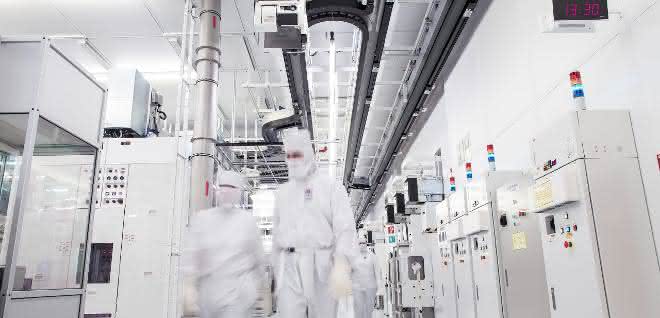
One company that is already successfully using predictive maintenance is the American semiconductor manufacturer Globalfoundries. It recently began using smart sensor technology at its Dresden site to monitor its ultrapure water valves. The valves are critical to production and were previously monitored analogously by employees at great expense. Globalfoundries is now recording audio data at the valves in order to create a data model using machine learning methods. In combination with continuously recorded sensor data, this enables an assessment of the current status of the valves, known as the "health condition", as well as a forecast of expected changes in status. Experts can view this information via a dashboard and initiate appropriate maintenance measures. In addition, detailed curves of historical and current parameters can be displayed and limit values for alarms can be defined. This enables early fault detection and needs-based maintenance planning, thereby preventing downtime, reducing maintenance costs and significantly increasing the reliability and service life of the system.
Customization of IoT systems
What companies should know: There is no ready-made system that can meet all the requirements of such a smart factory project from a standing start. IoT systems in production always require adaptation, as every production line differs in terms of the machinery used and the associated control systems, data and protocols. Requirements for dashboard visualization are usually just as different as the IT and OT systems and business processes to be integrated. To ensure a quick project start, it makes sense to encapsulate typical functions in prefabricated modules and assets and separate them from the customer- and system-specific aspects. Examples of such modules include anomaly detection, AR/VR-supported maintenance scenarios or blockchain-based proof of manufacture.

Despite modularization and individualization, solutions must be flexible at their core and implemented in such a way that they are scalable. This means that it must be possible to get started cost-effectively with just a few systems and quickly demonstrate added value. At the same time, scaling to several lines and production sites must be feasible.
Five phases to the digital twin
The development of seamless monitoring of production facilities and production lines is a step-by-step process. The goal is a complete digital image or model of all production systems and processes, i.e. a digital twin of the physical systems and processes. On the way there, the added value in the production processes increases with increasing maturity.
The first step is to record and consolidate data from every single machine, every single sensor and so on. In the second step, it is transferred for processing either on-premise, via an edge controller in the periphery or directly to the cloud. In the third stage, all structured and unstructured data is processed, visualized and interpreted in order to make it usable for process optimization. It is now possible to recognize patterns, establish correlations and determine threshold values, the violation of which triggers an alarm. Finally, the fifth and last phase allows the use of AI and machine learning to "learn" a fully digital image of the existing production processes. On this basis, digital start-up simulations to reduce set-up times or self-learning and self-optimizing models can be implemented, among other things.
A digital twin of this kind enables companies to minimize physical, retrospective quality controls, make maintenance processes more efficient using predictive maintenance and keep an eye on production sites across all locations. The entry barriers to setting up a digital twin are extremely low thanks to the scalable step-by-step model and the immediate added value. Dr. Stefan Pietschmann, Head of Digital Twin Solutions, T-Systems MMS


You might also be interested in
ESTIA aims to strengthen Europe's cloud
New tech alliance for EU sovereignty
Twelve companies, including Dassault Systèmes, are founding the European Sovereign Tech Industry Alliance (ESTIA). The initiative aims to strengthen Europe's technological independence and define requirements for sovereign cloud services. The start...
 read more...
Deutsche Telekom and Nvidia launch one of Europe's largest AI factories
With the Industrial AI Cloud in Munich, Deutsche Telekom and NVIDIA are creating one of the largest AI factories in Europe. Companies can train AI models, carry out simulations and access 10,000 GPUs.
read more...Leveraging data potential with AI and streaming
Huge data treasures are still lying dormant in many manufacturing companies. And yet it is high time that these treasures were unlocked. There is often a lack of resources and capacity to make data usable in real time. Streaming production data can...
read more...More awareness of noise
Dematic offers solutions that are tailored to different cloud environments and reduce environmental impact through reduced material consumption and improved energy efficiency.
read more...Generative AI in the automation environment
The mechanical engineering and automation industry is undergoing profound change. This transformation is being driven by more volatile global trade, geopolitical crises and increasing market pressure, which demands greater agility, technological...
read more...Rigid data structures have had their day
The traditional data center is no longer the center of data. A hybrid cloud storage approach enables manufacturing companies to both meet the current requirements of data-intensive processes and future-proof their infrastructure.
read more...Software as a service in three stages
CIM Database Cloud is a new out-of-the-box solution from Contact for end-to-end digital product development.
read more...How production can benefit from AI
Together with AI technology, IIoT networking makes it possible to better control machine parameters and optimize quality with predictive quality. Downtimes and set-up times can also be further minimized. Cloud platforms also make these technologies...
read more...More expertise for digital engineering
Altair, a computational science and artificial intelligence (AI) company, has acquired OmniV, a technology from Michigan, USA-based software company XLDyn.
read more...