

Wireless sensor networks
Bluetooth in Industry 4.0
For the implementation of Industry 4.0 scenarios, mechanical and vehicle engineering, process technology and the consumer goods industry are dependent on suitable sensors and their networking. Many manufacturing companies are currently working flat out to implement sensor networks in production. Wireless technologies can help here: Bluetooth Mesh Networking ensures secure and stable sensor networks.
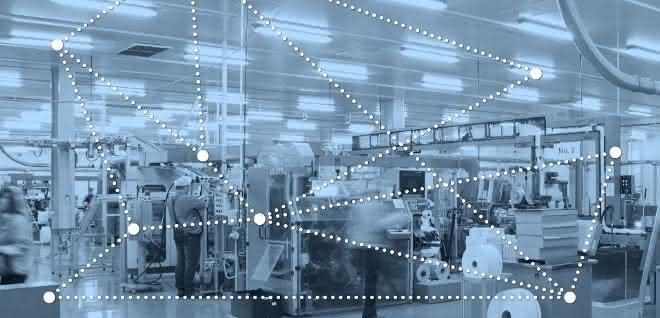
Wireless iIoT technologies are playing an increasingly important role in the implementation of sensor networks in production. They offer significant advantages over wired networks when setting up flexible, Industry 4.0-oriented production lines. Mesh networking via Bluetooth is a radio-based technology that offers a high level of security, scalability and interoperability for industrial environments.
Bluetooth Mesh Networking was designed especially for building automation and industrial wireless sensor networks (WSN). This standard enables so-called many-to-many networks with thousands, even tens of thousands of Bluetooth devices, which are called "nodes" in the mesh network. Messages sent by a sensor or device are transmitted by the network via these nodes to the destination. Messages can also be forwarded beyond the actual wireless range of a device. As messages travel through the network via different paths in parallel, no special rules or routes need to be configured.
This data transmission, known as "multi-path delivery", avoids one of the central weaknesses of wireless networks in industrial applications: in centralized radio-based networks, all data always runs via a central control device. This not only becomes the "single point of failure", but also leads to bottlenecks. This is because the sensors send information to the central control hardware, which in turn sends commands to each of the associated devices. This multiplies the volume of data traffic. Mesh networking via Bluetooth shifts the control functions to the individual devices. This reduces the volume of data transfer by half and enables information to be passed on without bottlenecks.
Intelligent Bluetooth-based lighting systems form the technical foundation for many industrial mesh networking application scenarios - both in company buildings and on the store floor. Luminaires are located in every building, are installed at short distances from each other and are therefore ideally suited as carriers for wireless network functions. To date, more than 100 products with mesh network capability have already been qualified for this purpose by the Bluetooth SIG.
Industrial network security is non-negotiable
Unlike in the consumer sector, the level of data security that providers incorporate into their Bluetooth mesh solutions is non-negotiable. Securing the network takes place on several levels and is mandatory. This is not least due to the particular importance of reliability, especially in manufacturing. Any disruption to production means a considerable financial risk for manufacturing companies. The same applies to data protection, especially when it comes to sensitive information about production processes. With mesh networking via Bluetooth, information security is achieved through a layered model based on separate security keys:
Network keys (NetKeys) apply to all messages in the network so that the nodes can communicate securely with each other.
Application keys (AppKeys) protect messages for specific applications such as air conditioning, lighting or physical security.
Device keys (DevKey) allow you to set up and configure a node to add new devices to the network.
This separation ensures that all nodes within the network are able to transmit messages securely. However, only those nodes that have the appropriate application key can also process the information.
Additional mechanisms protect the mesh network itself from exotic threats. For example, the device configuration is protected by asymmetric cryptography. Regularly updated security keys protect against trash-can attacks using decommissioned devices. And intelligent use of sequence numbers blocks replay attacks.
The industry turns blue

A number of technology trends are currently driving the development of smart industries. In addition to the increase in wireless sensor networks, these include the growing importance of mobile devices in production and the increasing transparency of manufacturing processes through asset management solutions. Bluetooth-based solutions are already playing a key role in all of these areas. Here are a few examples:
- Mobile devices such as tablets and smartphones are increasingly being used to operate machines. ABB, for example, has developed a Bluetooth-enabled control panel that establishes a wireless connection between the ABB drive and the mobile device. This allows a drive to be commissioned remotely in order to increase safety in the workplace.
- Bluetooth makes it possible to determine the exact location, availability and status of devices across the entire supply chain. This is the idea behind Bosch's Bluehound asset tracking tool, which is currently in an open pilot phase. The cloud-based solution enables easy tracking and localization of work equipment for more transparent work processes.
- A new direction finding function in Bluetooth Core Specfication 5.1 significantly improves location services. It enables the development of proximity solutions that determine the direction of a device, as well as positioning systems that achieve centimeter-level accuracy. This is essential for professional solutions in warehouse logistics, for example.
Interoperability central driver
According to a market analysis by ABI Research, the volume of Bluetooth devices for smart industries shipped each year will more than double to 253 million units by 2022. Interoperability is a key driver of this development. Especially for Industry 4.0 scenarios, in which production lines are configured flexibly, it is essential that devices from different providers work together reliably at all times. As a global wireless standard in the low-energy range, Bluetooth offers a decisive advantage over niche providers or rigid, wired networks.
Martin Woolley, Developer Relations Manager, EMEA of the Bluetooth Special Interest Group / ag


You might also be interested in
ESTIA aims to strengthen Europe's cloud
New tech alliance for EU sovereignty
Twelve companies, including Dassault Systèmes, are founding the European Sovereign Tech Industry Alliance (ESTIA). The initiative aims to strengthen Europe's technological independence and define requirements for sovereign cloud services. The start...
 read more...
Deutsche Telekom and Nvidia launch one of Europe's largest AI factories
With the Industrial AI Cloud in Munich, Deutsche Telekom and NVIDIA are creating one of the largest AI factories in Europe. Companies can train AI models, carry out simulations and access 10,000 GPUs.
read more...Leveraging data potential with AI and streaming
Huge data treasures are still lying dormant in many manufacturing companies. And yet it is high time that these treasures were unlocked. There is often a lack of resources and capacity to make data usable in real time. Streaming production data can...
read more...More awareness of noise
Dematic offers solutions that are tailored to different cloud environments and reduce environmental impact through reduced material consumption and improved energy efficiency.
read more...Generative AI in the automation environment
The mechanical engineering and automation industry is undergoing profound change. This transformation is being driven by more volatile global trade, geopolitical crises and increasing market pressure, which demands greater agility, technological...
read more...Rigid data structures have had their day
The traditional data center is no longer the center of data. A hybrid cloud storage approach enables manufacturing companies to both meet the current requirements of data-intensive processes and future-proof their infrastructure.
read more...Software as a service in three stages
CIM Database Cloud is a new out-of-the-box solution from Contact for end-to-end digital product development.
read more...How production can benefit from AI
Together with AI technology, IIoT networking makes it possible to better control machine parameters and optimize quality with predictive quality. Downtimes and set-up times can also be further minimized. Cloud platforms also make these technologies...
read more...More expertise for digital engineering
Altair, a computational science and artificial intelligence (AI) company, has acquired OmniV, a technology from Michigan, USA-based software company XLDyn.
read more...