
BDI at the Hannover Messe 2025
Industry in crisis
At the start of Hannover Messe 2025, leading industry associations BDI, VDMA and ZVEI described the economic situation in Germany as worrying. According to BDI President Peter Leibinger, the mood in many companies is worse than ever before.
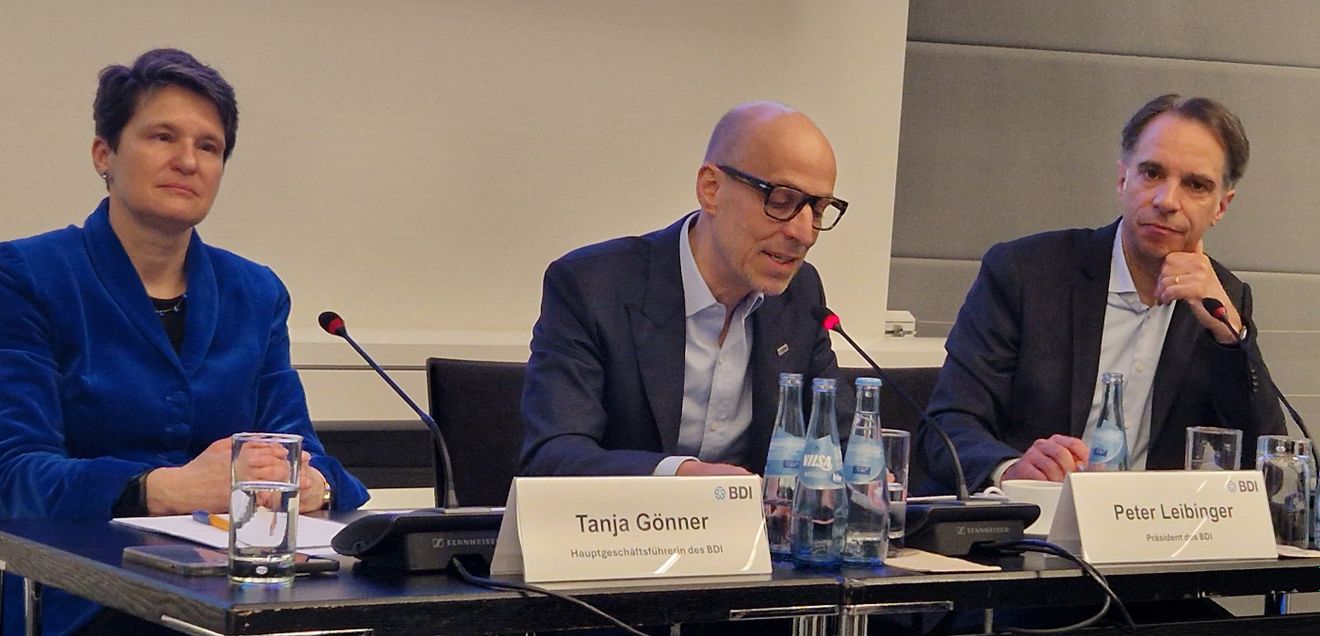
"We don't just have economic problems, we have structural problems," emphasized Leibinger. Industrial production in Germany is expected to fall by 0.5% in 2025, following a decline of 4.8% in the previous year. This means that the decline will continue for the fourth year in a row.
Industrial production also remains on a downward trend in the EU. In 2024, production in the EU's manufacturing sector fell by 2.7%, with a further decline of just under 1% expected for 2025. Globally, however, the picture is more positive: While Germany and the EU are lagging behind, global industrial production grew by almost 2% in 2024 and is expected to increase by 2.5% in 2025, driven in particular by emerging markets. A look at the pre-crisis level of 2019 shows that German industry was 11% lower in 2024, while European industrial production grew by 1% in the same period.
Demand for reforms
The industry associations are calling for decisive measures from the federal government to make Germany competitive again. "We need a major step forward, a bold reform agenda," says Leibinger. The industry sees an urgent need for action in four areas in particular:
- Reducing bureaucracy: The increasing density of regulation is slowing companies down. The VDMA is calling for a simplification of reporting obligations and a reduction in corporate taxes to a maximum of 25%.
- Taxes: The tax burden on companies must be reduced to an internationally competitive level in order to facilitate investment.
- Energy supply: High energy costs and uncertainties in energy policy make long-term planning difficult. A halving of transmission grid fees and an extension of electricity price compensation for energy-intensive companies are called for.
- Innovation: Germany must invest in key technologies such as AI, quantum technologies and automation. Openness to technology must be the basic principle here.
Effects and prospects
Weak industrial development is contributing significantly to overall economic stagnation. While Germany's gross domestic product is expected to continue to shrink, the global economy and the EU are expected to grow. Nevertheless, there is a small glimmer of hope: in the first quarter of 2025, production rose by just over one % compared to the previous quarter. "A bottoming out is emerging," says Leibinger. In addition, the additional spending of the special fund for infrastructure could have a positive effect on economic growth - provided it is used efficiently.
Significance of the Hannover Messe
Despite the economic uncertainties, the Hannover Messe remains an important meeting place for innovation and exchange. "The German economy does things. It tackles, invents and develops," says Leibinger. The VDMA will be presenting new developments in the fields of artificial intelligence and digital manufacturing at the trade fair. One practical example is the Manufacturing-X project, which creates secure, shared data rooms and enables companies to measure the carbon footprint of their products in real time.
The industry is facing major challenges, but is also demonstrating its innovative strength. "If we create the right framework conditions, our industry will not only remain competitive, but also set new standards," Leibinger concluded.


You might also be interested in
Ionos and Q.ANT cooperate on AI
Ionos and Q.ANT want to jointly advance photonic processor technologies for AI and high-performance computers. The aim of the partnership is to build energy-efficient and sovereign AI infrastructures in Europe.
 read more...
AI automation specialist reorganizes...
Generation change at Insiders Technologies
After almost 30 years at the helm, Werner Weiss is handing over the management of Insiders Technologies. Andree Albrecht takes over the management after a transition phase.
read more...AI 'CheckMate' optimizes industrial processes
With 'CheckMate', the University of Klagenfurt has developed an AI system that independently creates algorithms for complex combinatorics and optimization problems. The technology is designed to make industrial planning and logistics processes more...
read more...Intelligent brownfield networking
Many industrial companies are struggling with established plant structures and proprietary interfaces. Stefan Klaus' presentation will show in a practical way how brownfield environments can be efficiently networked with open technologies and made...
read more...Factory-X in practice
How can set-up processes in highly variant production be automated efficiently? Markus Benndorff from soffico shows how Factory-X, industrial data rooms and modular architectures create new possibilities for flexible production concepts.
read more...AI and virtual twins for the industry
Dassault Systèmes confirms annual forecast after solid start to 2026
The French software group Dassault Systèmes has made a solid start to 2026 and is continuing to focus on artificial intelligence, cloud applications and virtual twins as growth drivers in its industrial business.
read more...Siemens presents new AI agent
Siemens is launching 'Eigen Engineering Agent', an AI for automation technology. The solution is integrated into the TIA Portal, has been tested with over 100 companies and is designed to significantly accelerate engineering processes.
read more...Startup develops AI platform for industrial control systems
The Munich-based startup Linexa raises 2 million euros in pre-seed funding. The company structures manufacturer-independent control technology in factories and aims to create a basis for the use of AI in production.
read more...Physical AI at the Hannover Messe 2026
Friedrich Merz visits Beckhoff Automation
Beckhoff Automation is showcasing the integration of AI in machine control systems at Hannover Messe 2026. Physical AI enables autonomous processes directly in the machine - without a cloud connection.
read more...