

Predictive maintenance with Infineon
Reduced downtimes for industrial robots
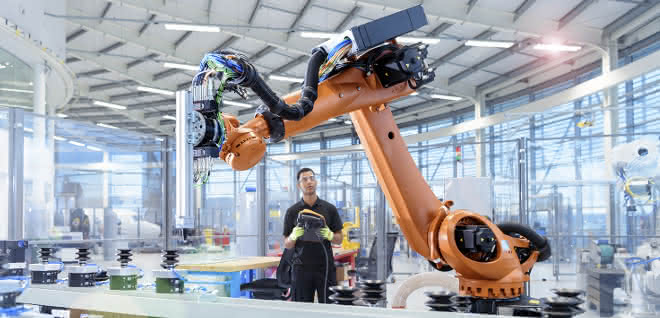
A machine that was previously working reliably suddenly stops and cannot be put back into operation despite all efforts. Then a member of the maintenance team arrives, and after some thought, tinkering with the machine and words of encouragement, it is suddenly up and running again.
Of course, the reality is - as a rule - somewhat different. Defined maintenance work is carried out according to schedule in order to optimize uptime. These preventive measures are usually carried out at times when the production process is least disrupted. In addition, the maintenance engineers check robots and automation equipment for impending faults. Against this backdrop, the question arises as to whether the implementation of supplementary sensor technology alongside process monitoring improves predictive maintenance.
In today's factories, there are hardly any workers left to carry out simple tasks during production. Modern factories are highly automated and hardly need a human hand for the actual production. In contrast, maintenance technicians are becoming increasingly important to keep the machines running, as unexpected breakdowns or downtime can significantly reduce productivity and margins.
A maintenance, repair and operating plan is therefore at the heart of every production process. Among other things, this coordinates predictive maintenance (PM) in such a way that it has as little impact as possible on the production process. If this PM plan is well implemented, the operating and service life of the robots and machines used can be extended. With regular maintenance, a robot can be in operation for up to 20 years, making it an excellent investment.
Robot manufacturers such as Fanuc, Yaskawa and Kuka provide detailed PM plans for this. These include activities such as the visual inspection of the drives, cable harnesses or cables through to regular checks, memory backups and lubrication. These maintenance intervals can cover between 4,000 and 10,000 operating hours. Of course, customer requirements and the PM plan cannot always be synchronized with each other. The different loads, movements and speeds of the robot can lead to more or less wear, so that maintenance is actually too frequent or too infrequent. Operator training also has an influence on wear. For example, if the emergency stop button is often used out of convenience to stop the robot instead of following the stop mechanism specified by the manufacturer, the brake system can wear out more quickly.
Today, CIPs (Continuous Improvement Programs) are mostly used to reduce unexpected downtimes, while at the same time the planned downtimes should be as balanced as possible. But even here you reach a point where the cost of improvements exceeds the potential cost savings from longer operating times.
The "Goldilock zone" for maintenance
As Industry 4.0 continues to be implemented, manufacturing managers are receiving more and more data about their production facilities. Networked systems and shared data enable continuous feedback on production and process status. Sensors are mainly used to monitor process parameters such as temperature, pressure or output. However, sensors also ensure functional safety and monitor, for example, whether a valve is working correctly or a safety door is closed.
The stored data from these sensors can be used to carry out a retrospective analysis in the event of a fault. For example, if it is determined that the emptying of a tank is gradually taking longer and longer over several weeks, this information can be used to adjust the planned maintenance for the tank outlet valve.
A key advantage of experienced maintenance staff is their keen sense that something could soon go wrong. This ability is essentially based on experience and the human senses. If, for example, a machine does not sound as usual or vibrates a little more than normal, then instinct kicks in. It can help to reduce downtimes and save costs caused by unscheduled breakdowns or maintenance work.
The aim of additional sensors on the production equipment is to replicate these senses. This ensures that the planned maintenance work is not carried out too frequently and, on the other hand, that there are not too many unexpected stoppages. The maintenance team therefore always tries to reach the so-called "Goldilock" zone. The aim is to achieve the optimum balance between too few or too many maintenance downtimes.
The sensors used serve to monitor the operation of the machines and indicate changes that could point to possible faults. For example, by simultaneously recording power consumption, temperature, noise and movement, wear-related damage in robot joints can be detected before a failure occurs.
Sensor fusion as an opportunity
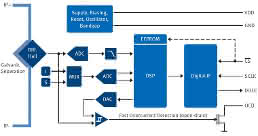
Digital sensors integrate comprehensive functions for signal processing, compensation and calibration - which makes implementation relatively simple. This enables precise current measurements in a small, flat housing for direct and alternating currents up to ±50 A. The TLI4970 from Infineon is such a device(Figure 1). It uses a Hall sensor and a measuring principle in which the primary side (with the current conductor) is electrically isolated from the secondary side with the logic.
This coreless measuring solution is very compact and more precise than open-loop systems with a magnetic core. The primary conductor (busbar) is integrated in the housing, which means that no external calibration is required. The output is highly linear without hysteresis, while stray fields are efficiently suppressed thanks to the differential measuring principle.
For the motion detection of robot joints, magnetic field-based measurement solutions can benefit from Giant Magneto Resistance (GMR) sensors. Such sensors enable accurate and fast angle measurement for commutated motors by monitoring magnetic fields with two plates. The resulting sine and cosine output is then converted into a 360-degree angle in a circuit block with digital signal processing and trigonometric ARCTAN2 function to provide, for example, the exact position of the rotor.
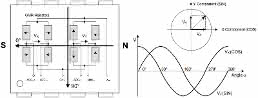
One such accurate angle sensor is the TLI5012B E1000(Fig. 2), which is supplied pre-calibrated. The integrated GMR sensors are implemented in a full bridge configuration to ensure maximum signal strength. The special design also ensures that the temperature effects of the individual sensors compensate for each other. The sensor can be connected to a microcontroller via the SPI interface, which provides access to the calculation results and the configuration registers.
Some sensors also integrate a circuit block for temperature measurement. Sensors such as the DPS310 for recording barometric air pressure have this integrated temperature measurement. This functionality therefore does not need to be implemented separately.
A compact solution for capturing audio signals can be realized with microelectromechanical solutions such as MEMS microphones. With integrated A/D converters, these sensors can be inserted directly into the digital signal processing chain. The IM69D130, for example, offers excellent sensitivity (±1dB) and a flat frequency response of only 28 kHz. In addition, the audio sensor can record and transmit signals in a very noisy production environment without distortion due to the high dynamic range of the MEMS microphones (Acoustic Overload Point: 130dB SPL).
In order to be able to use all the data collected by the sensors for fault prediction, it must be evaluated and processed in real time. In addition, the integration must be based on existing network technologies for Industry 4.0. Microcontrollers such as the XMC4000 family provide digital interfaces for communication with digital sensors. They also support industrial network communication standards such as EtherCAT for integration into industrial systems (Fig. 3). The XMC4000 family is based on the powerful ARM Cortex M4F processor core and enables the implementation of sensor fusion. This is because the processor also supports floating point calculations and digital signal processing - both of which are helpful for processing and evaluating sensor data.
In production facilities with 24-hour operation, systems with sensor fusion generate large amounts of data. By closely examining the data, operators may be able to detect anomalies. But with robots moving many loads and parts, it is becoming increasingly difficult to distinguish whether deviations in power consumption are simply load-related or an indication of a possible fault.
New insights through AI
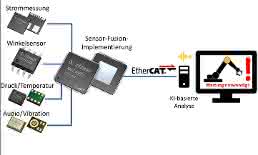
Sensors imitate the human senses. However, the second important component is missing for a functioning prediction system: the many years of experience of maintenance specialists. It is therefore necessary to combine overarching information such as load, noise, vibration, heating and movement in order to predict possible failures. This task falls within the domain of AI analysis techniques (artificial intelligence; Fig. 3).
AI is fundamentally about recognizing data patterns, often across multiple data sets from different sources. By analyzing data collected in the time domain, coupled with the tasks to be performed, a defined initial status for the operating state can be determined. In comparison to this, AI can then be used to detect deviations in operating noise or vibration that correlate with higher power consumption or an increase in temperature. This allows changes that could lead to faults to be detected.
Investments in Industry 4.0 are justified
Precise insights into the machine's condition enable improvements in predictive maintenance. They allow specific measures to be taken on machines or robots before longer downtimes become necessary. In addition, the information can also be used to proactively create an emergency plan. If necessary, the execution speed of the robot or its load can be reduced until a suitable maintenance window is reached.
With the availability of numerous compact, cost-effective and highly integrated sensors, there is no longer any reason why these should not be implemented for monitoring tasks in machines or robots. Powerful and easy-to-integrate microcontrollers also enable sensor fusion in order to merge the various sensor data against a common time base.
Against this backdrop, investments in the implementation of Industry 4.0 measures are easier to justify. With the advances in AI, the flood of data generated will be easier to handle and analyze. If this increases operating times and enables more efficient, data-based predictive maintenance, users will gain significant competitive and profitability advantages.
Dr. Clemens Müller, Director Business Development Robotics at Infineon / ag


You might also be interested in
Helu makes its first trade fair appearance under a new brand name
Helu Kabel will be presenting itself as Helu for the first time at Hannover Messe 2026, showcasing system solutions, Heluchain cables and new industrial luminaires.
 read more...
Strategic realignment with brand relaunch
In future, Helukabel will trade as Helu
The Helukabel Group is parting with part of its name: in future, the company will only operate under the Helu brand. With this step, the specialist for electrical connection technology is underlining its strategic development from a classic cable...
read more...Modular plant construction for corrugated board
Insight into the production of corrugators at BHS Corrugated: Automated, modular and equipped with Helukabel components.
read more...Best quality for the steel
Conditions in the steel industry are harsh and inhospitable. The machines used must be able to withstand the demanding environmental conditions in order to deliver the best quality at all times.
read more...If the standard cable is not sufficient
Lapp offers cables for countless applications - but not for all of them. From time to time, the developers have to modify a standard cable or develop a special cable.
read more...Slight decline in sales, strong investments
The Lapp Group has not been spared from the weakening global economy. However, the company only recorded a slight loss in the past 2024 financial year.
read more...Electrical connection technology
Cables and wires for industrial automation
Heukabel offers system solutions for cable routing from a single source. The subsidiary EKD Systems specializes in tailor-made cable drag chains made of steel, stainless steel and plastic, which are used in moving machines and systems as well as in...
read more...Lapp relies on Ultramid from BASF
Mobile charging of electric vehicles
The automotive industry is currently undergoing the biggest transformation in its history. The boom in battery electric vehicles in particular is presenting the industry with major challenges. Lapp, as a supplier of cables and connection...
read more...Cable handling application
At this year's Motek, ArtiMinds Robotics is showcasing a robot-based automation solution for the sensor-assisted assembly of flexible cables in connector housings.
read more...