

Second-hand market for robots
Second-hand automation
Robots take over monotonous and strenuous work from their human colleagues without complaint. But what happens when tasks change or the demands on performance increase? Then the automation helpers often end up on the second-hand market - much to the delight of buyers with a smaller budget or an urgent need.

It should be a new car. Less fuel consumption, maybe even an electric car. But the old car is actually still in pretty good shape, far too good for the scrap press. In such cases, there is a good solution: sell it on. A common practice worldwide. The advantage is obvious: customers with a small budget can find a vehicle quickly and easily.
The secondary market for robots is very similar, and in certain respects is very similar to the market for used cars. Here, too, user requirements are constantly changing and with them the possible applications for the automatic helpers. The increasing demands on quality and speed in production also require many companies to regularly update their hardware. The result is a growing market for used robots, as these are generally far from reaching the end of their service life and can still be used profitably for various applications.
Germany is a big player when it comes to industrial robots. With around 221,500 industrial robots, the country is the most automated economy in the European Union. As a result, there are around three times as many industrial robots in German factories as in Italy, for example, around five times as many as in France and a good ten times as many as in the UK. These are the figures published by the International Federation of Robotics (IFR) in September 2020. In Germany alone, almost 20,500 new units were installed in 2019. However, demand for new industrial robots is also high worldwide. In China, manufacturers delivered more than 140,000 new robots in 2019, and around 33,000 in the USA.
Boom for the secondary endowment policy market
As a result, the used robot market is also growing. "The annual turnover for used robots is around 500 million euros, compared to 300 million in 2016," says Roberto Rostri from automation specialist Kuka. Rostri is an expert in the field of used robots and therefore knows the market inside out. In principle, the same principle applies when buying robots as when buying a used car: "There are many suppliers, but not everywhere you can get what you actually want," says Rostri.
While some dealers simply give used robots a facelift, others subject the machines to an intensive check. "You should know where you are buying from and what you are getting," says Rostri. At Kuka, for example, all robots are thoroughly checked, repaired and repainted and, if necessary, overhauled and passed on to the buyer with a full warranty. "Most of our used robots have only been in operation for a few hours. Many are demonstration models, exhibition pieces from trade fairs or were set up as samples for customers to test operation in larger production lines," explains Rostri. In addition, many customers simply replace older models with newer successors.
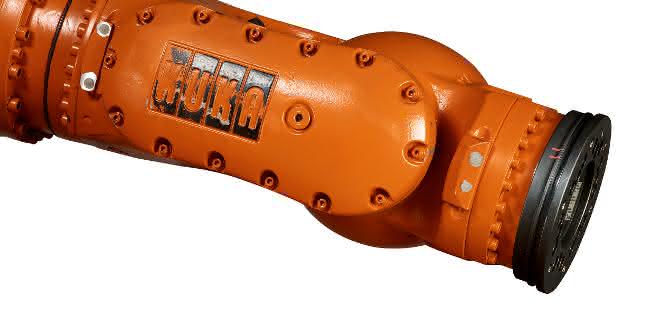
Selling your used robot directly back to the manufacturer has several advantages: Firstly, he is a specialist in his field and is therefore best placed to assess both the condition and performance. "Secondly, we are usually listed as a supplier to the companies and therefore have access to the factory halls, know our way around on site and can therefore dismantle the old equipment quickly and efficiently," says Rostri. "Large companies, such as those in the automotive industry, often replace entire production lines with dozens of robots. This can certainly be a logistical problem for smaller recyclers - for us, it's part of our day-to-day business."
The issue of payment should not be underestimated either: As a rule, there is not yet a new buyer for the used robots, but the customer rightly expects an immediate payment for the machines. These payments are much easier to make for a large company than for a private supplier.
For buyers, on the other hand, a used robot can be an interesting alternative to buying a new one. For example, smaller companies that want to venture into the field of automation can keep costs down by opting for a used robot from the manufacturer. An investment that can pay off. As a rule, robots reduce personnel costs, as they take over time-consuming, simple tasks and thus give skilled personnel more freedom for value-adding activities - an essential aspect, especially in times of a shortage of skilled workers. Demographic change alone will result in around 35% fewer employees being available by 2035. At the same time, the machines deliver consistently reproducible quality and are able to meet customer requirements in a cost-sensitive manner, even for small quantities.
Rapid assistance for time-critical requirements
In addition to being cheaper to purchase, used robots have another advantage: immediate availability. While a brand-new model often takes several weeks to deliver, used machines are usually available immediately. This can be a decisive argument for integrators, especially in time-critical processes. Buyers do not have to compromise on performance. At Kuka, for example, used robots are available in three categories: Superior, Premium and Certified. The latter are used robots that have been refurbished. Premium devices are completely overhauled robots that have been set up precisely for their new task. Superior devices are former exhibition devices that are brand new on paper.
"Robots have an average lifespan of 18 years. That's why we sometimes sell a 15-year-old model," says Roberto Rostri. This is also based on the idea of sustainability. Robots that have performed high-precision work for years in the automotive industry, for example, are no longer suitable for sensitive areas after a certain period of use. However, they are still fully operational in sectors with lower requirements. So instead of buying a new device that is literally overqualified for the task, it may be worth buying a used robot. The quality of these used devices is very high. This is also due to the fact that Kuka offers a worldwide guarantee for spare parts and service.
Sebastian Schuster, Global PR & Content Manager, Kuka Germany / am


You might also be interested in
"We are clearly different from the competition"
The IT company 21unity offers a range of hardware and software services, as well as traditional services. Andreas Mühlbauer spoke to Managing Director Anja I. Gondolf about the company's appearance at the Hannover Messe, its services and future...
 read more...
Think digital, act local
When it comes to industrial damping technology, on-site advice is often very valuable for engineers and designers.
read more...Plagiarius 2024 negative prize
On January 26, 2024, the Plagiarius campaign awarded its dreaded "Plagiarius" negative prize for the 48th time to manufacturers and retailers of particularly brazen counterfeits and fakes.
read more...Spindel Full Service records second-best...
Maintenance as an economic success factor
Spindel Full Service, the spindle repair specialist from Baden-Württemberg, can look back on its second-best financial year in its history - with 15% growth compared to the previous year. And the further forecast also looks good.
read more...Thyssenkrupp and Novelis cooperate
Platform for the circular economy
With a platform for the circular economy in the automotive industry, the two companies Thyssenkrupp Materials Services and Novelis want to set new standards for the recycling of used materials. The open platform will enable access to larger...
read more...How production can benefit from AI
Together with AI technology, IIoT networking makes it possible to better control machine parameters and optimize quality with predictive quality. Downtimes and set-up times can also be further minimized. Cloud platforms also make these technologies...
read more...Marco Ghirardello takes the lead
Fanuc has appointed Marco Ghirardello (48) as the new President and CEO of Fanuc Europe. Ghirardello succeeds Shinichi Tanzawa, who has led the company since 2016 and will take on a new role at Fanuc's headquarters in Japan.
read more...Efficient robot monitoring
Microchips are installed almost everywhere - whether in smartphones, washing machines or cars. With increasing digitalization, the demand for semiconductors has been growing rapidly in all areas of the economy for years.
read more...Everything on one platform
Functional and powerful tools are essential for professional work on the construction site, in the workshop or when carrying out repairs.
read more...