
Cooperative robot operation
Increase the safety and productivity of cobots
The sBot Speed safety system from Sick enables robots that slow down when approached, stop in good time and continue working independently as soon as the person has left the work area.
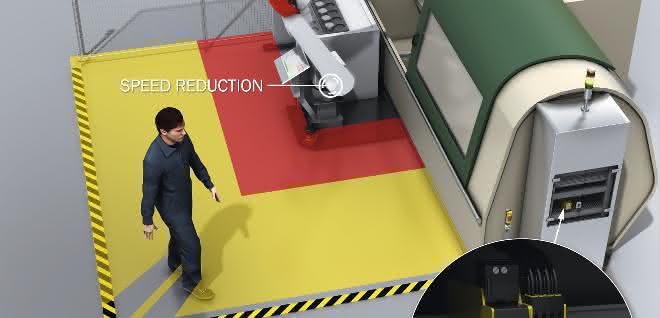
The safety system that Sick is presenting at Motek is a complete, ready-to-integrate solution consisting of an S300 mini safety laser scanner and a FlexiSoft safety controller. In addition to pre-configured and tested automation and safety functions, it offers a complete wiring plan that enables simple and smooth system integration into robot controllers. The sBot Speed-UR system variant is compatible with various robot models from Universal Robot (UR) - further variants with other robot manufacturers are in preparation.
Open access to the danger zone with safety for persons
Cooperative robot applications, in which man and machine share the same workspace at different times, support processes in assembly, for example. They also enable flexible adaptation to changing working or environmental conditions. In these scenarios, safety systems have the task of ensuring safe access to the robot's danger zone at all times. At the same time, they should support the process efficiency and productivity of human-robot interaction, for example through adaptive perception, which makes it possible to automatically adjust the operating conditions of the robot to the position of people in the environment. This protects against the risk of accidents and improves productivity at the same time, as downtimes are reduced and work processes are optimized.
This is exactly what sBot Speed does. The safety laser scanner monitors the robot's working area. To do this, it uses two field sets that are dependent on the robot speed - each consisting of a warning field and a protective field. If a person enters the warning field of field set 1 while the process is running, the robot safely reduces its speed. As the robot now runs more slowly and therefore has a shorter stopping time in the event of an emergency stop, the safety system activates field set 2 with a reduced protective field. If this is entered, the robot switches to the safety stop. If the person leaves the working area again, the robot starts up again automatically - initially at a safely reduced speed and monitored by field set 2, before resuming the original working speed with protection by field set 1.
The system makes it possible to adapt the operating conditions of robots according to the presence of people in their work area. Compared to a complete stop and process standstill, the safely monitored reduction in speed means greater productivity and availability with optimized human-robot interaction. The gently controlled, two-stage braking and acceleration during automatic restart avoids unnecessary wear on the robot and its drive components, which pays off with a longer service life.
Turnkey safety system for UR robots
By aligning sBot Speed to the requirements and functions of different robot makes and series, Sick is going one step further in terms of system integration. The sBot Speed-UR system variant has been specially adapted in key points for use in the UR3, UR5 and UR10 robot models. This applies, for example, to the UR-specific wiring diagram or the description and connection of additional safety components that are required to meet relevant safety standards. The wiring diagram, the safety logic program, the UR-specific parameter settings and the SISTEMA file are also included in the detailed documentation.
The specific adaptation to UR robots also applies to the selectable operating modes "Active mode" and "Programming mode". The sBot Speed-UR safety system enables the commissioning engineer or operator to program the robot when setting up the robot or changing functions and to move it safely, for example to teach in gripping points.


You might also be interested in
Plagiarius 2024 negative prize
On January 26, 2024, the Plagiarius campaign awarded its dreaded "Plagiarius" negative prize for the 48th time to manufacturers and retailers of particularly brazen counterfeits and fakes.
 read more...
Ivalua honors winners of the Generative AI...
AI-supported "add-ons" for buyers within 48 hours
Ivalua, provider of cloud-based spend management solutions, announced the winners and innovations of the first Generative AI Innovation Cup. The competition took place in December 2023. It was open to all Ivalua partners and employees - more than...
read more...Efaflex celebrates 50 years of high-speed...
The emphasis is on "fast"
Since day one, Efaflex has wanted to use new technologies as early as possible and drive progress in the industry. This year, the family business is celebrating its 50th anniversary under the motto "Fast Forward".
read more...Security of supply even during power outages
In the winter of 2022, Germany was worried about energy shortages. The drugstore retailer dm did not paint any horror scenarios, but nevertheless saw the possibility of controlled, temporary, regional power cuts (brownouts).
read more...Safety technology in mechanical engineering
Modules with new functions
Euchner's product highlights at EMO 2023 include the communication-capable solenoid interlocks.
read more...Transforming the paper industry towards climate neutrality
Together with partners from industry and research, Voith is developing a project for the optimization of energy and material flows in paper production. The aim of the research project is to develop a digital framework that enables effective process...
read more...Up to 95 percent less flue gas thanks to direct extraction
The requirements for occupational safety measures and safety technology are also constantly increasing in welding technology. The Technical Rules for Hazardous Substances (TRGS) stipulate that welding fumes and harmful substances must be extracted...
read more...Competitive advantages with large machines
Whether 3D-printed components for machines and systems, prototypes or aids for design: additive manufacturing is almost indispensable for modern companies in mechanical and plant engineering and automation if they want to play in the premier league.
read more...Transport technology from the modular system
Many transport tasks can be realized with the help of linear technology. Pre-configured solutions are available to simplify the interaction between the linear unit, motor, gearbox and controller. This minimizes the effort required for research and...
read more...