

Plug standard
Clear the way for Single Pair Ethernet
The standardization of Single Pair Ethernet is on the verge of a breakthrough. This removes a decisive hurdle: the unmanageable number of connector faces. The new, universal connector standard could significantly simplify industrial IoT networking for digital AI services and the smart factory in particular.
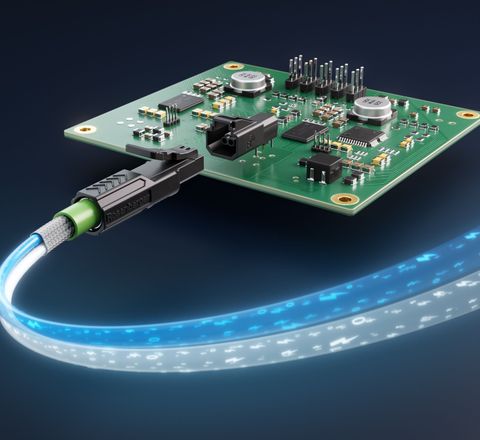
Single Pair Ethernet (SPE) has already become established in the automotive industry in recent years. Increasing networking in the "software-defined vehicle" requires secure, compact cabling in the tightest of spaces in the vehicle that connects sensors and controllers for autonomous driving, battery management and driver assistance systems. As a partner to OEMs, Rosenberger has accompanied this paradigm shift since 2012 and helped develop the protocols for the automotive connector. This experience has also been incorporated into the current standardization process and is reflected in the new hybrid connector standard IEC 63171-7 (ED2), which will soon form the basis for future interoperability.
Long-range transmission technology that combines power supply and data transmission in one cable is also becoming increasingly important in industrial networking. The development of Industry 4.0, digitalization and networking is becoming increasingly relevant. The basis for this is data! Although existing protocols are already being used in industrial networking, in practice it remains a problem to obtain data cost-effectively, sustainably and efficiently. As sensors and actuators in IoT applications provide the necessary information, which is analyzed by AI systems for predictive maintenance or simulations, for example, the need for affordable, intelligent networking continues to grow. SPE represents a sensible alternative here, which also enables security strategies such as Time Sensitive Networking (TSN) for security and safety-critical real-time applications.
Numerous application scenarios in a wide range of industries can benefit from SPE: The technology is particularly relevant in automation and robotics, where the much narrower and more flexible SPE cables contribute to greater freedom of movement. Another example is vehicles in the agricultural sector, which are increasingly incorporating data on soil conditions and weather. But applications are also emerging in electromobility - for example through sensor technology in charging stations or in the further use of vehicle batteries in large energy storage systems that require complex cabling. SPE can also simplify the networking of train compartments and is now also a trending topic in building automation.
The variety of protocols makes development more expensive
Wherever high-performance networking is important, SPE can shine with features such as miniaturization, power supply via the data cable (Power over Dataline [PoDL]) and significant material savings. Multidrop topology also allows several sensors and actuators to be controlled simultaneously via one cable. Especially in the IoT environment, many small devices also need to be supplied with power at the same time - wireless approaches are therefore generally not sufficient. They continue to play a subordinate role in factory automation: HMS Networks' market analysis for 2024 states that only 7% of all newly installed network nodes are based on wireless communication.
In industrial networking, there are currently over 80 different protocols that individual components can use to communicate. Expensive gateways are required to translate these protocols. Above all, however, implementation is cost-intensive because it requires a high level of expertise in these protocols: an area in which specialists are rare. This means that development costs in machine and system design, for example, rise relatively sharply. The more sensor, actuator and connector manufacturers rely on SPE, the faster a complete system - without gateways - could communicate exclusively via Ethernet protocol in the future. In a research project with the Technical University of Munich for a CNC system, development costs could be reduced by up to 25 percent. As Single Pair Ethernet becomes more widespread, the costs for this communication technology are also falling. So far, SPE has mainly been used to supplement existing Ethernet cabling for new digital, IoT-based scenarios. In the future, SPE could also become the basis for new products and production sites.
Uniform mating face strengthens the spread of SPE
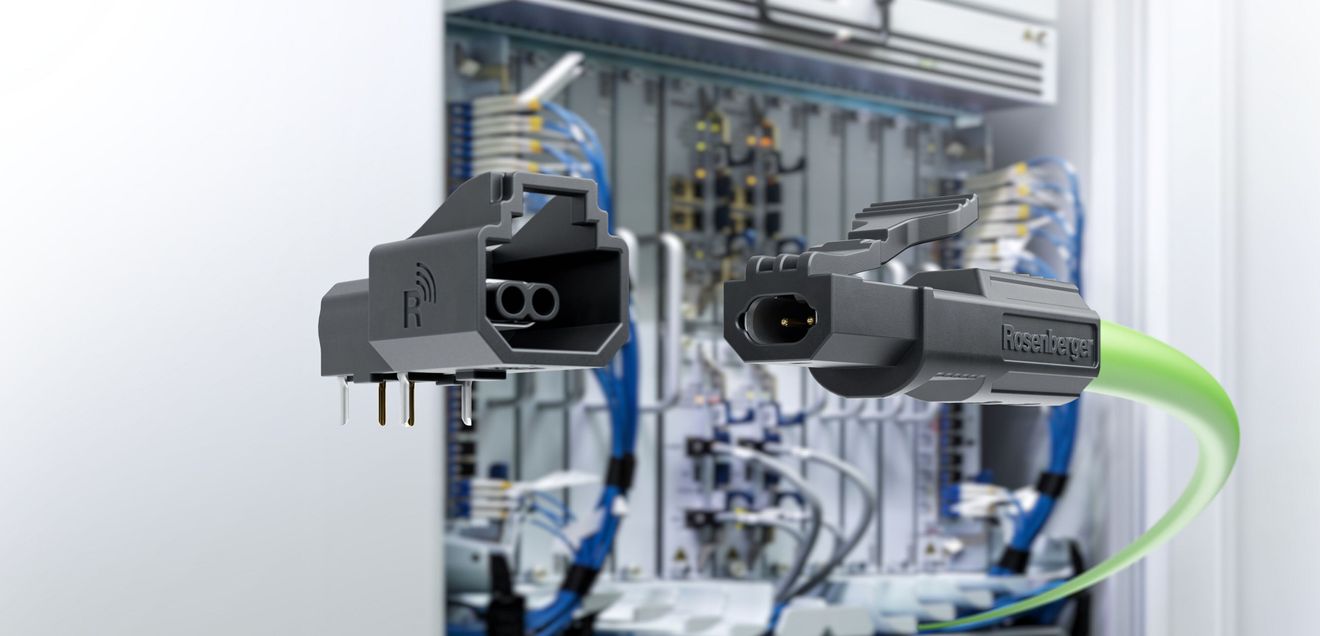
The IEEE 802.3 standard describes the SPE protocols for automotive, transportation and for factory, building and process automation in terms of physical layer and data transmission speeds. While 25 gigabits per second are required in the automotive industry due to the high data volumes, this would be oversized in the building industry, for example. For up to 80 percent of industrial use cases, 10 Mbit is sufficient, with 100 Mbit almost all cases can be covered. Different distances are also taken into account by the respective protocols: While sensors in greenhouses or chemical parks need to work together over hundreds of meters or several kilometers, only very short cable distances are required in a machine, plant or robot.
Based on earlier standardization efforts, there is already a whole range of standardized industrial connectors for SPE, which are described in the IEC 63171 sub-standards. They are suitable for different application scenarios, although some of them overlap. In addition, there are many non-standardized connectors on the market. This leads to a great deal of complexity for both manufacturers and operators. The associated uncertainty prompted many companies to wait and see. At the end of 2024, the Profibus User Organization (PNO) announced that it wanted to standardize a uniform, hybrid connector face with IEC 63171-7 (ED2) and define it as an industry standard. This should make it possible to universally cover all application scenarios, even in protected areas. From Rosenberger's point of view, this is in line with previous development work in the automotive industry, for which connectors are already being mass-produced fully automatically (300 million in 2024): With the "High-Speed Modular Twisted Pair Data", a single-panel connector for high data rates that is fully shielded has been available here since 2016. The connector recommended by the PNO in the future is very similar to this connector developed for the automotive industry, particularly in terms of size and shielding.
The right moment to evaluate SPE
The current standardization process, in which the key players have already agreed on a design, should result in a CDV standard by the end of 2025 - and then usher in the interoperability that the market wants and needs. The fact that many companies are already waiting in the wings shows the great interest on the customer side and the palpable relief that the "connector drama" is coming to an end. For many, however, SPE is still uncharted territory and there is a considerable need for advice: after all, it remains an important aspect to precisely analyze the respective use case and, based on this, to select the appropriate physical layer and protocol in order to work out the greatest possible benefits.
Every new technology takes time to gain a foothold in the market. However, the automotive industry is a good example of how quickly SPE can establish itself due to its advantages. The current economic downturn with less well-filled order books could provide the necessary breathing space to invest more resources in dealing with the new technology. Now is the right time for anyone in the company who is involved in data communication to get to grips with SPE. Manufacturers in particular should evaluate what advantages SPE will bring for the next product generations in order to increase their competitiveness.
Thomas Keller, Product Manager Industries at Rosenberger Hochfrequenztechnik


You might also be interested in
Performance boost in data transmission
Phoenix Contact is expanding its industrial network portfolio with WLAN client modules in accordance with the Wi-Fi 6 (IEEE 802.11ax) technology standard. The new modules in the WLAN 1000 series support gross WLAN data rates of up to 2,402 Mbit per...
 read more...
IO-Link Wireless is an international IEC standard
International standardization drives the worldwide use of the communication solution - and guarantees customers manufacturer-independent compatibility of all components. As a member of the IO-Link consortium, Balluff was involved in the development.
read more...Focus on intelligent networking
At SPS 2023, everything at Balluff revolved around the topic of network technology. Industrial image processing and other solutions for the factory of the future were also on the agenda at the trade fair stand.
read more...New gateways and expansion modules for the...
Integrate command devices into Industrial Ethernet
For its modular bus system (MBS), which Georg Schlegel uses to connect its control and signaling devices to industrial communication systems, the company is presenting four gateways and two expansion modules whose RFID interface can be used to...
read more...From product to solution provider
Evolution in five stages
Customers are not looking for products, but for solutions to their problems. For companies, this means that they have to transform themselves from product providers to solution providers. Science divides this path into five evolutionary stages,...
read more...Predictive maintenance with AI
With the Condition Monitoring Toolkit (CMTK), Balluff offers a complete solution for condition monitoring. Newly integrated AI functionality makes the system even more reliable.
read more...One network for all applications
Reliable data communication with high data rates and deterministic time behavior is one of the prerequisites for production in accordance with the principles of Industry 4.0.
read more...Save energy and optimize processes
Hundreds or even thousands of sensors integrated into a long-range network - these are the most important advantages of LoRaWAN.
read more...OPC UA is becoming the standard
When we come across the term "smart factory" today, we always come across the topic of "machine-to-machine (M2M) communication".
read more...