

Digital twin
KHS reduces error costs with virtual commissioning
In the future, the digital twin will be at the heart of industrial production. KHS is already using models to virtually map the commissioning of machines and conveyor systems.
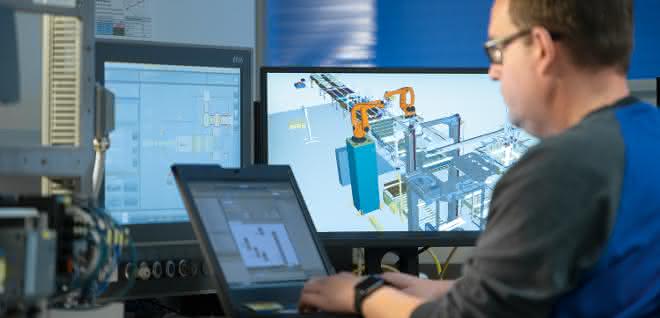
With the help of digital and smart technologies, KHS is networking and automating production processes step by step so that machines, products and complete systems can communicate and work together more efficiently. "The digital twin in particular enables the shift to virtual space by tracking and mapping all phases of a machine's life cycle. All production processes and products can be simulated virtually," says Stefan Diesner, Head of Product Center Palletizing. Alternative, optimized production processes appear on the computer.
One of the most important prerequisites for this is the consistency of engineering across the entire value chain in order to avoid so-called data breaks at the interfaces between the engineering disciplines of mechanics, electrics and software. Unlike is often the case today, work is not carried out sequentially, i.e. one after the other and separately. Ideally, all areas work in parallel on the implementation of a project and use a common data model - the basis for the digital twin, which virtually depicts a system down to the last detail and enables precise simulations.
The challenge of shared data
For a plant engineering company like KHS, which not only manufactures many different machines but also has its development and design departments spread across several locations, this is a major challenge. The KHS engineers at the Palletizing Product Center in Worms have been working on the virtual representation and simulation of machines and plant components for 13 years. The implementation of a simulation or virtual commissioning is particularly useful for logistics systems such as palletizers or conveyors.
"Our aim is to further reduce throughput times and lower error costs by expanding virtual commissioning," explains Diesner. To estimate the extent of the savings, it helps to remember the rule of ten. This states that the costs for error correction increase by a factor of ten the later an error is discovered in the process. So if an error can only be found and rectified during factory commissioning, the financial outlay is ten times higher than if the correction is made during the software design phase during virtual commissioning.
Reduce effort
Another aim of the current work is to reduce the effort required to implement virtual commissioning. A basic prerequisite for this is data consistency. "With virtual commissioning, we have the issue of data consistency in our own hands," explains Diesner. "All data is generated and stored in our plant, but so far in different systems. Further steps are required here before this data can be made available efficiently and bidirectionally in a tool for virtual engineering, including simulation. Once this has been achieved, we can quickly and efficiently commission machine designs configured or adapted to customer requirements on the screen."
Meanwhile, Worms is looking to the future: virtual commissioning is a first step towards the digitalization of systems in the beverage industry and a true digital twin. This will be able to do much more in the future. To achieve this, however, the digital twin must be supplied with additional information, such as data on conversions at KHS customers or operating data from production - an exciting challenge. as


You might also be interested in
Plagiarius 2024 negative prize
On January 26, 2024, the Plagiarius campaign awarded its dreaded "Plagiarius" negative prize for the 48th time to manufacturers and retailers of particularly brazen counterfeits and fakes.
 read more...
Ivalua honors winners of the Generative AI...
AI-supported "add-ons" for buyers within 48 hours
Ivalua, provider of cloud-based spend management solutions, announced the winners and innovations of the first Generative AI Innovation Cup. The competition took place in December 2023. It was open to all Ivalua partners and employees - more than...
read more...Efaflex celebrates 50 years of high-speed...
The emphasis is on "fast"
Since day one, Efaflex has wanted to use new technologies as early as possible and drive progress in the industry. This year, the family business is celebrating its 50th anniversary under the motto "Fast Forward".
read more...Security of supply even during power outages
In the winter of 2022, Germany was worried about energy shortages. The drugstore retailer dm did not paint any horror scenarios, but nevertheless saw the possibility of controlled, temporary, regional power cuts (brownouts).
read more...Safety technology in mechanical engineering
Modules with new functions
Euchner's product highlights at EMO 2023 include the communication-capable solenoid interlocks.
read more...Transforming the paper industry towards climate neutrality
Together with partners from industry and research, Voith is developing a project for the optimization of energy and material flows in paper production. The aim of the research project is to develop a digital framework that enables effective process...
read more...Up to 95 percent less flue gas thanks to direct extraction
The requirements for occupational safety measures and safety technology are also constantly increasing in welding technology. The Technical Rules for Hazardous Substances (TRGS) stipulate that welding fumes and harmful substances must be extracted...
read more...Competitive advantages with large machines
Whether 3D-printed components for machines and systems, prototypes or aids for design: additive manufacturing is almost indispensable for modern companies in mechanical and plant engineering and automation if they want to play in the premier league.
read more...Transport technology from the modular system
Many transport tasks can be realized with the help of linear technology. Pre-configured solutions are available to simplify the interaction between the linear unit, motor, gearbox and controller. This minimizes the effort required for research and...
read more...