

VUCA
Brave new VUCA world
The world is changing in many ways: New Work, digitalization, Industry 4.0, the mobility revolution, but also very serious challenges such as climate change and the Covid-19 pandemic. How can companies deal with the new circumstances?
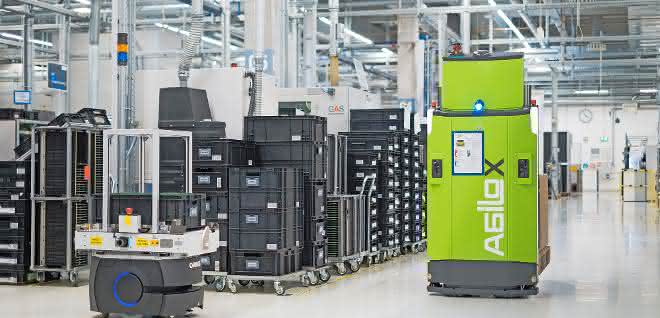
The acronym VUCA - volatility, uncertainty, complexity and ambiguity - has become more prevalent than ever in our everyday lives. The coronavirus pandemic is acting like a magnifying glass on companies' ability to navigate this VUCA world - including in the manufacturing industry. Demand has changed dramatically overnight and supply chains need to be reorganized in some cases. A large number of products are suddenly in demand in much higher quantities. What counts here is simply the ability to scale up your own supply chain accordingly.
We see every day that digitalization is making a significant contribution here. Retailers who also operate an online store have a decisive competitive advantage. And the online store that offers a reliable availability display for each individual item is once again one step ahead.
Flexibility takes center stage
Flexibility has been an issue in production for many years, driven by increasingly specific customer demand. As there are a number of suppliers in many markets that somehow differentiate themselves from one another
customized production has long since become the standard for some. In the old paradigm of assembly line production, optimizing resources was the recipe for success. In the early days of Industry 3.0, the principle was to achieve the highest possible level of automation and, in combination with this, the highest possible output of the same item, which reduced complexity costs.
There are many signs in factories today that flexibility is at the forefront. Many factories now rely on production islands instead of assembly line production, where highly trained skilled workers carry out all assembly, testing and packaging work on a product. Instead of a narrowly defined product range, many different products can be manufactured, as humans are still far superior to machines when it comes to mastering complexity. The material is supplied on demand by AGVs or by the employees themselves.
However, the dissolution of fixed links must remain transparent in order to enable the management of these loose structures. A broad database is the basis of a modern production management system that enables real-time control of production. This is where the difference between previous concepts and Industry 4.0 becomes clear. While automation is about the repeated execution of certain work steps in a consistent and defined quality, digitalization means reacting to undefined situations for which there is no standardized procedure. For example, when demand suddenly explodes and new ways of dealing with it have to be found.
Access to all information
From a communication architecture perspective, the role of the classic automation pyramid is changing here. The term "automation pyramid" refers to a hierarchy of field devices, controllers, visualization and control system. All of these components also exist in Industry 4.0, but their communication relationships are changing fundamentally. In the classic model, for example, all sensors were connected exclusively to controllers, which transmitted certain result values from the measured values to the next higher layer, for example the visualization level, based on the programmed processing logic. In digitalized production, however, direct communication relationships are required between all levels and segments. So instead of just sending a workpiece number recorded by an RFID reader to the control system, the data record must now also be transmitted to the factory IT system - for example, in order to develop possible optimizations in the production flow.
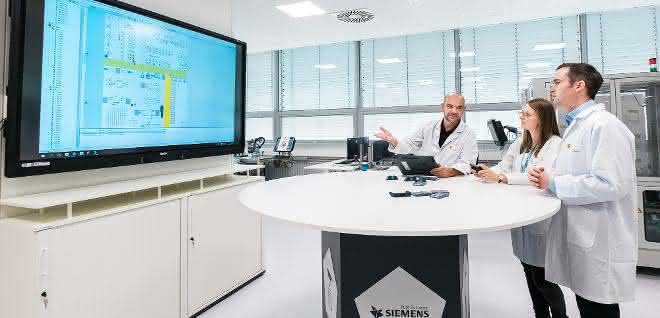
Digital connectivity as the basis for agile manufacturing
An architecture known as "digital connectivity" is developing for the communication model. From a communication perspective, all devices are combined to form a network, the Industrial Internet of Things (IIoT). However, there are a number of requirements to be met in these networks. The only obvious ones are the high bandwidth and number of nodes. However, even in such Industry 4.0 networks, availability, confidentiality and protection against attacks, fast configuration and support for functional safety must be ensured by suitable technologies, concepts and components. The existing communication patterns from the automation pyramid - typically low data volumes, cyclical transmission, primarily horizontal communication - are supplemented by data streaming, for example camera applications, and vertical communication from the sensor to the cloud.
However, the use of digital connectivity is not an end in itself, but rather serves to network all possible data sources and processing units - not in the sense of planned automation, but as an infrastructure for new ideas and concepts. An important response to VUCA is the application of agile principles in the factory. Instead of planning new concepts for a long time, a quick prototype is set up and tested in practice - for example, new software for route optimization in the factory. If successful, such an idea must then be able to be scaled up and rolled out quickly. However, this is only possible if an appropriate communication infrastructure is in place - because such prototyping must, of course, be possible without changes to the machines and automation.
Industry specialists support implementation
How can such an architecture be established? In addition to suitable technology suppliers, it is above all consulting and solution design that lead to success. Siemens offers a complete range of industrial connectivity products, from Simatic RFID and Industrial Wireless LAN to the Scalance X-500 backbone switch for the industrial data highway, which can be operated efficiently via the Sinec NMS network management system. In addition, there is a specific approach: over 600 partners from automation and IT work together with Siemens experts to develop the answer to the customer's specific requirements. Siemens contributes the technological expertise, while the partners can support the implementation as industry specialists. This ensures that the architecture developed can fully meet the requirements - today, and despite VUCA, also in the world of tomorrow. Markus Weinländer, Process Automation, Siemens / am


You might also be interested in
ESTIA aims to strengthen Europe's cloud
New tech alliance for EU sovereignty
Twelve companies, including Dassault Systèmes, are founding the European Sovereign Tech Industry Alliance (ESTIA). The initiative aims to strengthen Europe's technological independence and define requirements for sovereign cloud services. The start...
 read more...
Deutsche Telekom and Nvidia launch one of Europe's largest AI factories
With the Industrial AI Cloud in Munich, Deutsche Telekom and NVIDIA are creating one of the largest AI factories in Europe. Companies can train AI models, carry out simulations and access 10,000 GPUs.
read more...Leveraging data potential with AI and streaming
Huge data treasures are still lying dormant in many manufacturing companies. And yet it is high time that these treasures were unlocked. There is often a lack of resources and capacity to make data usable in real time. Streaming production data can...
read more...More awareness of noise
Dematic offers solutions that are tailored to different cloud environments and reduce environmental impact through reduced material consumption and improved energy efficiency.
read more...Generative AI in the automation environment
The mechanical engineering and automation industry is undergoing profound change. This transformation is being driven by more volatile global trade, geopolitical crises and increasing market pressure, which demands greater agility, technological...
read more...Rigid data structures have had their day
The traditional data center is no longer the center of data. A hybrid cloud storage approach enables manufacturing companies to both meet the current requirements of data-intensive processes and future-proof their infrastructure.
read more...Software as a service in three stages
CIM Database Cloud is a new out-of-the-box solution from Contact for end-to-end digital product development.
read more...How production can benefit from AI
Together with AI technology, IIoT networking makes it possible to better control machine parameters and optimize quality with predictive quality. Downtimes and set-up times can also be further minimized. Cloud platforms also make these technologies...
read more...More expertise for digital engineering
Altair, a computational science and artificial intelligence (AI) company, has acquired OmniV, a technology from Michigan, USA-based software company XLDyn.
read more...