

Compact plug connector
Smaller and faster
Due to increasing miniaturization, Conec has expanded its Industrial Ethernet range to include the M8x1 D coding standardized in IEC standard 61076-2-114. The connector enables transmission rates of up to 100 Mbit per second.
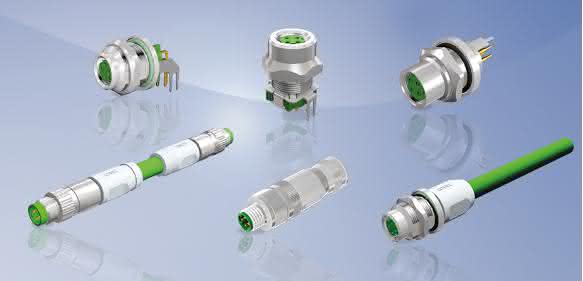
Industrial Ethernet data transmission has become indispensable in many areas of automation technology. Up to now, M12x1 D-coded connectors have mainly been used for monitoring and control units. Many manufacturers are now switching to connecting their sensors, cameras and other components via Industrial Ethernet.
Due to the increasing miniaturization of these devices, it was time to develop a suitable compact connector. For this reason, Conec has expanded its Industrial Ethernet range to include the M8x1 D-coding standardized in IEC standard 61076-2-114. The pin pattern is based on that of the M12x1 D-coding and prevents it from being hidden by all other M8x1 codings on the market. Industrial Ethernet transmission is realized with the M8x1 D-coding using a four-pin M8x1 connector in conjunction with 360-degree shielding and a standard Ethernet cable. Together with the contacts modified to a diameter of 0.8 millimeters, the connector enables transmission rates of up to 100 Mbit per second. (Fast Ethernet).
Continuous field cabling
Additional components were developed to enable continuous field cabling:
Shielded, axially overmoulded designs with a TPU cable (4x AWG22) suitable for drag chains are currently available in standard lengths. Connector-plug connection cables are used almost exclusively for the 100 Mbit device connection.
Axial coupling and plug variants are available for the field attachable connectors, optionally with screw connection (coupling) or crimp connection (coupling, plug).
An extensive product range is available for the device connection, so that there are many variable installation options for the user. Both axial and angled two-piece flanges as well as axial one-piece flanges are available. With the two-piece PCB flanges, the continuous shielding from the flange housing to the PCB is provided by a stamped sheet metal. Molded contact tabs provide the radial connection to the flange housing, while the connection to the PCB is made via latching elements with subsequent soldering. The materials used are suitable for wave soldering, whereby the flange housing and the insulating bodies can be processed separately and married later.
In the case of axial one-piece PCB flanges, the insulating body and the flange housing are firmly connected to each other. The flange is first mounted from the inside of the device before the PCB is fitted and finally soldered.
A special flange version is the version with a molded cable and an additional plug connector on side B, preferably M8x1 D-coded. This is ideal for wiring through a wall, for example through a control cabinet. as


You might also be interested in
Basler acquires 76% of Indian image processor
Basler, supplier of image processing components for computer vision solutions, has acquired 76% of the Indian sales partner Alpha TechSys Automation.
 read more...
Process monitoring and fault detection
Cameras ensure quality during laser melting
Powder bed-based laser melting (PBF-LB/M) opens up new possibilities in additive manufacturing. Modern camera systems provide crucial process data to further increase quality and efficiency.
read more...Vision Sensor is three times faster than its predecessor
The 'CS-62' vision sensor from di-soric is around three times faster than its predecessor, the 'CS-60'. In combination with the 'nVision-i 25.1' software, it enables image processing solutions that were previously reserved for smart cameras.
read more...Thermal imaging cameras for quality control
Automated thermal imaging cameras are often suitable for quality control applications where temperature plays a role. However, while there are various solutions on the market for slow processes, it is challenging to select a camera that reliably...
read more...Easy entry into industrial VGA thermography
Reliable temperature measurement is a prerequisite for the success of many industrial processes. Berlin-based manufacturer Optris presents the Xi 640 infrared camera, a new member of its Compact Line, which enables non-contact temperature...
read more...Powder bed-based laser melting optimized
Aconity3D has set itself the goal of optimizing the stability of the manufacturing method of powder bed-based laser melting and thereby promoting its use in a wide range of industries. By using high-speed industrial cameras from SVS-Vistek, the...
read more...INDUSTRIAL Production Products of the year...
2nd place, category handling, assembly and production logistics: SICK
safeVisionary2 is the first 3D time-of-flight camera with Performance Level c safety certification. It enables safe three-dimensional environmental detection and won 2nd place in the competition for Product of the Year 2024 in the handling, assembly...
read more...Nomination Products of the Year 2024
SICK: Camera systems safeVisionary2
safeVisionary2 is the first 3D time-of-flight camera with Performance Level c safety certification. It enables safe three-dimensional environmental detection and has been nominated in the 2024 Product of the Year competition in the handling,...
read more...AI vision brings additional opportunities
The seamless integration of AI into the consumer sector has helped to improve our quality of life and make interactions with technology more efficient. In industry, AI vision with machine learning opens up new possibilities that are not covered by...
read more...