

Know-how
Blockchain - secure, reliable and fast
Information and communication technology are key to the success of functioning, decentralized systems. They enable the optimization between flexibility, safety (security), environmental compatibility and economic efficiency of an industrial plant.
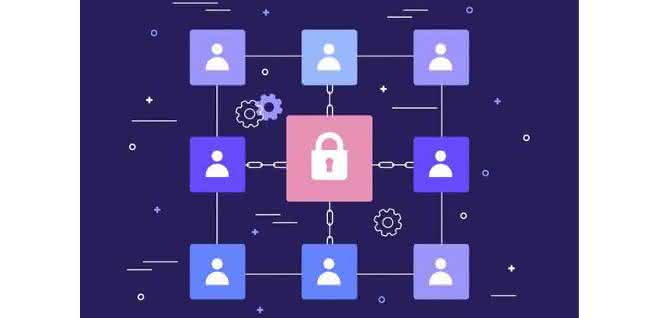
Blockchain or distributed ledger technology (DLT) is also a suitable instrument for this, and in many cases it is only Industry 4.0, improved logistics solutions or new business models that make it practical. As a combination of proven technologies and encryption mechanisms, it is largely tamper-proof. Without a traditional central memory, all recorded data is stored in several locations simultaneously. Their history can therefore be checked at any time. The best-known blockchain that triggered this technology hype is that of the cryptocurrency Bitcoin.
The table summarizes important advantages of the decentralized database, which is available licence-free as open source.
Distributed ledger technology DLT
A distributed ledger (general ledger, register, transaction ledger, stock ledger) manages and monitors various transactions in the decentralized database. All information stored on it can be permanently saved with a digital signature (cryptographic code). They form the basis of the blockchain. As a huge database, this data protocol is not stored on one server or at one company, but is distributed across many computers. There is no one who owns this journal. No authority, company or person is the authorized owner of this ledger. All participants have the same access rights and options.
DLT represents serious competition for edge and cloud computing, the antithesis of the central server, so to speak.
Function
The decentralized database of blockchains - launched in August 2011 as a form of DLT - is operated jointly by the participants of a network without central data storage and administration functionality (image). All their current and past transactions are documented in "chained" blocks. Additional transactions are added as new blocks. Before they are entered in the desired position, all computers in the network must confirm the connection to the new block. The blockchain thus corresponds to the central register of a huge accounting system that stores the data decentrally and redundantly on all blocks in the chain.
The network participants jointly manage this decentralized database without a controlling intermediary and initiate transactions. As senders and receivers, they can monitor all operations at any time, with both triggers and content remaining anonymous. A fraudster would have to exchange all data on all blocks of the chain, which seems impossible, especially for networks with ≥ 50 participants.
Information, data type can be very different, such as a financial/transaction, a contract, shares, purchase contracts, production data. A block always stores the history of each transaction in the form of a checksum of the previous block. In addition, the block always has the checksum of the entire chain.
Federal Blockchain Association
The German Blockchain Association was founded in Berlin in 2017 to promote blockchain and DLT, the interests of all companies involved (developers and users) and the associated social progress resulting from a digital economy.
Because "almost all transactions consist of changes in databases, and these changes have two fixed points - the database itself and the person initiating them - the following applies to a future-oriented policy, according to the Federal Association: firstly, the interfaces to databases must be securely digital, and secondly, digital identities must be sufficiently legally secure".
In order to develop Germany into a global player in this area, the association is developing problems, solutions and political recommendations for action. Initial results for future viability were presented in a position paper (https://bundesblock.de), which also helps newcomers. Considerations on education, energy, the healthcare system, financial supervision, legal issues (tax law, IT law, intellectual property), digital identities, data protection, research through to applications (Industry 4.0, real estate industry, etc.), standardization and certification, ethical issues and governance are summarized in a ready-to-use format.
Applications
A wide variety of applications that require transparency and traceability, even anonymity, are conceivable with great savings potential, as the following examples show:
- Administration (contracts, tax law, finance, stock trading, orders),
- supply and production chains,
- insurance,
- "intelligent" energy supply,
- voting systems
The best-known application is the virtual digital cryptocurrency Bitcoin (BTC), which was created in 2008. Other forms of DLT now exist (Dogecoin, Litecoin, Monero, Ethereum, Agrello, etc.).
Outlook
Blockchain makes information a public good. "Blockchains will be the driving force behind the next evolutionary step of the internet, the so-called decentralized network or the internet of contracts and transactions. Blockchain technology makes it possible to establish trust between unknown participants through special protocols based on cryptographic one-way functions," summarizes the Federal Association in the aforementioned position paper. The new generation of embedded server processors contributes to this goal(http://www.amd.com).
In order to be fully usable, its legal framework must be adapted for all necessary areas, including ethical aspects and supervision. Joachim Krause
Virtual currency Cryptographic, encrypted cash substitute for the purchase of goods and services on the Internet. It is created using a computerized process. Transactions and balances are managed decentrally(www.bafin.de)
Advantages of blockchain technology
Integrity of the data (impossibility of data modification),
Security (data security, replacement firewall and secure connections through cryptography)
Reliability (no central point of failure, high reliability)
Speed and storage (close to real time)
Application flexibility, autonomy of participants (trust-creating renunciation of mediation, central register)
Analysis and transparency (unchangeable and traceable system, visualization of partners)


You might also be interested in
ESTIA aims to strengthen Europe's cloud
New tech alliance for EU sovereignty
Twelve companies, including Dassault Systèmes, are founding the European Sovereign Tech Industry Alliance (ESTIA). The initiative aims to strengthen Europe's technological independence and define requirements for sovereign cloud services. The start...
 read more...
Deutsche Telekom and Nvidia launch one of Europe's largest AI factories
With the Industrial AI Cloud in Munich, Deutsche Telekom and NVIDIA are creating one of the largest AI factories in Europe. Companies can train AI models, carry out simulations and access 10,000 GPUs.
read more...Leveraging data potential with AI and streaming
Huge data treasures are still lying dormant in many manufacturing companies. And yet it is high time that these treasures were unlocked. There is often a lack of resources and capacity to make data usable in real time. Streaming production data can...
read more...More awareness of noise
Dematic offers solutions that are tailored to different cloud environments and reduce environmental impact through reduced material consumption and improved energy efficiency.
read more...Generative AI in the automation environment
The mechanical engineering and automation industry is undergoing profound change. This transformation is being driven by more volatile global trade, geopolitical crises and increasing market pressure, which demands greater agility, technological...
read more...Rigid data structures have had their day
The traditional data center is no longer the center of data. A hybrid cloud storage approach enables manufacturing companies to both meet the current requirements of data-intensive processes and future-proof their infrastructure.
read more...Software as a service in three stages
CIM Database Cloud is a new out-of-the-box solution from Contact for end-to-end digital product development.
read more...How production can benefit from AI
Together with AI technology, IIoT networking makes it possible to better control machine parameters and optimize quality with predictive quality. Downtimes and set-up times can also be further minimized. Cloud platforms also make these technologies...
read more...More expertise for digital engineering
Altair, a computational science and artificial intelligence (AI) company, has acquired OmniV, a technology from Michigan, USA-based software company XLDyn.
read more...