

Component labeling
Printing at 1000 degrees Celsius
Marking specialist Leibinger has developed a new pigment ink for industrial component marking with CIJ printers that enables a clear typeface even at temperatures of up to 1,000 degrees Celsius.
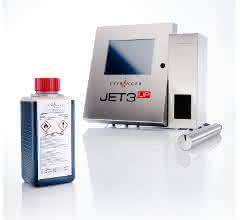
A stream of red lava is between 600 and 900 degrees Celsius. It can get even hotter in a kiln, for example, where ceramic components for industry are hardened - such as spark plugs, insulators and cutting tools. Temperatures of up to 1000 degrees Celsius prevail inside. The high temperatures are a challenge for the printing ink that manufacturers use to mark the components before firing. "There is a risk that the ink burns in the oven and dissolves into soot. The typeface, such as a model number, would no longer be legible and the component would be a reject," explains Christina Leibinger, Managing Director of Paul Leibinger.
The marking specialist from Tuttlingen has therefore launched a pigment ink on the market that enables clear lettering even at 1000 degrees Celsius. Not only ceramics can be printed on, but also metal and glass, for example in the manufacture of light bulbs and halogen lamps. The printer ink is available immediately and is compatible with the Leibinger CIJ printer JET3up PI.
The heat-resistant ink is a pigmented ink. Black color particles float in a medium - unlike a dye ink, where the dye is dissolved in the medium. It would evaporate immediately at extreme temperatures. However, after some research work, the experts were able to modify the particles and medium of the pigment ink in such a way that they can withstand heat of up to 1000 degrees Celsius without damage. They have also found a way to keep the particles in suspension for longer by chemically stabilizing them. This slows down the process known as sedimentation, in which the pigments are deposited on the bottom. The JET3up PI CIJ printer also has an integrated stirring mechanism that continuously mixes the ink.
120 million characters per tank filling
The heat-resistant pigment ink is designed for the JET3up PI - a printer that marks products without contact using continuous inkjet (CIJ) technology. An ink jet consisting of up to 96,000 electrically charged individual droplets per second shoots through a nozzle in the print head. During printing, a high-voltage field changes the trajectory of individual drops so that they land on the product surface as image dots. The remaining droplets fly into a catcher tube and are sucked back into the circulating hydraulic circuit for further use. The printing technology is fast enough to keep up with conveyor belt speeds of up to ten meters per second. It is also economical. The CIJ printer can print up to 120 million letters with one liter of ink. as


You might also be interested in
VDE study on electrical engineering
More retirements than graduations
According to a VDE analysis, more than 30,000 electrical engineers will retire by 2029 without enough graduates to replace them. This is due to falling student numbers and high drop-out rates.
 read more...
Giving lightweight construction a profile
Pultrusion: A process that forms fibers under tension
Pultrusion is developing from a niche process into a key process for lightweight construction and sustainable fiber composite structures. The Fraunhofer IWU shows applications from energy to mobility.
read more...Green hydrogen directly from the sun and water
A start-up project at the Karlsruhe Institute of Technology (KIT) aims to fundamentally simplify the production of green hydrogen: Mass-produced photoreactor panels are to be used to produce hydrogen directly from sunlight and water - without...
read more...Fraunhofer shows industrial future between AI, data and new materials
At Hannover Messe 2026, the Fraunhofer-Gesellschaft will be presenting solutions for a resilient industry: from AI and data rooms to hydrogen technologies and material and recycling innovations.
read more...The bottleneck is in the system
Is the transformation of the industry failing due to "German Angst"?
A recent ISF study examines what is slowing down change in German industrial companies. According to the results of the study, the causes of innovation bottlenecks often lie in internal structures and a lack of strategic orientation.
read more...Why a data-secure Germany needs joint implementation
Is 2026 a key year for a data-secure and networked Germany? Michael Fritz from the Fraunhofer Cluster CCIT explains why the coming year will be crucial for secure data spaces, common technical standards and Germany's digital future.
read more...Biodegradable label makes transportation conditions traceable
Researchers are developing a smart, compostable label that measures temperature and humidity and detects when limit values are exceeded.
read more...AI support for the circular economy
An assistance system developed at Fraunhofer IPK is used to identify, sort and assess the quality of disused household appliances, thus contributing to recycling and waste avoidance with the help of artificial intelligence.
read more...VDW Research Institute honors industrial projects
At EMO Hannover 2025, the VDW Research Institute will be honoring projects for increasing the efficiency of forging hammers and safe protective devices for grinding machines. Practical research for Industry 4.0, occupational safety and automation
read more...