

Laser marking
Marking for the circular economy and traceability
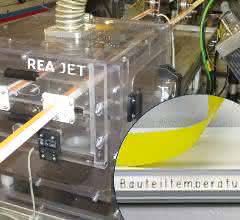
Product marking with individual barcodes or data matrix codes, incremented serial numbers in plain text and logos during the extrusion process have become indispensable in the extrusion of pipes or profiles. The switch to a sustainable circular economy and traceability are placing increasing demands on marking.
In the last two decades, digital, non-contact marking methods such as inkjet technology have covered the majority of marking tasks and largely replaced embossing with fixed tools. In addition to this, marking with laser technology has developed and today offers many opportunities for cost reduction. The decisive technical advantage of laser technology is the symbiosis of the captive nature of the marking with the flexibility of digital marking technology without the use of additives. The following article explains what is important with lasers.
The basics of laser marking
Even if, ideally, the operating unit for laser and inkjet are identical, the internal functions of the systems differ significantly. With inkjet, individual ink drops are applied to the product, which leads to the familiar definition of resolution in DPI, i.e. "dots per inch", whereas with laser, one and the same focused laser beam (focal point) is guided over the material in continuous lines.
The laser print file is therefore a vector graphic. However, this does not exclude the simulation of individual points using laser markers. The most common formats for vector files are .DXF and .SVG. When designing texts and graphics, you are not bound to specific line numbers, as the beam is deflected and focused using an electrically controlled mirror system, the so-called galvo scan head and a downstream plane field lens, and the desired typeface or logo is thus created on the material.
The focus point can be deflected in both the X and Y directions and can mark not only moving parts but also stationary parts. The actual material feed and possible speed fluctuations are usually also taken into account and compensated for, effectively avoiding distortions in the marking.
Laser systems are largely insensitive to typical deviations along the Z-axis (laser beam axis) due to positioning tolerances or curved product geometries and do not require active compensation if the focusing optics are designed correctly. Depending on the focal length of the focusing optics, the length (Rayleigh length) of a laser focus can range from a few tenths of a millimeter to a few millimeters.
What type of laser is used?
In the laser marking of extrusion products, a distinction is primarily made between two types of beam source and their fundamental wavelengths. As a rough guide, CO2 lasers can be used for engravings in organic materials and fiber lasers for color change markings on plastics and metals.
However, the boundary is not sharp: In addition to the different absorption characteristics of the respective wavelengths, depending on the material category, they also differ in terms of focusability. The fiber laser typically emits in the 1,040 to 1,070 nm range and is characterized by a wavelength ten times shorter than the CO2 laser spectrum (most commonly used spectrum 9.3 to 10.6 µm). This is accompanied by a minimum focus size of around one tenth of the CO2 laser focus diameter.
Laser safety
Industrial laser technology has been established for almost 60 years. During this time, expertise has been developed by both the system manufacturers and the relevant testing bodies and laid down in guidelines and standards according to which installations are approved. Essentially, these are DIN EN ISO 13849-1 for the general functional safety of systems, which already applies during product development, and DIN EN 60825-1, which relates to safety in connection with laser technology.
In line with this, the area around the laser process should be enclosed and possible scattered radiation outside the process chamber should be prevented. It is not necessary to enclose the entire device, but only the working area with the appropriate design of the material supply and removal in order to achieve the maximum protection of laser class 1.
In addition to the housing solution, established manufacturers also offer the appropriate extraction system with filter technology from a single source. But how can savings be made when the laser marker tends to require a higher initial investment?
Why invest in laser technology?
The most obvious savings potential is the elimination of consumables and the associated hidden costs for material planning, procurement, storage and personnel. Furthermore, there is no downtime for maintenance and cleaning with the associated service costs that are common with mechanical or application technologies. Both the deflection unit and the laser source are designed for several 10,000 operating hours. With laser marking devices, maintenance is therefore limited to occasional cleaning of the focusing lens or protective glass. With good accessibility, this is a matter of seconds.
As an extraction system with corresponding filter technology is usually used, filter changes should also be included in the calculation for the sake of fairness. Due to the low vaporized material volume per marking, the change intervals are long, usually in the weekly or monthly range.
Double extruders offer an elegant way of scoring points on the investment side. If two profiles are positioned close to each other, the large processing field of a single laser can be designed to mark both profiles alternately. As I said: with just one laser marker. This means that the initial investment is similar, but the consumables for two conventional printers are saved.
In addition to the reduction in production costs, further customer benefits can be realized thanks to the properties of laser marking. Captive and abrasion-resistant and resistant to solvents within the limits of the resistance of the plastic itself: These are the outstanding properties with which the end product is enhanced, thus reliably guaranteeing traceability from initial placement on the market to recycling as well as protection against plagiarism. In addition, products for the processing trade also have the option of very precise length measurements. The high graphic resolution of the laser systems makes it possible to transfer complex logos to the product in high quality.
In addition, the laser marking, whether color change or engraving, is not applied to the extrusion profile but into it. No pre- or post-treatment of the marking surface is required. Laser marking is therefore a single-stage process that is statistically less prone to errors than multi-stage processes with pre- and post-processing. The laser process offers the advantage that no additives are required and therefore do not need to be moved. Laser markers are also insensitive to electrostatic charging of the extrusion profiles. Distorted markings due to electric fields are therefore also ruled out.
Before purchasing a marking solution, samples are always provided. However, the user is not tied to a specific number of lines even if the application is changed at a later date, be it a product change or a modified graphic. The optimum parameterization can be determined quickly and usually purely via entries in the operating software, thus increasing flexibility on the line.
Although industrial laser technology has been around for almost 60 years, there are still reservations in the field. Those who embrace the technology are provided with a flexible, reliable and virtually maintenance-free production tool. The main advantages of laser marking are captive product markings with maximum flexibility in terms of design, a high degree of protection against counterfeiting, all while reducing material logistics and costs. This means that sustainability can not only be practiced in the product creation process, but also implemented in the recycling process and increase your own competitiveness.


You might also be interested in
Protection against electrostatic discharge
StoFloor ESD KU 614 from StoCretec: dissipative flooring with the latest technology meets all ESD standards, is economical, extremely durable, mechanically and chemically resistant. The surface can be adjusted to be slip-resistant. The system is...
 read more...
Cables and wires from Helukabel
Food cultivation on a new level
Vertical farming - cultivation in multi-storey greenhouses - is considered one of the most exciting trends in food production. One of the pioneers in this field is the Romanian start-up Ultragreens. The company relies on solutions from Helukabel to...
read more...Further training for specialists to become security experts
With the "CESA - Certified Expert for Security in Automation" qualification, automation expert Pilz offers a two-day expert course designed to provide participants with compact security knowledge in line with the latest standards.
read more...Meaningful data on the service life of the seal
Seals prevent substances from penetrating or entering technical components. The intelligent seals from Freudenberg Sealing Technologies can significantly expand this core task in the future: the seal itself is also a sensor and becomes a "smart...
read more...Online stud configurator according to drawing
For standard bolts, with head, thread or hole
For standard bolts, with head, thread, bore or as a version with recess, mbo Osswald configurators map the standard specifications, are very easy to use, take a lot of work off the user's hands and save a lot of time.
read more...Safe palletizing with the Cobot
Verla-Pharm's medicinal products and food supplements have been available for decades. Ever-increasing throughputs result in ever-increasing logistics costs, whereby optimum utilization of the available production space is necessary.
read more...The tiger among processors
Since the move towards the Industrial Internet of Things (IIoT) and Industry 4.0 has picked up speed, processor boards and modules must be able to process exponentially growing amounts of data.
read more...VDWF publishes "Sustainability Compendium"
Nowadays, nobody can avoid "sustainability": In addition to a far-reaching presence in the media, it is also becoming increasingly important for companies in the tool and mold making industry to develop and implement appropriate concepts.
read more...More transparency and synergies with QM software
Weber, manufacturer of wood and metal sanding machines and extruders, has reorganized its quality management with ConSense IMS Professional. The software solution enables transparent documentation and more efficient processes.
read more...