

Ceramic marking with laser
Precise engraving to go
Ceramic marking with laser. Mobil-Mark has developed a laser especially for engraving on ceramics. It is particularly dust-resistant, can switch quickly between different jobs and can be used on robots.
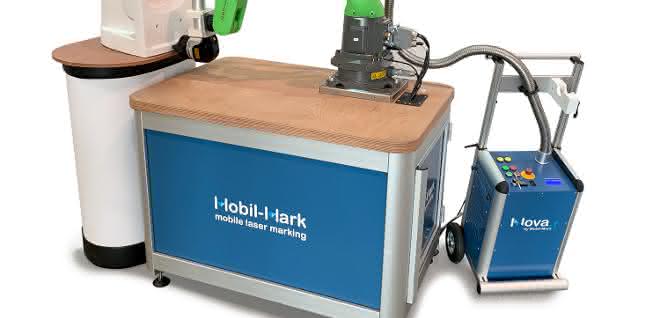
Just a few micrometres can make the difference between a successful engraving on ceramic and not: laser engraving of ceramic products requires care and precision - even under harsh production conditions with a high level of dust. With the Nova-f, Mobil-Mark has therefore developed a laser that is highly dust-resistant and durable. Like its brother Quasar, the ceramic laser can be used immediately and without safety goggles thanks to its patented safety certificate in accordance with laser protection class 1.
The Nova-f uses a deposition process to mark products in the ceramics industry: the spectrum ranges from workpieces from the sanitary ceramics industry to parts for medical technology and high-quality tableware. Mobil-Mark has developed a laser that is especially suitable for marking spray paints and foils in the ceramics industry. Its laser diode service life is 100,000 hours - making it ideal for long-term use, according to the manufacturer. Furthermore, at 520 x 430 millimetres, it does not require a lot of space and can be easily integrated into any production environment. To operate the laser, all you need is a 230-volt power socket and laser engraving can begin.
Accessories and additional functions
Switching back and forth between several jobs without spending a lot of time is easy with the Nova-f: an unlimited number of marking jobs can be saved directly on the PC in the laser. A job selector switch on the device makes it easy to switch between 15 marking jobs. In addition, the marking software in the integrated computer can be accessed directly via the remote desktop function or a touchscreen. By using different lenses, a marking field size of up to 100 x 80 millimetres can be achieved. The laser also offers all the necessary connection options for integration into a production environment and external control. Use on a robot is therefore also possible. as


You might also be interested in
Schweißen und Markieren an einer Insel
Ein Eberdinger Unternehmen setzt zur Kennzeichnung von LKW-Achswellen, die im Reibschweißverfahren hergestellt werden, ein Lasersystem von Mobil-Mark ein. Nun können in einer Schicht bis zu 500 Teile geschweißt und im gleichen Arbeitsschritt...
 read more...
Plagiarius 2024 negative prize
On January 26, 2024, the Plagiarius campaign awarded its dreaded "Plagiarius" negative prize for the 48th time to manufacturers and retailers of particularly brazen counterfeits and fakes.
read more...Ivalua honors winners of the Generative AI...
AI-supported "add-ons" for buyers within 48 hours
Ivalua, provider of cloud-based spend management solutions, announced the winners and innovations of the first Generative AI Innovation Cup. The competition took place in December 2023. It was open to all Ivalua partners and employees - more than...
read more...Efaflex celebrates 50 years of high-speed...
The emphasis is on "fast"
Since day one, Efaflex has wanted to use new technologies as early as possible and drive progress in the industry. This year, the family business is celebrating its 50th anniversary under the motto "Fast Forward".
read more...Security of supply even during power outages
In the winter of 2022, Germany was worried about energy shortages. The drugstore retailer dm did not paint any horror scenarios, but nevertheless saw the possibility of controlled, temporary, regional power cuts (brownouts).
read more...Safety technology in mechanical engineering
Modules with new functions
Euchner's product highlights at EMO 2023 include the communication-capable solenoid interlocks.
read more...Transforming the paper industry towards climate neutrality
Together with partners from industry and research, Voith is developing a project for the optimization of energy and material flows in paper production. The aim of the research project is to develop a digital framework that enables effective process...
read more...Up to 95 percent less flue gas thanks to direct extraction
The requirements for occupational safety measures and safety technology are also constantly increasing in welding technology. The Technical Rules for Hazardous Substances (TRGS) stipulate that welding fumes and harmful substances must be extracted...
read more...Competitive advantages with large machines
Whether 3D-printed components for machines and systems, prototypes or aids for design: additive manufacturing is almost indispensable for modern companies in mechanical and plant engineering and automation if they want to play in the premier league.
read more...