

Energy data management
Zumtobel introduces Zenon from Copa-Data
What actually makes a production plant a smart factory? Certainly the ability to integrate different plants and systems, but also networked devices and technologies that can automatically store and process data. Energy management is a key component of this. After all, the factory of tomorrow will produce in a sustainable, energy-efficient and environmentally friendly way, as is the case with lighting specialist Zumtobel, for example.
Many companies do not even know how much energy their various production processes consume. To find out, more and more companies are turning to automated energy data management. The advantages are obvious: in addition to environmentally conscious production, meaningful energy data management also has a financial impact. Saving energy saves costs - and reductions are also possible due to government regulations. In Germany, for example, an energy data management system (EDMS) in accordance with ISO 50001 brings a discount on energy tax. This means that the topic of energy management is of great interest in all industrial sectors - especially for energy-intensive production facilities. However, companies should also look at their own consumption independently of savings and subsidy programs: Energy costs are often an underestimated factor when it comes to the profitability of a plant.
Exploiting existing potential
Companies often have a lot of information about their energy consumption, but are unable to link it to production. If this is the case, existing potentials are not exploited: possible synergies and energy leaks may remain undetected. For informative reporting and a good overview of the efficiency of a plant, it makes sense to collect data on the consumption of electricity, gas, heat and water. In addition, other key figures such as price data, tariffs or quotas and information on the system statuses such as temperatures, flow rates, motor, fan and valve status should be documented. To guarantee a smooth process, the integration of a well-networked EDMS is recommended. The aim of these systems is always to optimize the energy efficiency of production without restricting productivity or availability.
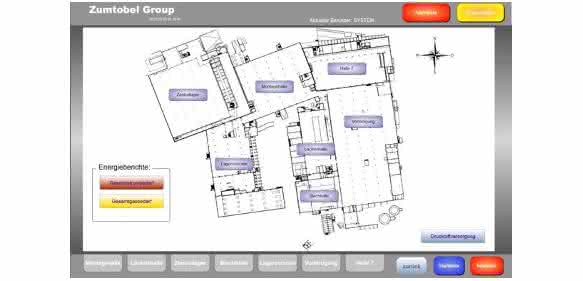
When a company decides to introduce an energy management system, it often faces a variety of challenges. The first major hurdle that needs to be overcome: Bundling all the data from the various sources centrally in order to be able to process it further. The software solution must therefore be compatible with the existing systems to ensure seamless documentation. Intuitive visualization is important in order to draw conclusions from the data quickly and easily: the clear presentation of key figures - in real time and historically - is crucial to the success of the project. After all, all employees should be able to find their way around the EDMS quickly and easily.
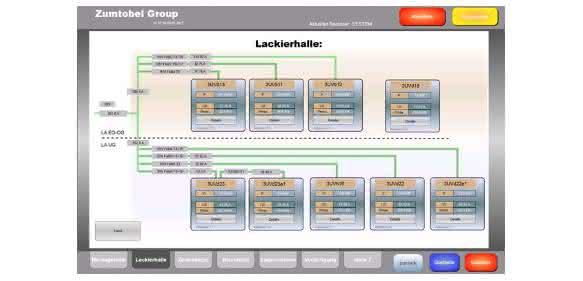
The Zumtobel Group faced precisely this challenge in 2014. The company is a leading international provider of innovative lighting solutions for professional indoor and outdoor applications in offices, hotels, bathrooms, cultural centers as well as in industrial and technical environments. In order to improve energy efficiency in its production, the company opted for the Zenon IT solution from automation specialist Copa-Data. This is HMI/SCADA software that can be integrated into the existing infrastructure as an EDMS. Zumtobel had already looked at its energy efficiency before implementing the new EDMS: The company had installed electricity meters throughout the facility to make it easier to calculate power consumption. The employees only read the data from the devices they needed for the calculation. The electricity meters were interconnected. "We had a huge system of connections within the building, like a network," explains Barbara Mihatsch, project manager at Zumtobel. "The primary task was to collect the data. An employee walked through the building and read the energy consumption on each device. This was noted down and later transferred to an Excel spreadsheet by another employee. The collected data was then checked every month."
Automated data documentation
The problem: the electricity meters could not store the measured values. The data was therefore documented manually and could never be 100 percent accurate. Real-time evaluation was out of the question with this system. Zenon was therefore integrated into the existing system as an EDMS. Employees can now create individual reports easily and without errors. Different types of data are clearly displayed, and the system creates the corresponding reports automatically at the touch of a button. The new EDMS can even access SAP data. "Now, with Zenon, the data is 100 percent accurate. We save a lot of time as we no longer have to carry out manual calculations," says Barbara Mihatsch. And the new solution has another advantage: following successful integration into the building management system, production is certified in accordance with the international standard DIN EN ISO 50001. ee


You might also be interested in
Motors, gearboxes and encoders: Faulhaber expands Ø 16 mm portfolio
Faulhaber is expanding its portfolio with new DC motors from the SXR and GXR family, a 16 mm planetary gearbox and the IEX3 magnetic encoder for compact drive solutions.
 read more...
New drive solutions for industrial automation and robotics
Faulhaber presents drive solutions with the new GXR and SXR motor family, which offer high efficiency and flexibility in combination with powerful gearboxes and encoders. These optimized components open up new possibilities for applications in...
read more...Marco Altherr becomes new Chief Financial Officer
The Supervisory Board of Ziehl-Abegg has appointed Marco Altherr as the company's new Chief Financial Officer (CFO). Altherr will take up his post in May 2025.
read more...Hydrogen storage in metal hydride
With its focus on storage systems for green hydrogen in solid form (metal hydride), GKN Hydrogen presents itself as a pioneer in safety and efficiency for the industry. GKN Hydrogen offers safe storage systems for green hydrogen and focuses on two...
read more...INDUSTRIAL Production Products of the year...
2nd place, Robotics category: EGS Automation
The SUMO automation systems from EGS Automation - economical standard solutions for automating a wide range of processes in plastics and metalworking - took second place in the robotics category in the competition for Product of the Year 2024.
read more...More productivity with Drive Intelligence
The trends in automation are productivity, sustainability and connectivity. Baumüller is launching new products on the market that address these trends, including new tools for smart energy monitoring, condition monitoring in the drive and new...
read more...Intelligence in Motion
At SPS, Koco Motion will be showcasing its expertise in customized drive solutions based on DC and BLDC motors, stepper motors, servo motors, linear drives and controllers.
read more...Nomination Products of the Year 2024
EGS Automation: SUMO automation systems
The SUMO automation systems from EGS Automation, economical standard solutions for automating a wide range of processes in plastics and metalworking, have been nominated in the Robotics category in the competition for Product of the Year 2024.
read more...Transport technology from the modular system
Many transport tasks can be realized with the help of linear technology. Pre-configured solutions are available to simplify the interaction between the linear unit, motor, gearbox and controller. This minimizes the effort required for research and...
read more...