

Vacuum pump unit
Operational safety for the automotive industry
When working with heavy, valuable objects such as metal or glass in automotive production, operator and product safety play an important role in all automation efforts. With the PiSafe program, Piab enables safe workflows while maintaining flexibility, speed and performance.
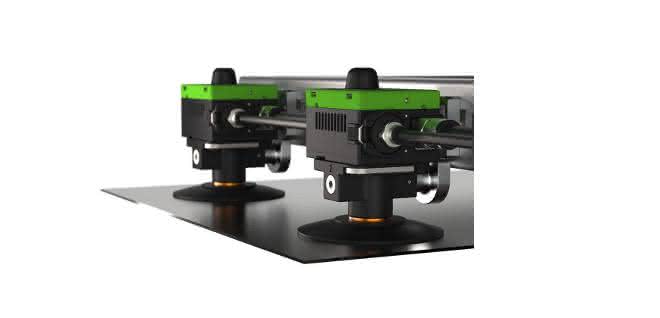
Operational safety plays a particularly important role in the automotive industry. Taking these requirements into account led to the development of the PiSafe range, consisting of decentralized vacuum pump units with integrated non-return valves as well as separate non-return valves for use in central vacuum generation systems. The operator must be able to enter the robot cell without being endangered by falling parts, particularly when troubleshooting, maintaining the system or in the event of a compressed air shutdown.
Integration in end-of-arm tools
The PiSafe vacuum pump unit can be integrated into the end-of-arm tool (EOAT) as a decentralized vacuum generator. With the integrated vacuum safety non-return valve, it offers more control in the event of a leak in one of the suction cups of the EOAT. In this case, the part to be handled, for example a car windshield, will continue to be held by all the other suction cups of the EOAT, while in the event of a power failure, the vacuum in such a sealed application will remain, allowing the EOAT to hold the part despite the loss of compressed air.
Equipped with a vacuum ejector based on Piab's energy-efficient coax technology, the PiSafe vacuum unit is available with similar energy-saving features to the flagship PiCompact ejector. It automatically switches off the compressed air supply when a sufficient vacuum level is reached and restarts it automatically when the vacuum level drops. The function is fully pneumatic and can save up to 98 percent of compressed air consumption in a lifting cycle. In addition, the use of coax ejectors makes it possible to achieve a consistently high vacuum performance even with fluctuating compressed air conditions.
Reduced installation costs
An important advantage of the PiSafe decentralized vacuum ejector is the reduction in installation costs, as no separate valve stations are required. Expensive bypass solutions or additional modules such as mechanical or vacuum tank safety devices, which previously prevented the use of decentralized vacuum generation solutions in automotive production, are also not required. Although the conventional blow-off check valve is safe as a release function, it uses compressed air during operation, while the conventional atmospheric quick release in the normally open version (AQR-NO) does not require air during operation, but is not safe in the event of a compressed air supply failure.
The new release function Atmospheric Quick Release-Normally Closed (AQR-NC), is both safe and energy efficient. It is safe because it is closed and requires separate control air for activation, but uses only a minimal amount of air for each cycle. It only requires the amount of air needed to control the activating valve and the PiSafe device itself. By using the atmosphere as a source for equalizing the vacuum pressure in the device, a quick release is made possible.
Due to the very low control air pressure, several units in larger systems can also be released simultaneously in a controlled manner and consume very little additional air. This prevents the compressed air pressure of the entire system from dropping, which also feeds other applications in the plant. The PiSafe pump unit is particularly suitable for applications where a high degree of safety is important, even in the event of a power or compressed air failure, when a heavy part is held by the suction cups of the EOAT. At the same time, compressed air consumption is reduced even further.
Compressed air consumption values
As an example of the different compressed air consumption values of the three triggering functions, consider an installation on a robot with six PiSafe units. With the blow-off function, each unit would consume approximately 160 Nl/m at a pressure level of 6 bar. When releasing a product, the operator would need to run air for at least one second, which is short but sufficient in a correctly designed system.
In each cycle, this would consume 16 liters of air plus the air in the 4 meter long hoses from the activation valve to the PiSafe units, which is about 1 liter. The same system with the new AQR-NC would only consume the air in the hoses and the control air to open and close the valve, which is 1 liter. The same system with an AQR-NO release system activated internally in each PiSafe unit would consume virtually no air.
For example, the newly developed AQR-NC release function available with PiSafe consumes almost as little air as the AQR-NO release function, but offers a high level of safety in the event of power or compressed air failures in the system when holding parts.
Modular design
Thanks to the quick-release fastener and the modular design, the PiSafe pump can be replaced quickly and easily at any position in the EOAT without the need for additional tools. As the frame remains in position, there is no need to realign the EOAT when replacing pump units during maintenance, which greatly reduces machine downtime and keeps production running.
When developing the PiSafe pump unit, the focus was on using lightweight materials to keep the weight of the EOAT as low as possible. This reduces wear and tear on robot motors and drives and allows for greater speed and acceleration of the process or alternatively the use of a smaller, more cost-effective robot. Coupled with the small size and a common housing, regardless of which of the three different triggering options is selected, the PiSafe unit is a suitable choice where space is limited and a maintenance-friendly device.
For centralized systems that use one vacuum pump for all suction cups on an EOAT, a separate vacuum safety valve has been developed to hold the grippers on heavy parts even in the event of a vacuum leak in a pump. In the event of a leak in a suction cup, atmospheric air flows through this leaking suction cup and prevents the EOAT from lifting the part, preventing it from falling during the process.


You might also be interested in
Atlas Copco takes over long-standing sales partner
Atlas Copco has taken over Heide-Pumpen. The specialist for mobile pumps has been working closely with Atlas Copco in sales and service for a long time, especially for surface pumps for construction site dewatering and wastewater detour or in the...
 read more...
Lutz Pumpen at the Achema 2024
New mobile drum pump with battery drive
The new B3 Battery from Lutz Pumpen promises mobile and safe working with aggressive liquids without having to compromise on pumping performance compared to wired versions. The battery-powered drum pump will be on display at Achema, the world's...
read more...Maintenance and Pumps&Valves in February
Final preparations are underway in Dortmund: On February 21, 2024, maintenance will start as the leading trade fair for industrial maintenance and with it Pumps&Valves as the trade fair for industrial pumps, fittings and valves.
read more...Liquid separator keeps pumps dry
Vacuum clamping minimizes distortion and enables five sides to be machined in one clamping operation. The use of cooling lubricants poses a challenge: If they get into the vacuum generator, they can cause serious damage.
read more...Spring clutches for construction machinery
Spring clutches from Torsion Control Products (TCP) are ideal for use in construction machinery where modern diesel engines are used.
read more...Protection against cooling lubricant
Liquid separator from Schmalz keeps pumps dry
Anyone clamping with a vacuum during CNC machining must protect the pump from cooling lubricant. The NLS liquid separator from Schmalz separates the cooling lubricant and returns it to the running process - without interrupting the vacuum.
read more...Which clutch for what?
Mechanical engineering and its applications are multifaceted. Every application is special and requires a perfect machine design. Individual components in the system must also be optimally designed.
read more...Energy efficiency needs electrical engineering and IT
The energy crisis makes one thing clear: it is not enough to simply screw a photovoltaic system onto your roof or purchase green electricity. Industry is faced with the challenge of reducing consumption in order to counter the rise in energy prices,...
read more...Solutions for a networked and climate-neutral industry
At the world's leading trade fair for industry, around 4,000 companies from the mechanical engineering, electrical and digital industries as well as the energy sector will be showcasing solutions for the production and energy supply of the future.
read more...