

Pneumatic gripper
Simply well gripped
In final assembly, cars are given their cockpit, seats and other parts. They are fitted into the painted bodywork - often with the help of electric or pneumatic grippers that transport them and hold them in place until they are attached.
When man and machine come so close together, safety is the top priority. Smooth functionality and easy maintenance are also required. A purely pneumatic solution is suitable for safe final assembly.
The production of cars is very tightly timed: new cars have to roll off the assembly line every minute, the faster the better. In final assembly, the painted and prepared car bodies therefore never come to rest. The complete interior fittings with cockpits and seats as well as drive components such as axle carriers are inserted into the suspended bodies as they slowly move along.
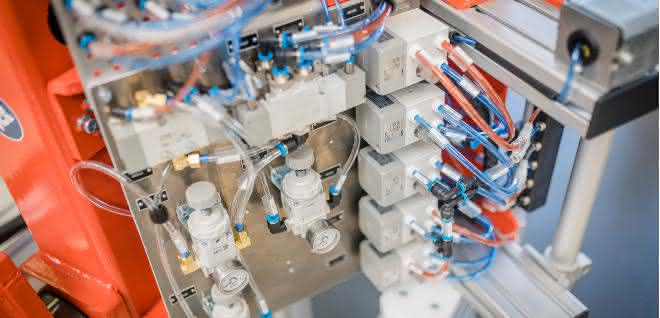
The assembly experts bring the components to the body with grippers that transport the parts and place them precisely so that they can be firmly installed. A complete cockpit has completely different dimensions to an axle carrier - which is why the grippers used must be able to flexibly grip different geometries. Safety is required throughout the entire application, because where people and electric or pneumatic grippers work so closely together, protection against accidents is a decisive factor. NMH has therefore developed a purely pneumatic solution consisting of valves and indicators from SMC for handling applications.
NMH has been focusing on mechanical engineering for almost 40 years. Today, the company based in Hohentengen, Baden-Württemberg, manufactures complex measuring, testing and assembly systems for customers from the automotive industry, for example. NMH offers the entire spectrum of development itself - from concept to production and commissioning. In addition to the development of special machines, the team of around 120 employees is also involved in the individual and series production of metal parts and plastic injection-molded articles.
Full control over the device
Today, many work steps in the automotive industry are automated and carried out by highly specialized robots. From transporting the various body parts to welding and painting, humans are often only involved in quality control. Monotonous work that nevertheless has to be carried out repeatedly with high precision and quality, sometimes thousands of times a day, can easily be performed by appropriately designed machines, while human experts devote themselves to more skilled tasks. For example, those that require flexibility and sensitivity - such as final assembly. "These assembly steps require smooth and intuitive handling solutions," explains Christan Bulander, Managing Director of NMH. "They must be able to pick up the individual components, transport them into the body and position them there." This process can be carried out completely automatically or guided by the worker - the handling technology is crucial, as it must be able to grip and position even heavy and unwieldy parts securely.
The handling devices are confronted with various component geometries - a cockpit module and a seat not only have different materials, but also completely different grip points. At the same time, the close contact between man and machine harbors risks. Heavy components have to be gripped force-fit and partially deflected - this means a potential risk of crushing. Electric or pneumatic drives are often used to actuate the grippers.
The different clamping sequences required for a reliable process can be realized very well by electric drives. However, electrically operated solutions are often complex and therefore more cost-intensive. This is why NMH, supported by SMC, has purely pneumatic handling devices for the automotive industry in its portfolio. Bulander: "The advantages of pneumatic systems are obvious - they are much simpler in design and can therefore be maintained quickly and efficiently."
SMC has designed a pneumatic package with perfectly coordinated components for the handling devices from NMH. "The focus was on safety and process quality," says Ingo Aberer, Sales Manager at SMC. "The VR51 series two-hand control valves therefore form the heart of our solution for NMH." Their output is only activated by synchronous, two-handed operation. The gripping and handling sequences themselves are realized by VR1211F and VR1210F series and several VM100 valves.
Grip securely and transport reliably
To ensure a safe process in final automotive assembly, operators must always have full control over their handling equipment. Aberer: "The VR51 two-hand control valves ensure that no fingers or hands are near the grippers when they are gripping. The control valve only releases the compressed air required for a firm grip to the respective pneumatic cylinders when two buttons are pressed within 0.5 seconds. The buttons are mounted in such a way that they cannot be operated with one hand. This keeps hands at a safe distance from the gripper and minimizes the risk of crushing." In addition, thanks to the VR3100-01 series pneumatic indicator, the assembly experts in the automotive plant always know whether pressure is currently being applied to the system and whether the gripping process has been carried out correctly - the indicator then lights up clearly.
The two switches are realized by SMC with mechanical 2/2 and 2/3 directional control valves from the VM100 series. With their compact design and connection options from the side or from below, they are particularly flexible in their construction. They also support a wide range of switches, buttons and knobs - from rotary and key switches to various knob variants. SMC supplies several valve solutions for the sometimes complex gripping and clamping sequences that the handling devices have to perform during final assembly. "The VR1211F series AND valves only switch pressure through to the output when both inputs are pressurized - i.e. when the operator has pressed both buttons simultaneously," explains Aberer. "If the input pressures are different, the lower pressure is always switched through." This is how the valves secure the gripping process. The Oder valves of the VR1210F series, on the other hand, always switch the input with the higher pressure through to the output and thus control the different clamping sequences for each auto component.
The purely pneumatic design of the handling devices has many advantages. Aberer: "The devices are flexible enough to move different car components in final assembly - and they are particularly safe. According to the motto 'keep it simple', all installed solutions are not only very compact, but also quick and easy to maintain or replace."
System for high demands
A safe system that also meets the highest quality and performance requirements - that is the challenge that NMH took on together with SMC. "SMC was a flexible partner in the design and implementation of our handling devices," says Christian Bulander. "With the support of the pneumatics experts, we were able to convincingly implement this time-critical project for our customer and score points for reliability."
Alexander Schur, Sales Engineer Key Accounts at SMC Germany


You might also be interested in
Further simplify assembly processes
In addition to the proven racks with a length of one meter, Wittenstein alpha now offers optional two-meter racks for linear systems. They are particularly suitable for use in short axes, for example, in order to simplify assembly even further.
 read more...
Hiwin manufactures its own shaft gearboxes
Have you ever waited several months for an urgently needed corrugated gearbox? Hiwin has too. That's why the Offenburg-based drive specialist has decided to produce its own space and weight-saving reduction talent.
read more...Human-robot interaction at the trade fair
Sumitomo Drive Technologies is presenting its drive solutions for automation and robotics at Automatica 2023 together with the Lafert Group. The company will be showcasing two different applications of the Tuaka drive system for robot applications...
read more...Partial automation with robots
At Automatica, Promess will be showcasing its modular individual workstations and how these can be partially automated with robot support. The servo press manufacturer will also be providing information about the latest features of its Revolution X...
read more...A new benchmark for collaborative robots
At this year's Automatica, Denso Robotics will be showcasing its innovations in the field of robotics. The collaborative Cobotta Pro product family will be the focus of the presentations. Visitors to the trade fair can see all variants in various...
read more...Clamping system for a new milling machine
Investments in machinery often lead to further purchases - as is the case at Joma-Maschinenbau, whose modern production facility has recently been supplemented by a 5-axis milling machine.
read more...Schunk wants to simplify processes in automated production
The declared aim of automation specialist Schunk is to make its customers' processes comprehensible, simple and efficient. Data transparency plays an important role in this. It enables reliable processes and provides the basis for resource-saving...
read more...Festo and Hahn Automation develop battery tester for greater safety
The success and reputation of electric vehicle manufacturers depend on the safe and flawless functioning of batteries. Hahn Automation has therefore developed a battery tester that performs a fully automated 100% test of mobile energy storage...
read more...SPN Schwaben Präzision presents gearbox solutions for automation and industrial robotics
Short cycle times, robust technology, wear-free surfaces and compact designs have always been relevant for automation and robotics solutions. This year's Automatica trend topics include "Sustainable production" and "Digitalization and AI". SPN aims...
read more...