

Metal bellows couplings
R+W equips agricultural commercial vehicles
Metal bellows couplings were designed, among other things, to compensate for offsets from the input to the output side in the radial, angular and axial directions and, despite all this, to ensure a torsionally rigid connection in the long term. Originally developed in the field of mechanical engineering, metal bellows couplings are now conquering all industries in which the input and output sides require a torsionally rigid connection. The metal bellows couplings from the manufacturer R+W are also used in the agricultural sector.
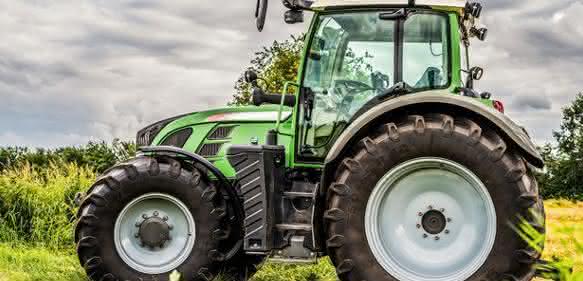
Agricultural businesses have to hold their own on the market in the face of falling prices or strongly fluctuating prices, and ultimately costs have to be reduced and efficiency increased. Technology has long since found its way into agriculture. If you look at a modern cab on a tractor today, it has more in common with the cockpit of an airliner. Fuel, with its fluctuating prices, is another factor that needs to be taken into account. In addition, there are increasingly powerful tractors that now have to be all-rounders for different tasks in the most diverse areas with the most diverse surfaces. The special metal bellows coupling from R+W is used in such applications. Modern tractors have a tire pressure monitoring system that adapts the tire pressure to the ground. The tires are supplied with air at the push of a button via a compressor and adapt optimally to the ground conditions. In our case, the compressor is driven by a hydraulic motor connected via a welded steel BK2 Series 30 bellows coupling. The coupling itself, with the stainless steel metal bellows at its heart, compensates for any misalignment of the input and output shafts during assembly, transmits the torque and reliably withstands a wide range of external environmental influences. The hubs of the clutch can be made of aluminum, steel or stainless steel. An additional possible coating of the hubs, for example by nickel plating, nitrocarburizing, anodizing or oxidizing, offers the best possible surface protection to maintain the service life.
Less fuel - lower costs
Lower fuel consumption is achieved through optimum tire pressure. This is the key to energy efficiency in everyday tractor operation. Reducing slippage on the road and in the field, less rolling resistance overall and therefore lower fuel consumption play a key role for tractor operators. The correct tire pressure is not only important on the land to be worked, but also on the road. What is good for working the land can be dangerous on the road. The compressor ensures that the tire pressure is always correct. The clutch component must work reliably and deliver a level of quality that takes equal account of costs and benefits. In the field, the tire pressure is reduced, for example, to reduce the punctual ground pressure through a larger contact area, to protect the soil, to achieve low soil compaction, to minimize slippage and, last but not least, to save fuel. On the road, the tire pressure must be increased. This is because factors such as braking distance, rolling resistance, steering safety and, ultimately, energy efficiency play a major role. The compressor therefore works several times a day and thus saves fuel. High slippage and deep ruts not only mean considerably higher fuel consumption, but also damage the land. Today's high-tech farmer can therefore minimize tractor costs with such a system and at the same time protect the land to be cultivated in order to achieve higher yields.
This example demonstrates the many possible uses of a bellows coupling. A seemingly simple component for energy-efficient use of a tractor, which also helps to increase road safety and maintain the quality of the soil structure. The farmer reduces costs and thus increases the profitability of his business. Couplings of this type are commonly used as precision components in mechanical and plant engineering, aerospace technology, medical technology, automation and many other areas. However, they also work reliably and perform well when used in completely different applications with particularly harsh environments. Thanks to early and cooperative collaboration, such unusual applications can be planned and implemented with couplings. The hub material and connection variants of various applications are challenges that R+W faces every day. ee
Features of the BK2 metal bellows coupling
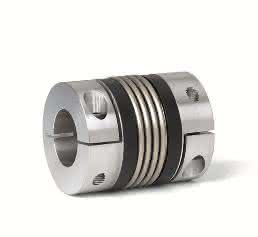
Structure:
- With clamping hub and one ISO 476 screw on each side
- From series 800, two each offset by 180° due to force-fit clamping connection
Temperature range: -30 to +100 °C
Backlash: Due to friction-locked clamping connection and proven principle, absolutely backlash-free
Service life: If the technical information is observed, the metal bellows couplings are service life-proof and maintenance-free
Backlash: of the shaft-hub connection 0.01-0.05 mm
Material:
- Bellows made of highly flexible stainless steel
- Secondary material see table
Short-term overload: permissible up to 1.5 times the value of TKN
Technical data: up to 10,000 min-1. Above 10,000 min-1 in finely balanced design (up to G = 2.5 possible)


You might also be interested in
Plagiarius 2024 negative prize
On January 26, 2024, the Plagiarius campaign awarded its dreaded "Plagiarius" negative prize for the 48th time to manufacturers and retailers of particularly brazen counterfeits and fakes.
 read more...
Ivalua honors winners of the Generative AI...
AI-supported "add-ons" for buyers within 48 hours
Ivalua, provider of cloud-based spend management solutions, announced the winners and innovations of the first Generative AI Innovation Cup. The competition took place in December 2023. It was open to all Ivalua partners and employees - more than...
read more...Efaflex celebrates 50 years of high-speed...
The emphasis is on "fast"
Since day one, Efaflex has wanted to use new technologies as early as possible and drive progress in the industry. This year, the family business is celebrating its 50th anniversary under the motto "Fast Forward".
read more...Security of supply even during power outages
In the winter of 2022, Germany was worried about energy shortages. The drugstore retailer dm did not paint any horror scenarios, but nevertheless saw the possibility of controlled, temporary, regional power cuts (brownouts).
read more...Safety technology in mechanical engineering
Modules with new functions
Euchner's product highlights at EMO 2023 include the communication-capable solenoid interlocks.
read more...Transforming the paper industry towards climate neutrality
Together with partners from industry and research, Voith is developing a project for the optimization of energy and material flows in paper production. The aim of the research project is to develop a digital framework that enables effective process...
read more...Up to 95 percent less flue gas thanks to direct extraction
The requirements for occupational safety measures and safety technology are also constantly increasing in welding technology. The Technical Rules for Hazardous Substances (TRGS) stipulate that welding fumes and harmful substances must be extracted...
read more...Competitive advantages with large machines
Whether 3D-printed components for machines and systems, prototypes or aids for design: additive manufacturing is almost indispensable for modern companies in mechanical and plant engineering and automation if they want to play in the premier league.
read more...Transport technology from the modular system
Many transport tasks can be realized with the help of linear technology. Pre-configured solutions are available to simplify the interaction between the linear unit, motor, gearbox and controller. This minimizes the effort required for research and...
read more...