

Bionic profiling
Of humpback whale, owl and tree
The humpback whale was the inspiration for the new development of a plastic fan from Ziehl-Abegg. The bionic aspects of the owl and tree were also incorporated. By reducing the use of materials and lowering energy consumption during operation, the fan specialist improves theCO2 balance in central air conditioning units and industrial ventilation systems in two ways.

Ziehl-Abegg 's peak efficiency of centrifugal fans is already more than 70 percent. Therefore, every approach must be used for optimization. The new centrifugal impeller has features from three different bionic approaches: aerodynamics (ornithology), hydrodynamics (marine biology) and biomechanics (trees). Material savings and improved aerodynamics halve theCO2 consumption for the same air performance. Modern injection moulding tools enable the implementation of bionically optimized geometries.
The trailing edges of the fan blades are modeled on an owl's wing. "As the quietest bird of prey, the owl has already been the model for several of our designs," says CEO Peter Fenkl. The jagged trailing edges of fans are considered a trademark of the company. In the new fan, however, the serrations have been softened somewhat.
Evolution has optimized the humpback whale in terms of flow efficiency so that it is considered a very good and agile swimmer despite its body size. The new generation of fans is based on these bionic findings.
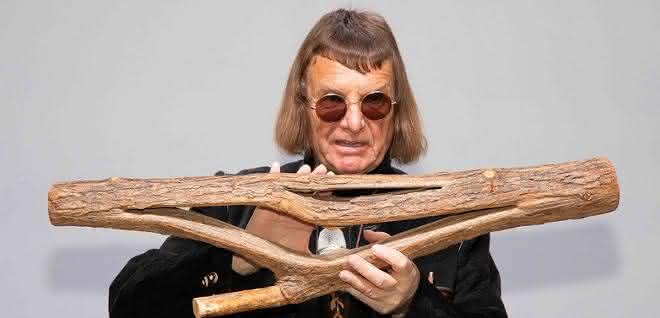
The developers at Ziehl-Abegg are also inspired by "tree whisperer" Professor Claus Mattheck. The professor is a pioneer in the science of biomechanics. Trees are a model for maximum strength with minimum use of materials.
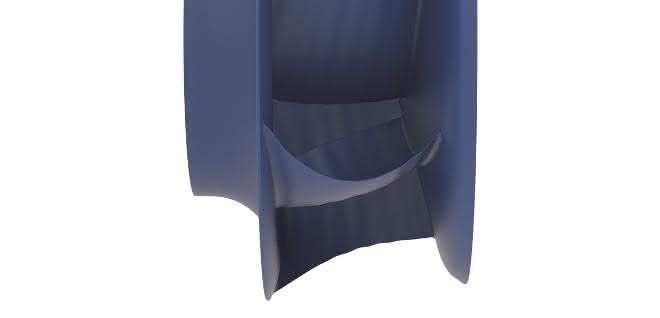
How is this implemented in the ZAbluefin fan? The five blades of the centrifugal fan open into both the top and bottom disks just as trees grow upwards: in a slight radius at the bottom. This is barely visible to the naked eye because the curves, which are modeled on the tree, are slight. Nevertheless, these bionic approaches offer the same strength as heavy wings when the blades transition - meaning that the amount of material used can be significantly reduced. Less material consumption in production also means a betterCO2 balance.
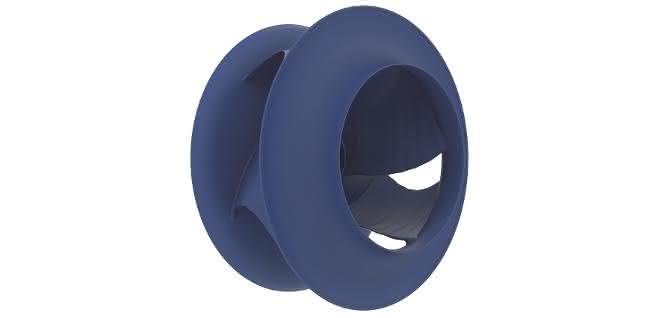
With centrifugal fans, the air flow hits the fan blades at different angles depending on the volume flow. The whale has to overcome similar challenges when swimming in the sea: the movement of its fins causes their angular position to change constantly. If its pectoral fins were positioned at too steep an angle to the oncoming current, the water would detach from the fins with large eddies. "Large turbulence is characterized by high flow losses and noise," says Dr. Walter Angelis, Technical Director at Ziehl-Abegg. The humpback whale has optimized its fins over thousands of years. For example, the leading edges of the whale's fins have bulges the size of golf balls (technical term: tubercles). This allows an animal weighing 25 to 30 tons to swim very quickly and agilely with its long pectoral fins. "We modeled this on the leading edge of the fan blade and implemented it as a wavy profile," explains Angelis.
The flow engineers also took a closer look at the rear fin of the whale, the fluke. The V-shaped contour of the rear wing section delays possible stalls - which makes the fan suitable for many different pressure ranges. Overall, evolution has optimized the humpback whale in terms of flow efficiency so that it is considered a very good and agile swimmer despite its body size. Otherwise, its long migrations through the world's oceans without feeding would not be possible. Ziehl-Abegg is now benefiting from these bionic findings in its latest generation of radial fans in sizes from 250 to 560 mm. The product name ZAbluefin is based on the English word for fin.


You might also be interested in
Plagiarius 2024 negative prize
On January 26, 2024, the Plagiarius campaign awarded its dreaded "Plagiarius" negative prize for the 48th time to manufacturers and retailers of particularly brazen counterfeits and fakes.
 read more...
Ivalua honors winners of the Generative AI...
AI-supported "add-ons" for buyers within 48 hours
Ivalua, provider of cloud-based spend management solutions, announced the winners and innovations of the first Generative AI Innovation Cup. The competition took place in December 2023. It was open to all Ivalua partners and employees - more than...
read more...Efaflex celebrates 50 years of high-speed...
The emphasis is on "fast"
Since day one, Efaflex has wanted to use new technologies as early as possible and drive progress in the industry. This year, the family business is celebrating its 50th anniversary under the motto "Fast Forward".
read more...Security of supply even during power outages
In the winter of 2022, Germany was worried about energy shortages. The drugstore retailer dm did not paint any horror scenarios, but nevertheless saw the possibility of controlled, temporary, regional power cuts (brownouts).
read more...Safety technology in mechanical engineering
Modules with new functions
Euchner's product highlights at EMO 2023 include the communication-capable solenoid interlocks.
read more...Transforming the paper industry towards climate neutrality
Together with partners from industry and research, Voith is developing a project for the optimization of energy and material flows in paper production. The aim of the research project is to develop a digital framework that enables effective process...
read more...Up to 95 percent less flue gas thanks to direct extraction
The requirements for occupational safety measures and safety technology are also constantly increasing in welding technology. The Technical Rules for Hazardous Substances (TRGS) stipulate that welding fumes and harmful substances must be extracted...
read more...Competitive advantages with large machines
Whether 3D-printed components for machines and systems, prototypes or aids for design: additive manufacturing is almost indispensable for modern companies in mechanical and plant engineering and automation if they want to play in the premier league.
read more...Transport technology from the modular system
Many transport tasks can be realized with the help of linear technology. Pre-configured solutions are available to simplify the interaction between the linear unit, motor, gearbox and controller. This minimizes the effort required for research and...
read more...