
Corona virus
Rehab robot supports physiotherapists
Together with Robert, the company Life Science Robotics has developed a robot for mobilizing patients to support physiotherapists in their work. The lightweight robot LBR Med from Kuka is used.
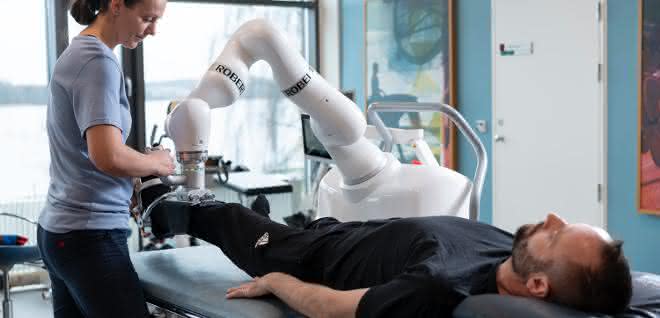
The robot-based medical device Robert supports physiotherapists in their work. Technical assistants can be used when people need to keep their distance from each other to prevent the spread of coronavirus. "We are currently seeing increased demand because hospitals want to reduce direct physical contact with patients. With our solution, we want to help mobilize patients faster and more efficiently and relieve the burden on physiotherapists," says Keld Thorsen, CEO of Life Science Robotics, based in Aalborg, Denmark.
The company was founded in 2014 and now employs eight people. It all started in Denmark. However, Thorsen is currently also receiving inquiries from large German hospital groups and a university hospital, where Robert has already been undergoing testing for three months. The medical device, in which Kuka's LBR Med lightweight robot is integrated, has also been approved for sale in the USA by the US Food and Drug Administration (FDA) since March 2020. "More and more robots are being integrated into medical devices. We are proud to be helping to shape automation in the medical sector," says Axel Weber, Vice President of the Medical Robotics business unit at Kuka, whose team worked on this solution.
Mobilizing patients faster with rehabilitation robots
Having enough specialist staff and hospital beds available is more important than ever during the coronavirus crisis. "With Robert, we are fundamentally improving the efficiency of the healthcare system," Thorsen emphasizes and adds: "The longer a patient lies in bed without training, the longer rehabilitation takes and other complications such as muscle atrophy or the formation of blood clots can occur."
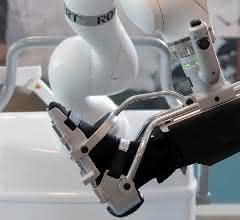
Robert works individually and flexibly, and with great precision. He is able to perform exactly the same movements over and over again - without interruption, fatigue or time constraints. There are two ways to use Robert - either for active training or passive training if the patient is still too weak. In the case of active training, the set-up and learning process takes a maximum of five minutes. After that, the patient can train independently for as long as recommended - including breaks.
This relieves the physiotherapists, who can take care of other patients during mobilization. In addition, the patient can be mobilized more frequently, regardless of whether a therapist is currently unavailable or not allowed to have intensive contact with patients.
Clinical tests underway - first rehab robots in use
The company is working closely with Odense University Hospital and other hospitals to develop a competitive robotic solution that is suitable for everyday use. The LBR Med plays a key role in obtaining approval as a medical device. It is the only robot certified for integration into a medical device.
Robert is already in use in Denmark and Germany. Three Roberts are currently on their way to Texas, where they will be used in hospitals in Houston. Life Science Robotics is currently focusing on new software upgrades. The latest update included sound effects to make training even easier. At the moment, the company's goal is a successful product launch and establishment in the USA and Europe. as


You might also be interested in
AI automation specialist reorganizes...
Generation change at Insiders Technologies
After almost 30 years at the helm, Werner Weiss is handing over the management of Insiders Technologies. Andree Albrecht takes over the management after a transition phase.
 read more...
Intelligent brownfield networking
Many industrial companies are struggling with established plant structures and proprietary interfaces. Stefan Klaus' presentation will show in a practical way how brownfield environments can be efficiently networked with open technologies and made...
read more...Factory-X in practice
How can set-up processes in highly variant production be automated efficiently? Markus Benndorff from soffico shows how Factory-X, industrial data rooms and modular architectures create new possibilities for flexible production concepts.
read more...Quality controls in production
Robots check car floor pans fully automatically
How can complex components in automotive production be inspected fully automatically and in real time with the help of machine vision and robotics? The case study shows how floor pans are measured and inspected fully automatically.
read more...Measurement software with integrated calibration wizard
The WinControl measurement software from Ahlborn is designed for the acquisition and processing of measurement data with Almemo measuring devices and offers functions for complex calibration tasks. A graphical user interface and context-sensitive...
read more...New platform facilitates chip design
Siemens opens access to EDA software in Europe
Siemens is cooperating with the Chips JU within the framework of EuroCDP and is facilitating access to modern EDA software for chip design, development and innovation for European companies. The aim is to strengthen start-ups, SMEs and research...
read more...AI and virtual twins for the industry
Dassault Systèmes confirms annual forecast after solid start to 2026
The French software group Dassault Systèmes has made a solid start to 2026 and is continuing to focus on artificial intelligence, cloud applications and virtual twins as growth drivers in its industrial business.
read more...Use data consistently and uniformly
New connectors and an app solution for the IIoT framework from PLCnext Technology make it easier to collect data from controllers, sensors and field devices - especially in existing systems.
read more...How companies can prevent cyberattacks
Instead of using traditional malware, attackers use legitimate programs and system tools within their victims' IT environments. Malicious behavior can hardly be distinguished from normal user behavior. For companies, this means that security...
read more...