

Humans and robots
Don't be afraid of the mechanical helpers
HRC has a lot of potential - for the right application in each case. But HRC integration can only succeed if all aspects of safety are taken into account and the solution pays for itself in economic terms.
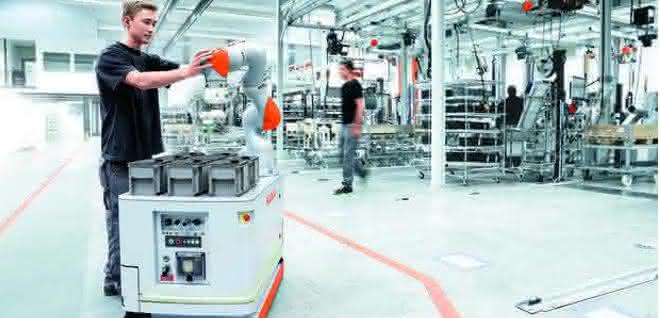
From assembly in the automotive industry to the production of electronic components: Solutions for human-robot collaboration (HRC) continue to find their way into modern production. Volatile markets and ever shorter product life cycles are the reason for the change in production halls. Those who act and produce flexibly and adaptably can gain a competitive advantage. HRC is one possible solution here. However, this does not apply to all processes. This is because its use must be re-evaluated depending on the application and assessed in terms of cost-effectiveness.
Human-robot collaboration can offer a lot of potential for the right application. What this right process looks like is decided during the planning of the system. This is where the production process is examined more closely and the question of economic efficiency is taken into account. In addition to ergonomic aspects, the time factor is a decisive criterion: How quickly can you switch to HRC? And when will it pay for itself? If everything speaks in favor of its use, the HRC solution can be integrated into the system. Safety plays a decisive role here, as it must be ensured that humans are not put at risk when working with the robot.
The robot must slow down
When working directly with humans, the robot must not only be fast and powerful. In the case of sweeping movements, it must carry out the production step more slowly, but with increased sensitivity, and powerful movements may only be carried out if no one is endangered in the process. This is the only way to eliminate the risk of injury. If an unexpected collision does occur, the robot must immediately switch to stop mode and may only continue working when it receives the "OK" from the human, for example in the form of another touch. Of course, the robot is only HRC-capable if the respective end effectors, such as grippers or other tools that it needs for the process, do not have any sharp or pointed edges.
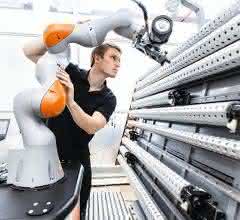
"Know-how, experience and careful planning are crucial in order to realize successful cooperation between humans and robots and to integrate an HRC application," says Kim Reeslev, Kuka Country Manager Denmark & Baltic States. Possible application scenarios can be found in the less automated areas of the automotive industry or other sectors. For example, in the assembly area. Here, the robot can relieve the strain on humans. Another area of application is quality inspection. In all cases, however, it is important to consider each situation individually and ensure the protection of workers: in accordance with the safety standards of ISO 10218, TS15066 Technical Specification and the current machinery directives. After all, production is only permitted by law with a CE marking.
CE marking: you can't do without it!
Validating HRC applications is a crucial process when integrating them into a system. This is because legislation stipulates that certain standards must be met in order to be allowed to produce: From the risk assessment to the safety concept and the validation and testing of all collision scenarios, the final step is CE marking. All risk factors must be assessed before, during and after use of the robot and CE documentation must be created: for the general robot description and for its use.
Ultimately, it is the integrator or the customer who has purchased the robot and installed it in their system who is liable in the absence of CE marking. They must ensure that the application complies with the applicable directives and regulations. Typical risk factors that can occur on the way to CE conformity are, for example, dangerous end effectors with sharp edges, incorrect configuration of the safety software or the stop mechanism. If humans and robots are really to work together, the robot's force and power must be limited. The worker can touch, guide and even collide with the mechanical helper. The robot must therefore have sensitive properties and ensure that biomechanical limit values (force, pressure) are not exceeded in the event of a possible collision. All these aspects must be taken into account in the risk analysis before the application can be put into operation. HRC integration can only be successful if all aspects of safety are taken into account and the solution then also pays for itself in economic terms.
Take the pressure off employees? Make the process more flexible? Be adaptable? These are some of the reasons that could speak in favor of an HRC solution. If the production step is really suitable, then possible fears regarding safety measures should not be a deterrent. At Kuka, customers receive a well-secured HRC solution: robots and necessary safety functions such as subcomponents or sensors are officially certified. "In this way, we want to show our customers that we know what we are doing and that we won't leave them to fend for themselves when it comes to CE marking," says Reeslev. as


You might also be interested in
Robotics and autonomous order picking
Locus Robotics acquires Nexera Robotics and expands autonomous warehouse logistics
Locus Robotics takes over Nexera Robotics and may have taken a decisive step towards truly universal warehouse automation. A new gripping technology should now make possible what was previously considered difficult to automate.
 read more...
Gentle wheel handling
The newly founded Eisenmann Robotics division develops new robotics concepts to increase the level of automation in modern production facilities.
read more...Gripping systems and vacuum generators
Schmalz is presenting new gripping systems and vacuum generators at Automatica. Exoskeletons, which allow employees to move heavy workpieces effortlessly, will also be on display.
read more...Smart universal gripper for power electronics
The power electronics manufacturer Semikron Danfoss uses the EGU 50 mechatronic parallel gripper from Schunk in a robotic cell. It handles different components and feeds them to a measuring line. With its functionalities, it meets all requirements...
read more...Schmalz takes over finger gripper from Soft Robotics
The vacuum specialist Schmalz is expanding its gripper portfolio and acquiring the mGrip product family from the US company Soft Robotics (SRI), including all finger gripper configurations, patents and the associated know-how.
read more...Soldering with special gripper
In order to make the mini wave soldering of large panels stable and reproducible, Eutect developed a special gripper that prevents the panel from bending, among other things.
read more...Loading and unloading machines
Artificial intelligence and ergonomic lifting
Loading and unloading machines ergonomically and efficiently - Schmalz supports metalworking companies in this. At Euroblech, the company will be presenting solutions for intelligent and ergonomic handling with vacuum.
read more...Reliable end effector for cobots
Collaborative robots are now widely used for a wide range of handling tasks. SMC offers three versions of the RMH pneumatic gripper for this purpose; it is compatible with cobots from a total of twelve companies.
read more...Making access as easy as possible
Responsibility and technological progress go hand in hand - in the form of resource-saving and efficient processes in a healthy working environment. At Hannover Messe 2024, Schunk will be showcasing automated solutions that pave the way for this...
read more...