

Human-robot collaboration
The robot becomes a colleague
Best practice for HRC. Companies see human-robot collaboration as a key technology for solving emerging challenges such as increasing variant diversity, ageing workforces and flexibilization. A closer look reveals that HRC-capable robots are not always used for human-robot collaboration.
One reason why genuine collaboration and therefore an overlap of workspaces is often not currently implemented in industry is the uncertainty of companies when planning the workstation and the division of work content. When designing HRC applications, there is a lack of appropriate system interfaces for existing simulation and planning software or software used in companies. In addition, there is a need for interdisciplinary expertise in the fields of ergonomics and automation. The empirical knowledge for the implementation of manual and automated production systems is usually available separately. For this reason, the Safemate and KoMPI projects were launched in 2017 together with seven other projects as part of the BMBF's "Assembly expertise" call for proposals. One aspect that all projects have in common is the validation of the basic principles developed using at least one best-practice application. To this end, use cases are identified with the help of the respective project partners and practically integrated into the partners' production processes. The aim is to implement the use cases with measurable added value for the respective companies so that the knowledge gained can be made available to interested companies.
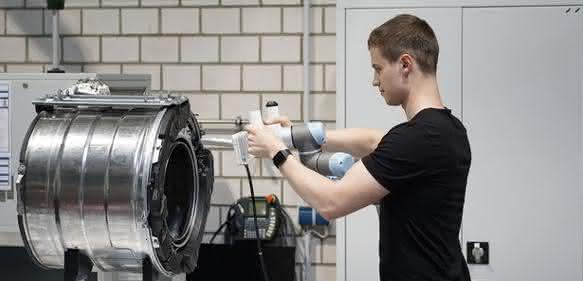
Safemate has set itself the task of creating implementation strategies for safe and accepted collaboration. The guidelines to be developed should be as generic as possible so that they can be used across all industries and, above all, regardless of company size. One use case in the Safemate project deals with the assembly of washing machines at Miele. The scenario implemented is a sub-process in which a so-called air trap is attached to the unit to measure the water level. Employee surveys and workplace evaluations have shown that the existing manual process is ergonomically stressful for employees and therefore needs to be changed. The current planning status envisages manual guidance of the robot, whereby the air trap can be brought into a pre-position on the unit. The final assembly is then carried out automatically by the robot using a force- and torque-guided movement process. The manual guidance to the pre-position is necessary in order to be able to dispense with additional sensors.
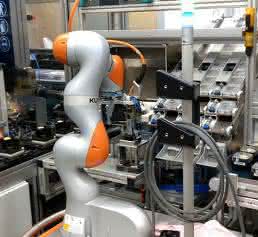
One part of the KoMPI joint project deals with the analysis and evaluation of existing manual assembly lines using the HRC Quick Check developed with the project partners. Criteria such as handling weight, order status or the geometry of the components are considered for the selection. One industrial application of the project involves the assembly of pressure control modules at Karl Dungs. The workstation under consideration involves the completion of various small parts and the subsequent packaging process of the assembled pressure monitor. The Quick Check application has shown that, based on the characteristics of the criteria (orderly provision of parts, high quantities) and a separate cycle time analysis, the use of a lightweight robot as part of a coexisting workstation represents a high potential from an economic and balancing point of view. In practical implementation, the LBR iiwa from Kuka has been used in the assembly line in Karl Dungs' real production operations since the beginning of 2018.
The aforementioned reference processes from the Safemate and KoMPI projects will be exhibited at the joint MHI stand at Automatica as part of the public relations work accompanying the project.
The Safemate and Kompi projects are funded by the Federal Ministry of Education and Research (BMBF) as part of the "Innovations for the production, services and work of tomorrow" funding program in the field of "Competence Assembly - Collaborative and Adaptable (KoMo)" and managed by the Project Management Agency Karlsruhe (PTKA).
S. Blankemayer, K. Lemmerz, as

Briefly explained: The MHI e.V.
The Wissenschaftliche Gesellschaft für Montage, Handhabung und Industrierobotik e.V. (MHI e.V.) is a network of renowned university professors - institute directors and chair holders - from German-speaking countries. The members conduct both fundamental and application-oriented research on a wide range of current topics in the fields of assembly, handling and industrial robotics. Further information on the society, its members and activities: www.wgmhi.de.
Briefly explained: The IFA
The Institute of Production Systems and Logistics (IFA) at Leibniz Universität Hannover was founded in 1966 and is currently headed by Prof. Dr. Peter Nyhuis. The institute is concerned with the holistic description and design of production systems. Its research focuses on the areas of factory planning, production management and production and work design. www.ifa.uni-hannover.de
Briefly explained: The LPS
The Chair of Production Systems (LPS) is headed by Prof. Dr. Bernd Kuhlenkötter. The scientific focus of the LPS covers the fields of production management, production automation and industrial robotics. The LPS operates a learning and research factory (LFF) in which the theoretical concepts are implemented and evaluated. Through these demonstrations of the results, the LPS promotes the transfer of technology to industry. www. lps.ruhr-uni-bochum.de
Briefly explained: The match
The Chair of Assembly Technology (match) at Leibniz Universität Hannover was founded in 2013 by Prof. Dr. Annika Raatz. Since then, ideas for automated and robot-assisted assembly and handling in production have been pursued. The research focuses on collaborative assembly, soft material robotic systems, handling and control technology and precision assembly. www.match.uni-hannover.de


You might also be interested in
Humanoid robotics from Germany
Igus launches service robots for everyday industrial use
Humanoid robotics: With the Iggy Rob Home, igus presents a service robot for industry and everyday life. What's behind it.
 read more...
New sales and service unit in Gurugram
Yamaha Motor expands robotics business in India
Yamaha Motor is opening a new Robotics Business Support Division in India to strengthen sales and service in the growing robotics market. The unit will support SMT systems and industrial robots, among other things, and will be complemented by a...
read more...Robotics and autonomous order picking
Locus Robotics acquires Nexera Robotics and expands autonomous warehouse logistics
Locus Robotics takes over Nexera Robotics and may have taken a decisive step towards truly universal warehouse automation. A new gripping technology should now make possible what was previously considered difficult to automate.
read more...Factory planning without compressed air...
How vacuum becomes mobile
Modular factories, mobile robotics and rising energy prices are fundamentally changing automation. One solution: into the future without compressed air. Electric vacuum systems reduce costs, save energy and support flexible manufacturing and...
read more...A robot for all occasions
Industrial robots take on many tasks. Even milling with accuracies in the sub-millimeter range is now possible.
read more...Why stator and rotor laminations are becoming a performance factor
Why the future of robotics depends not only on software, but also on high-precision stator and rotor laminations inside the motor.
read more...Infineon Startup Challenge 2026
Focus on humanoid robotics
Infineon brings together young deep-tech companies worldwide to drive innovation in humanoid robotics. The focus is on hardware and system solutions from sensor technology to motor control. Applications are still possible until May 27, 2026.
read more...Synergy in the special machine
Highly automated production line for scaffolding standpipes sets standards in efficiency and process reliability
How is one of the most modern scaffolding tube production lines in Europe created? At MJ-Gerüst, a fully networked high-tech line produces six finished standpipes every 60 seconds. With automation, robotics and precision technology from Schunk. How...
read more...Quality controls in production
Robots check car floor pans fully automatically
How can complex components in automotive production be inspected fully automatically and in real time with the help of machine vision and robotics? The case study shows how floor pans are measured and inspected fully automatically.
read more...