

Dürr Smart Factory
Fully automated paint shop for electric cars
New suppliers are increasingly entering the electric vehicle market, especially in China. Dürr is building a fully automated paint shop for a local OEM. The plant in Hefei is designed for a capacity of 100,000 units per year and is scheduled to go into operation in June 2018.
The new JAC (Anhui Jianghuai Automobile) plant will in future produce battery-powered passenger cars on behalf of a local electric vehicle manufacturer. The vehicles will be given a two-tone color design in Dürr's fully automated paint shop. The plant in Hefei combines advanced vehicle drives with intelligent plant technology and modern painting concepts. The Dürr software solution Itac-MES-Suite is responsible for controlling the entire plant with data acquisition and evaluation as well as plant monitoring. The modular MES system provides a detailed insight into the production processes and consumption data at all times.
Electric vehicles are increasingly using plastic and lightweight components that are painted separately and only fitted to the body in the final assembly line. The processes in the painting lines are adapting to these changes. Before the bodies receive their top coat in the paint booth, they undergo pre-treatment (VHB) and cataphoretic dip coating (KTL). The Rodip rotational dip coating process is used to apply the anti-corrosion paint. The rotational movement of the car bodies makes it possible to dispense with inlet and outlet slopes in the dip tank, which leads to significant space savings. Due to smaller bath volumes, Rodip consumes less energy, water and chemicals, thus reducing unit costs.
Fully automatic interior and exterior painting stations
The seams on the underbody are then sealed, a full-surface underbody protection is applied and insulating protection mats are sprayed onto the inside of the body. These tasks are performed by the new Ecogun2 3D applicator, which is suitable for all sealing materials and processes. The new channel guide in the applicator head results in a longer service life and a lower pressure level in the material supply. The innovative applicators are mounted on a total of eight EcoRS-16 or EcoRS-30L-16 robots and apply the sealing material to the car bodies fully automatically.
The painting line itself consists of a filler station as well as an interior painting station and two exterior painting stations for the top coat. Here, the bodies are partially ejected and conveyed back to the top coat line for the two-tone top coat. The final clear coat is also applied in fully automatic interior and exterior painting stations. To reduce solvent emissions as much as possible, the exhaust air flow is cleaned not only from the clear coat booths, but also from the paint mixing rooms.
As particularly large exhaust air volume flows are generated here in the painting process, but these only have low pollutant loads, the combination of highly efficient VOC concentration (Ecopure KPR) with downstream thermal exhaust air purification (Ecopure TAR) is ideal. The energy required for the desorption air in the KPR system is recovered from the clean gas of the thermal exhaust air purification system. This reduces the energy requirement. Ecopure exhaust air purification reduces solvent emissions by more than 95 percent and therefore falls below the particularly strict emission limits.
A total of 26 EcoRP-E/L033 and EcoRP-E/L133 painting robots ensure fully automatic paint application. Eight EcoRP-130 Scara robots support the painting process as door openers and an EcoRP 133 acts as a hood opener in the front area. The trunk lid and the fenders for the electric vehicles are made of plastic and are only fitted to the body later. The hood opener at the rear can therefore be dispensed with completely.
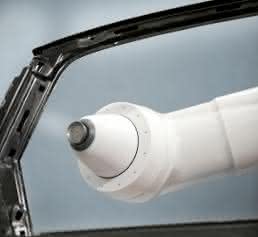
The EcoBell3-Ci atomizers are being used for the first time by a local Chinese car manufacturer. They are suitable for interior painting with water-based paints and do not require complex potential separation. Thanks to its compact design, the atomizer reaches every nook and cranny inside the car body. The robust high-voltage technology works with minimal self-contamination. Short rinsing and color change times as well as fast cleaning intervals in combination with the EcoBell Cleaner D2 atomizer cleaner increase system capacity and productivity.
Energy on demand during drying
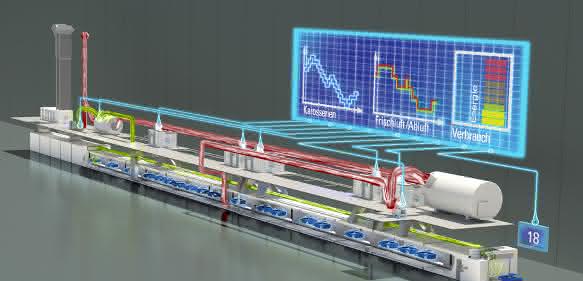
The integration of numerous digital@Dürr solutions turns the paint shop into a smart factory with comprehensive data utilization. This also includes the integration of a new software solution for fresh and exhaust air control in the dryers in Hefei. The intelligent EcoSmart VEC air management system operates fully automatically and delivers "energy on demand". This technology reduces the consumption of gas and electricity when drying freshly painted car bodies. In conventional pure gas-heated dryer systems, fresh air supply and exhaust air disposal are operated at a constant volume flow.
The EcoSmart VEC air management system, on the other hand, is a predictive control system. It controls the volume flow of fresh and exhaust air depending on the number and position of the vehicles currently in the dryer. The system thus ensures an optimum and individual supply to each individual dryer zone and combines energy efficiency with consistently high painting quality. The exhaust air from the dryers is cleaned via the integrated Ecopure TAR afterburner with heat recovery and then reused to heat the dryers. as


You might also be interested in
Plagiarius 2024 negative prize
On January 26, 2024, the Plagiarius campaign awarded its dreaded "Plagiarius" negative prize for the 48th time to manufacturers and retailers of particularly brazen counterfeits and fakes.
 read more...
Ivalua honors winners of the Generative AI...
AI-supported "add-ons" for buyers within 48 hours
Ivalua, provider of cloud-based spend management solutions, announced the winners and innovations of the first Generative AI Innovation Cup. The competition took place in December 2023. It was open to all Ivalua partners and employees - more than...
read more...Efaflex celebrates 50 years of high-speed...
The emphasis is on "fast"
Since day one, Efaflex has wanted to use new technologies as early as possible and drive progress in the industry. This year, the family business is celebrating its 50th anniversary under the motto "Fast Forward".
read more...Security of supply even during power outages
In the winter of 2022, Germany was worried about energy shortages. The drugstore retailer dm did not paint any horror scenarios, but nevertheless saw the possibility of controlled, temporary, regional power cuts (brownouts).
read more...Safety technology in mechanical engineering
Modules with new functions
Euchner's product highlights at EMO 2023 include the communication-capable solenoid interlocks.
read more...Transforming the paper industry towards climate neutrality
Together with partners from industry and research, Voith is developing a project for the optimization of energy and material flows in paper production. The aim of the research project is to develop a digital framework that enables effective process...
read more...Up to 95 percent less flue gas thanks to direct extraction
The requirements for occupational safety measures and safety technology are also constantly increasing in welding technology. The Technical Rules for Hazardous Substances (TRGS) stipulate that welding fumes and harmful substances must be extracted...
read more...Competitive advantages with large machines
Whether 3D-printed components for machines and systems, prototypes or aids for design: additive manufacturing is almost indispensable for modern companies in mechanical and plant engineering and automation if they want to play in the premier league.
read more...Transport technology from the modular system
Many transport tasks can be realized with the help of linear technology. Pre-configured solutions are available to simplify the interaction between the linear unit, motor, gearbox and controller. This minimizes the effort required for research and...
read more...