

Deburring plate
Consistently high process quality
Deburring cell with ABB robot shows what is possible with automation in machining production. In addition to system availability, productivity and cycle time, the motor specialist Deutz was also able to increase flexibility and product quality - with consistently reproducible results.
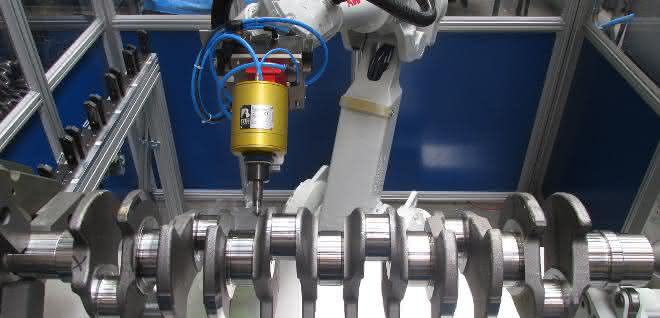
Deutz, the oldest engine factory in the world, develops, produces and sells a wide range of high-quality liquid-cooled and air-cooled engines, which are used in construction and agricultural machinery, stationary equipment as well as commercial and rail vehicles. As the industries supplied place special demands on the material quality and condition of the engines, Deutz checks its procedures, production processes and tools in every detail. They must be optimally tailored to the individual components and be as economical as possible. System availability, failure rate and process quality are consistently set in relation to technical and economic aspects.
The challenge of component diversity
The company was looking for an optimized automation solution for deburring the cheeks of crankshafts for six-, eight- and twelve-cylinder industrial engines. Together with its partner Mühlbauer Maschinenbau, a solution for the technically complex process was finally implemented. 13 different crankshaft types, nine different crankshaft lengths and three different mounting sizes for the positioning unit require flexibility. The variety of components also makes things tricky - the different crankshaft types have to be picked up without long set-up times and additional set-up components and must be able to be processed automatically with consistently high quality. For this task, it was clear that a robot with serial parallel kinematics should be used.
The results of automation include process optimization and high product quality with consistently reproducible results - even after processing several components. The robot deburring cell with an IRB 2400 robot in the special foundry version at its heart makes the production process flexible. It enables different types of crankshafts to be picked up - from 52 to 118 kilograms in different lengths. The set-up process has been optimized to such an extent that no changing units are required for the crankshaft type change. Mühlbauer Maschinenbau has solved this problem by means of an adjustment and staking system so that the change from type one to type two, for example, can be carried out quickly.
The software application challenge
Deburring is an important step in the crankshaft manufacturing process chain. Component positioning is crucial to the outcome of the process. If this is not exact by just a tenth of a millimeter, this has a negative effect on the machining of the crankshafts. Mühlbauer Maschinenbau has therefore worked with ABB to develop a solution for this process step. The crankshaft is moved into the cell from above. In this position, the crankshaft is picked up by a lifting unit and clamped on the machine table by a triple chuck and a tailstock is fed from the opposite side. The robot then follows the defined path for deburring the cheeks with the utmost precision and deburrs the contours automatically and repeatedly using a pneumatically driven milling cutter. The tool can be deflected in all directions in order to carry out the deburring process efficiently and safely and to keep the programming effort to a minimum. Thanks to the precise motion simulation in the offline programming and simulation program Robotstudio, motion programming has been greatly simplified and the commissioning time reduced, despite the complex component geometry. At the same time, the cell also communicates with the loading and unloading portal for integrated process monitoring.
Further projects planned
Overall, with robot-based automation at Deutz, Mühlbauer Maschinenbau and ABB are demonstrating a way in which small and medium-sized companies can also benefit from maximum flexibility and future-proofing. Investments become more profitable and the productivity of machining production is sustainably increased. Mühlbauer Maschinenbau is currently also implementing five other systems with ABB robots, including another major project for Deutz for the automated final cleaning of crankshafts; ABB's hardware and software solutions are also being used here. pb


You might also be interested in
Motors, gearboxes and encoders: Faulhaber expands Ø 16 mm portfolio
Faulhaber is expanding its portfolio with new DC motors from the SXR and GXR family, a 16 mm planetary gearbox and the IEX3 magnetic encoder for compact drive solutions.
 read more...
New drive solutions for industrial automation and robotics
Faulhaber presents drive solutions with the new GXR and SXR motor family, which offer high efficiency and flexibility in combination with powerful gearboxes and encoders. These optimized components open up new possibilities for applications in...
read more...Marco Altherr becomes new Chief Financial Officer
The Supervisory Board of Ziehl-Abegg has appointed Marco Altherr as the company's new Chief Financial Officer (CFO). Altherr will take up his post in May 2025.
read more...Hydrogen storage in metal hydride
With its focus on storage systems for green hydrogen in solid form (metal hydride), GKN Hydrogen presents itself as a pioneer in safety and efficiency for the industry. GKN Hydrogen offers safe storage systems for green hydrogen and focuses on two...
read more...INDUSTRIAL Production Products of the year...
2nd place, Robotics category: EGS Automation
The SUMO automation systems from EGS Automation - economical standard solutions for automating a wide range of processes in plastics and metalworking - took second place in the robotics category in the competition for Product of the Year 2024.
read more...More productivity with Drive Intelligence
The trends in automation are productivity, sustainability and connectivity. Baumüller is launching new products on the market that address these trends, including new tools for smart energy monitoring, condition monitoring in the drive and new...
read more...Intelligence in Motion
At SPS, Koco Motion will be showcasing its expertise in customized drive solutions based on DC and BLDC motors, stepper motors, servo motors, linear drives and controllers.
read more...Nomination Products of the Year 2024
EGS Automation: SUMO automation systems
The SUMO automation systems from EGS Automation, economical standard solutions for automating a wide range of processes in plastics and metalworking, have been nominated in the Robotics category in the competition for Product of the Year 2024.
read more...Transport technology from the modular system
Many transport tasks can be realized with the help of linear technology. Pre-configured solutions are available to simplify the interaction between the linear unit, motor, gearbox and controller. This minimizes the effort required for research and...
read more...