

Human-robot collaboration
Cobots - what counts is working together
In everyday life, humans and machines are often still seen as competitors. This is unnecessary; robots in industrial production can support, relieve and indirectly even protect human employees.
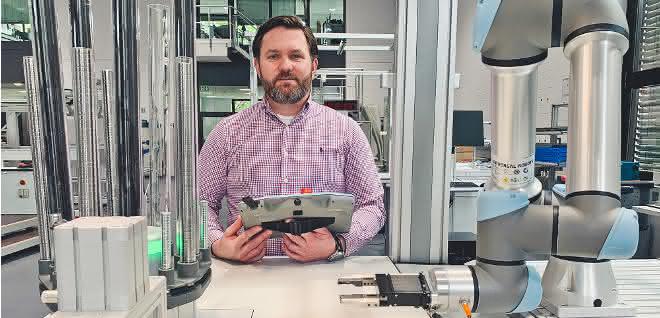
Although technical devices have become an integral part of our everyday lives, humans and machines are often still seen as competitors. However, this "either-or" way of thinking ignores the valuable middle ground of working together, which is becoming increasingly important in times of digitalization and Industry 4.0. The keyword is "human-robot collaboration": cooperation between humans and robots. A very simple approach with great potential. It combines the experience, judgment and flexibility of humans with the strength, endurance and precision of robots. This reduces the workload on employees and increases production efficiency. A special feature of human-robot collaboration is the fact that humans and robots are not separated by a safety fence when working. Instead, they use a shared workspace and process the same components. This is usually realized with special lightweight robots: so-called collaborative robots - or cobots for short.
All-rounder
In contrast to industrial robots, which are usually specialized in specific tasks, cobots are all-rounders. Their shape and mode of operation are reminiscent of a human arm. The advantages of cobots include their relatively small footprint and versatility. They are able to perform many different tasks. These are primarily monotonous, repetitive tasks that bore human employees in the long term and quickly tire them out, leading to a high error rate. Cobots can help here, as an example from Miami shows: the company Creating Revolutions had to contend with an error rate in the double-digit percentage range in the production of a special pager device for the hotel and catering industry. After a small number of selected work steps, which require enormous precision, were handed over to cobots, the error rate fell to less than one percent. Another advantage of cobots is that they provide large amounts of data on demand, which can be used for predictive maintenance and other big data applications.
When humans and robots work in close proximity to each other, special measures and precautions are necessary to ensure the safety of employees. DIN ISO/TS 15066 specifies the relevant safety requirements for collaborative industrial robot systems and the working environment. Among other things, it defines upper limits for the maximum force that a robot may exert on a person when it comes into contact with them. These forces must therefore be limited to a safe level. In order to meet such requirements, cobots need appropriate sensors - these use ultrasound or radar technology, for example, to detect people and obstacles in their environment. Some cobots are even equipped with a touch-sensitive surface so that they can "sense" contact with humans and immediately stop any movement. The safety of human colleagues is therefore the top priority in human-robot collaboration.
Relief for people
However, ensuring the physical safety of employees in human-robot collaboration is not limited to ensuring that the worker is not injured by their robot colleague. Quite the opposite: it is not uncommon for cobots to step into the breach for humans and relieve them of physically demanding, non-ergonomic tasks. At the BWM Group plant in Dingolfing, for example, cobots assist with the installation of car side windows. Before the window is inserted into the car body, adhesive must be applied to the windows in a precise process - this used to be done by hand while the employee walked around the window. Today, a cobot takes over this strenuous, unergonomic task. The subsequent installation of the panes is then carried out by a human again.
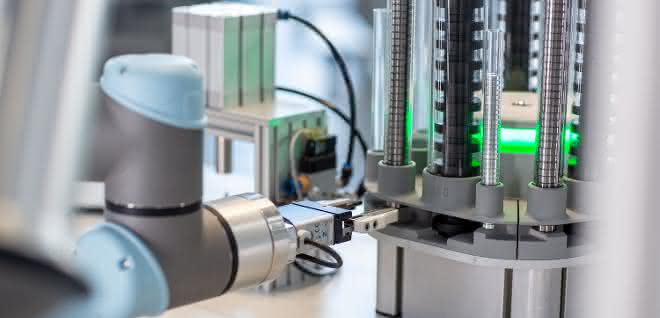
However, the ergonomic benefits of cobots do not end with tasks that require a strenuous or permanently unhealthy posture. Human-robot collaboration also has an answer when it comes to lifting heavy loads. For example, cobots such as the Universal Robots UR16e can lift loads of up to 16 kilograms. By comparison, a 16-inch diameter steel wheel rim weighs around 8.5 kilograms without tires. If the robot colleague takes such loads from a worker, this not only reduces the physical strain on the employee. For example, the worker can prepare for processing the next component while the cobot removes the previous one. This shows that humans and robots do not have to be competitors - instead, the combination of their respective advantages can optimize value creation.


You might also be interested in
Intelligent sensor technology for the packaging industry
At Interpack 2026, Sick will be showcasing its portfolio of sensor, automation and AI-supported solutions for secure and digitally networked packaging processes in the consumer goods, healthcare and pharmaceutical industries.
 read more...
Sales growth in a turbulent market environment
Thanks to innovations and a focus on strategic industrial markets, Sick was able to moderately increase its sales in the 2025 financial year. In a turbulent market environment, the company was able to maintain its position and gain market share with...
read more...Photonic microchips with 3D connector
How a 3D system makes photonic chips industrially viable
A research team from Heidelberg is developing a 3D-printed "connector" for photonic microchips. The solution promises a low-loss, standardized coupling of glass fibre and chip - and could fundamentally simplify the production of photonic integrated...
read more...Advanced material retrieval system
Steute shows nexy wireless network with extended connectivity
Steute's Leantec division is presenting an enhanced version of the nexy wireless network with improved connectivity and additional cybersecurity functions. The background to the further development is the increasing use of automated guided vehicles...
read more...Detecting air bubbles in liquids
EBE is launching a capacitive bubble sensor on the market that reliably detects air bubbles and liquid breakages, regardless of the liquid and the condition of the hose.
read more...Miniature acceleration sensors
Structural tests on printed circuit boards
The Z22198 family consists of very small triaxial accelerometers from Kistler that measure vibrations in three orthogonal axes.
read more...Positive development in sensor and measurement technology
In the first quarter of 2025, the sensor and measurement technology industry recorded sales growth of three percent compared to the previous quarter - according to the results of the quarterly member survey conducted by the AMA Association for...
read more...Sick extends contract with CEO
The Supervisory Board of Sick has extended the contract of CEO Dr. Mats Gökstorp by 5 years. The company also announced that Feng Jiao has resigned from his position as Chief Sales Officer at his own request. Markus Scaglioso has been appointed to...
read more...Kistler and Keller Pressure deepen partnership in China
The Kistler Group is intensifying its cooperation with Keller Pressure. By signing the agreement, the two companies are reaffirming their commitment to strengthening synergies and developing the Chinese market in a targeted manner.
read more...