

Asset tracking in production
Track and trace in the smart factory
At the end of Industry 4.0 is the smart factory, i.e. networked production. A must-have on the way there is the tracking of products and components. Continuous asset tracking can be realized with the help of ultra-wideband technology.
Industry 4.0 (I4.0) is currently focusing in particular on the smart factory: a self-controlling factory according to the visionaries, in which the product independently tells the production systems how it should be manufactured, is at the heart of digitalization in production technology. Especially in the areas of logistics and order planning, experts see potential for increasing a company's productivity through new technologies and complete networking. All components, from the production system to the product itself, play a role in this ecosystem and form so-called cyber-physical systems (CPS), whose communication basis is Industrial Internet of Things (IIoT) technology. Technologies such as WLAN or Bluetooth LE (BLE), which have long been indispensable in the consumer sector, are also increasingly being used in the industrial environment to exchange data between CPS and the environment. Proven technologies for positioning, on the other hand, such as the Global Positioning System (GPS), do not work adequately inside buildings and are therefore ruled out as a core technology for end-to-end industrial track-and-trace applications in this area. This is precisely where ultra-wideband (UWB), a new wireless technology for industrial automation, comes in, which has established itself as the de facto standard for continuous indoor localization due to its different mode of operation.
UWB as an enabling technology for I4.0
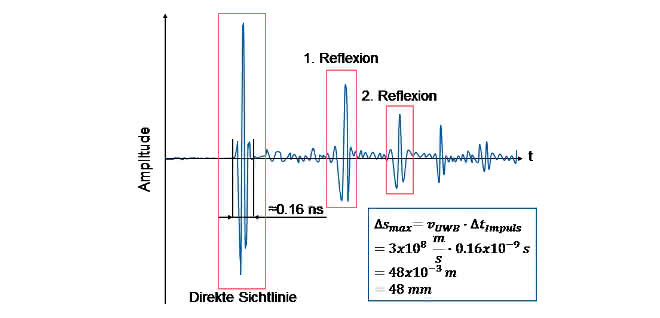
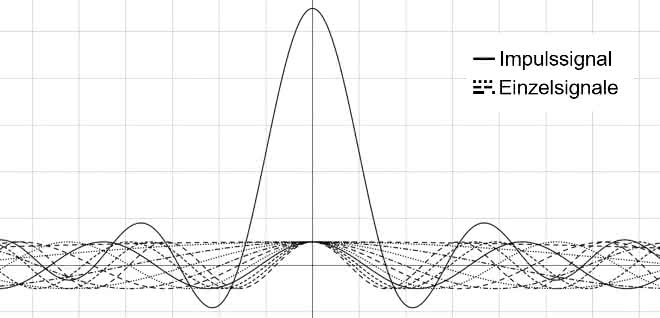
Classic wireless communication systems use different modulation methods to transmit data, depending on the technology. Here, a high-frequency carrier signal is modified by a low-frequency wanted signal to be transmitted by the transmitter and demodulated accordingly on the receiver side in order to reconstruct the wanted signal. In contrast, ultra-wideband technology uses individual pulses for data transmission. This difference can be illustrated using the example of a pure periodic sinusoidal oscillation: If this is transferred to the image area using Fourier transformation (FT), it appears as a single spectral line. If the signal is limited to a temporal range, the width of the spectrum in the image area increases, as the spectrum of a pulse and its temporal progression are directly coupled with each other according to the rules of the FT: The shorter a pulse in the time domain, the broader the spectral representation in the image domain. Due to these very short pulses with times of 0.16 ns, a time-of-flight (ToF) measurement can be carried out between the transmitter and receiver with high resolution if the clocks are highly synchronized. The correlation between the propagation speed of the pulse and the measured time-of-flight allows the distance to be clearly determined. The advantage of ToF determination compared to alternative systems based on signal strength measurement, such as iBeacon technologies, lies primarily in the elimination of reflection interference. With a signal strength-based system, this ensures that there is no clear correlation between signal strength and distance. Due to the extremely short pulse times in the ultra-wideband system, reflections from the environment can be clearly separated and filtered from the directly radiated signal. If the system is set up in such a way that at least 4 distances from the object to be localized (generally referred to as a tag) to base stations (generally referred to as an anchor) with a known position are measured, the position of the tag can be determined by multilateration in three dimensions with an accuracy in the centimetre range. Depending on the requirements of the application, the determination rate can be configured depending on the number of tags to be localized. A constant of 352 tags per second can be determined by the system. For example, 44 tags can be localized simultaneously at 8 Hz or 88 tags at 4 Hz.
Cross-site-capable real-time tracking via UWB, BLE and mobile radio
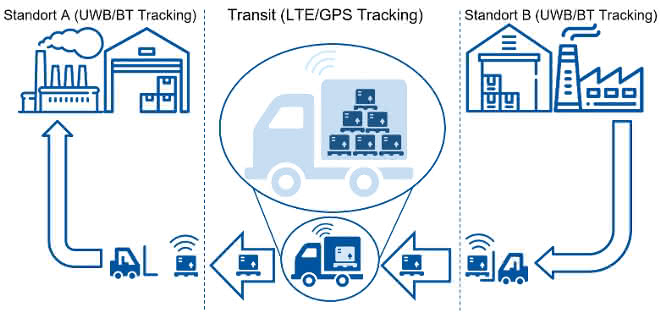
The possibilities described with regard to distance determination make ultra-wideband technology particularly suitable for use in the field of indoor localization. Before tags can be localized, the area to be covered (zone) is equipped with a number of stationary anchors corresponding to its size and characteristics. A central software component orchestrates the resources and calculates the positions of the individual tags within the zone. The tags to be localized use a combination of UWB and Bluetooth LE technology. If the factory site consists of several locally separated production facilities or if further work steps are carried out entirely at different locations, equipping the entire process line with UWB technology is usually not feasible in a capital-efficient manner. In order to ensure continuous localization and data acquisition on these routes, aggregation points in the form of gateways with a mobile radio connection are used. These can be distributed across the company premises or installed directly in the transport vehicle in order to determine an approximate position based on GPS and mobile radio data. In this case, there is no runtime determination with subsequent multilateration; instead, presence detection is carried out on the basis of the built-in Bluetooth LE module. With the data obtained in this way, it is possible to make well-founded statements about the exact throughput time of a workpiece, to identify bottlenecks due to increased machine utilization based on material jams and to carry out work preparation measures more efficiently, as the time-consuming search for material and tools within the workshop is no longer necessary. It can also be connected to existing Manufacturing Execution Systems (MES), enabling complete and comprehensive integration into the company's vertical data management. At the administrative level of production planning, the additional real-time and historical information gained opens up completely new possibilities for more transparent order planning. The efficiency of in-house production is increased and the customer receives more precise information on the expected completion date of their product.
Application and benefits of UWB
The combination of ultra-broadband systems with traditional short-range radio and mobile communications for bridging long distances enables completely new systems and methods for transparent analysis of production. The digitalization of production technology enables continuous real-time recording of orders at store floor level. The presented ultra-wideband system for indoor localization can be tested in Aachen.
Simon Storms, Division and Department Manager Industrial IoT at WZL Aachen GmbH, and Nicolai Hoffmann, Research Associate at the Machine Tool Laboratory (WZL) of RWTH Aachen University / ag


You might also be interested in
Robotics and autonomous order picking
Locus Robotics acquires Nexera Robotics and expands autonomous warehouse logistics
Locus Robotics takes over Nexera Robotics and may have taken a decisive step towards truly universal warehouse automation. A new gripping technology should now make possible what was previously considered difficult to automate.
 read more...
How bridging steps, stairs and catwalks are changing processes in production and logistics
At Logimat 2026, Munk Günzburger Steigtechnik will be showcasing modular bridging steps, stairs, platform and walkway systems for production, warehousing and logistics. With online configurators, distances can be efficiently shortened, processes...
read more...Highly automated warehouse for...
SSI Schaefer implements highly automated warehouse for CERP in France
SSI Schaefer and CERP are building a highly automated logistics center for pharmaceutical logistics in Wissous with shuttle storage, A-Frame, robotics and WAMAS software.
read more...Start of construction for new production hall
Mayr Antriebstechnik invests in its home base and internationally
Mayr Antriebstechnik strengthens location and international logistics: Construction of a new hall in Mauerstetten - parallel expansion of the plant in Poland as a logistics hub.
read more...Conveyor systems that adapt
Modern conveyor systems must reliably transport different product sizes, shapes and materials. The new modular product system from Kipp offers flexible, modular solutions for this: Adjustable side guides ensure precise alignment and gentle...
read more...Focus on sustainability and AI at the trade fair
With more than 120,000 square meters of exhibition space, LogiMAT 2025 will once again occupy all ten halls of the Stuttgart exhibition grounds. From March 11 to 13, global players, medium-sized companies and start-ups will provide an overview of...
read more...Workstation system for shipping and logistics
With Sintro Packing, Karl is launching a workstation system that is designed to meet the specific requirements of shipping and logistics. It is characterized by modular adaptability and ergonomic efficiency.
read more...Deutsche Messe announces Robotics Award
On the occasion of Hannover Messe 2025, Deutsche Messe is once again presenting the Robotics Award after a break of several years. Prizes will be awarded for robot-supported automation and logistics solutions. Companies and institutions from Germany...
read more...Micro motors as the driving force behind intralogistics
Suitable transport structures in intralogistics are a prerequisite in all industries in order to withstand competitive pressure in the future. The basis for this is comprehensive automation, which would be inconceivable without an armada of powerful...
read more...