

Zero point clamping technology
Schunks Vero-S in use in rotary transfer plant construction
Zero-point clamping modules have been ensuring high efficiency in machine tools for years. The Neher Group, a leading manufacturer of polycrystalline diamond tools and automation solutions, has now extended the range of applications in its new MX01 modular series to rotary transfer machine construction and uses Schunk's modules, which are both stable and precise, to clamp workpiece carrier pallets in leak testing systems.

The modern headquarters of the Neher Group is located in the Sigmaringen district, surrounded by greenery and framed by the romantic, babbling river Ostrach. The Swabian high-tech company is considered a successful newcomer. Founded in 1999, the company has grown rapidly since then and now has almost 100 employees. The company owes its rise to low-wear, customized PCD, CBN and CVD tools in particular. Thanks to their high hardness, the efficient diamond tools are particularly suitable for machining lightweight materials such as aluminum and magnesium alloys as well as for machining composite materials. However, instead of getting bogged down as a tool manufacturer in the area of tension between clamping devices and machines, Neher has bundled more and more expertise under its roof: This includes its own laser and additive manufacturing as well as system expertise for clamping devices, leak testing systems and automation solutions.
One efficient example is a modular leak testing system for housing components that combines all functions in a compact space, from component testing to bushing assembly, leak and flow testing and marking with a data matrix code. Not least the combination of compact installation space and high functional integration meant that a whole series of users became aware of the variable, semi-standardized concept within a very short time.

In the system, Neher combines a fixed indexing rotary table for transporting the workpiece carrier pallets with Schunk Vero-S zero-point clamping modules for precise clamping. The system can be loaded either manually or by robot. All requirements for subsequent full automation have already been taken into account. The carrier pallets are placed on two zero-point clamping modules at a total of five stations and precisely clamped using a Vero-S type A clamping pin (for fixing) and a VeroS type B clamping pin (for positioning). Radially arranged clamping slides pull in the clamping pins and lock them in a self-locking and positive-locking manner via a spring assembly. A short taper is used for fixing and positioning. This guarantees a change repetition accuracy of <0.005 millimetres. The position of the clamping slides is queried via a dynamic pressure sensor and reported to the system control. Thanks to the patented rapid and clamping stroke, the modules have a pull-in force of 7,500 newtons. With the turbo function activated, the proven pull-in force is 25,000 newtons. To increase service life and process reliability, all functional parts are made of hardened stainless steel and are therefore absolutely corrosion-resistant. The modules are also completely sealed.
All torques are absorbed
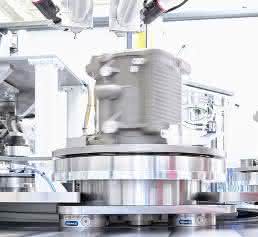
At the individual stations, some of the housing components are subjected to considerable torques. For example, radial press-fitting of the bushings generates forces of up to 25,000 newtons. "Such dimensions cannot be absorbed by the rotary table alone," emphasizes Managing Director Gökhan Sonuç, which is why the decision was made to use Schunk zero-point clamping technology. "With Vero-S, we can absorb all the torques that arise during the individual process steps." The rotary table itself is used to transport the parts and to cycle at 72 degrees, while the modules are used to securely fix the carrier pallets at the individual stations. The cycle time is in the region of around 110 seconds.
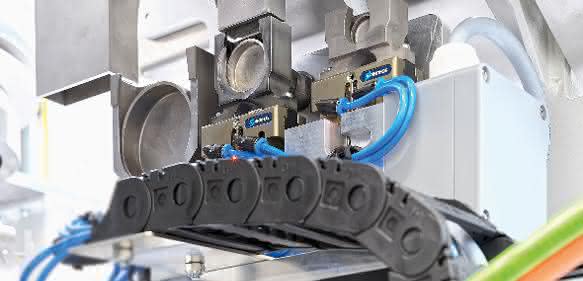
In the system, the housings are first scanned in order to distinguish between new parts and reworked parts. Glue is applied to open holes fully automatically. The bushings are separated at the two pressing stations, fed on an auxiliary axis using the pneumatic JGP 50 2-finger parallel gripper from Schunk, picked up by the press plunger via vacuum and pressed into the component. The individual positioning of the components to the press stamp is carried out via a rotary table driven by a servo motor on the carrier pallet, which can be freely positioned using an absolute encoder. A total of 21 servomotors are harmonized in the system. Up to four bushing variants can be distinguished and each handled by four different Schunk grippers. With a cycle time of 110 seconds, up to ten sockets can be pressed in per station. The sealed housings are then tested for vacuum, flow and tightness in several test cycles, the results are recorded and the components are finally labeled, released and removed.
The use of Schunk Vero-S was initially a leap in the dark for Neher, as the company had no previous experience with the use of zero point clamping systems in its own solutions. The result today is correspondingly pleasing: "The system worked well and stably right from the start," emphasizes Gökhan Sonuç. "As soon as it is clear how the installation is carried out and where the seals belong, the system is virtually self-explanatory." ee
Hanover Fair, Hall 17, Stand B40


You might also be interested in
Housing and inserts for plenty of power
Lapp presented the expansion of its Epic Power series at SPS 2023: four new M23 circular connector inserts and three new M23 housings. The special feature: all housings can be combined with any of the four inserts.
 read more...
News and product updates from Smartgas
Portable gas analyzers for outdoor use
Smartgas is starting the second half of the year with a series of updates to existing products and a number of new products. Portable analyzers expand the range of applications, while new accessories such as protective housings and heating modules...
read more...Everything accurate in switch cabinet construction
To ensure smooth work processes, tools for processing enclosures and housings must function flawlessly and reliably. Häwa rounds off its punching range with the Multi-Press 500.
read more...Shafts and conversion parts
The Rodriguez range includes ball bushings including matching housings, shaft brackets, crossbars and supports.
read more...Cooling and temperature control units
Hygienic packaging sells safely
In few industries are the requirements for hygiene in the production process as strict as in the food sector - the health of consumers has top priority. This results in enormous challenges for all machines and components involved, especially in...
read more...Simple tool change in seconds
With the CMS, Schunk is launching a user-friendly, manual change system for quick component replacement. In addition to its simple and convenient operation, the CMS also stands out with its extensive range of optional modules and complementary end...
read more...Motion controller for small drives
Medium power range covered
Faulhaber has another housing-less and compact motion controller in its range, which is particularly suitable for integration in device construction and medical technology applications.
read more...Welding solutions in the name of resource efficiency
At the Welding & Cutting trade fair in Essen (September 11-15), Fronius will be focusing on the major drivers in welding technology. Quality requirements are increasing in all industries, but the required welding specialists are scarce. In...
read more...Safe solutions for cable installations
From thick power cables to thin sensor lines, cables and lines must be routed safely through systems and machines. A challenge that should not be underestimated, explains Jörg Sokat, Head of Product Management at Pflitsch.
read more...