

Grinding with robots
Flexible, precise and polished
At a contract manufacturer in sheet metal processing, a robot colleague takes over the grinding. This saves the company time and achieves high quality end products.
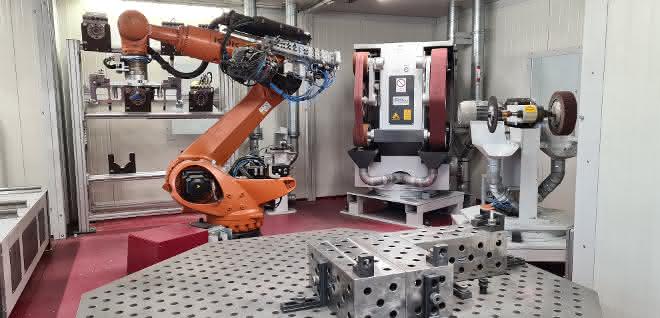
At Robert Plersch Edelstahltechnik in Hawangen, around 100 employees manufacture products from sheet metal on behalf of customers, from individual parts to entire assemblies. The company has recently started using a fully automated robot cell for surface and weld seam processing of stainless steel components. The system was designed and implemented by SHL from Böttingen together with its cooperation partner 3M.
"There were many reasons for automating the processing of weld seams and surfaces," says Managing Director Georg Plersch. "One was the fact that surface finishing, i.e. grinding, brushing and blasting, was always a bottleneck in our production process. And our customers have increasingly high demands in terms of replicability and quality. We also had to respond to this. In the stainless steel sector in particular, these are mostly visible parts, where customers attach great importance to high quality." In the search for a suitable partner for the project, they finally came across SHL. The company has been an official cooperation partner of 3M since May 2021. However, the cooperation between SHL and the abrasives experts at 3M has already been very good for several years, as Berthold Kammerer, sales specialist for grinding and polishing systems at 3M, emphasizes.
The result is a very flexible robot cell. Workpiece-guided or tool-guided, the robot can process workpieces from the size of a cell phone up to a size of around one cubic meter - with stationary and guided belt sanders and guided tools in disc form. "In addition to maximum flexibility, the programming times were of course also very important to us. We can't afford for the system to be down for a long time due to reprogramming," says Georg Plersch. Overall, the time factor naturally plays an important role. "Compared to manual processing, we were able to more than halve the times with the robot cell," says the Managing Director.
And, of course, the service life of the abrasives used also plays a major role, as fewer changes means additional time and therefore cost savings. "We don't sell our customers a product, but a solution for the entire process, and this includes high-performance, universally applicable abrasive belts and grinding wheels from 3M," says Thomas Magnussen, Head of Sales & Marketing at SHL. And so 3M Cubitron II abrasive belts and grinding wheels are used in the robot cell, which enable fast and cool grinding. Scotch-Brite non-woven belts are used for fine sanding.
"The abrasives naturally have a considerable influence on such an automated process, not only because of the quality of the surface achieved, but also because of the long service life," says Magnussen. "The big advantage of automated sanding is, among other things, unmanned working. And if I have to keep changing the sanding belt, I still have to provide an employee to take over this task," explains Plersch.
Unique overall solution
"Such a complete solution is unique in the highly competitive contract manufacturing market, and we have thus created a unique selling point for ourselves," emphasizes Georg Plersch. Incidentally, automated finishing is just another step towards comprehensive automation at Robert Plersch Edelstahltechnik. "Most of the processes in our company are already automated or fully automated - the last department was the grinding shop. We have tried to bring the entire production process up to the same level. Of course, further automation will follow; time and competition will bring this trend with them and it will be unstoppable."
According to Plersch, a decisive factor is also the shortage of skilled workers, which the company wants to counteract with such investments. "Nobody wants to do this kind of work anymore," he says, not least because of the health risks caused by the grinding dust. Incidentally, this is extracted in the robot cell, even though there are no workers in the cell during sanding. The robot sanding cell has been in operation since October 2020, and Georg Plersch draws a positive conclusion: "With my vision of a fully automated sanding process, we broke new ground and of course took a certain risk, as we couldn't fall back on a standard solution. But with SHL and 3M as partners, we were able to implement this complex and demanding project in the best possible way."


You might also be interested in
Plagiarius 2024 negative prize
On January 26, 2024, the Plagiarius campaign awarded its dreaded "Plagiarius" negative prize for the 48th time to manufacturers and retailers of particularly brazen counterfeits and fakes.
 read more...
Ivalua honors winners of the Generative AI...
AI-supported "add-ons" for buyers within 48 hours
Ivalua, provider of cloud-based spend management solutions, announced the winners and innovations of the first Generative AI Innovation Cup. The competition took place in December 2023. It was open to all Ivalua partners and employees - more than...
read more...Efaflex celebrates 50 years of high-speed...
The emphasis is on "fast"
Since day one, Efaflex has wanted to use new technologies as early as possible and drive progress in the industry. This year, the family business is celebrating its 50th anniversary under the motto "Fast Forward".
read more...Security of supply even during power outages
In the winter of 2022, Germany was worried about energy shortages. The drugstore retailer dm did not paint any horror scenarios, but nevertheless saw the possibility of controlled, temporary, regional power cuts (brownouts).
read more...Safety technology in mechanical engineering
Modules with new functions
Euchner's product highlights at EMO 2023 include the communication-capable solenoid interlocks.
read more...Transforming the paper industry towards climate neutrality
Together with partners from industry and research, Voith is developing a project for the optimization of energy and material flows in paper production. The aim of the research project is to develop a digital framework that enables effective process...
read more...Up to 95 percent less flue gas thanks to direct extraction
The requirements for occupational safety measures and safety technology are also constantly increasing in welding technology. The Technical Rules for Hazardous Substances (TRGS) stipulate that welding fumes and harmful substances must be extracted...
read more...Competitive advantages with large machines
Whether 3D-printed components for machines and systems, prototypes or aids for design: additive manufacturing is almost indispensable for modern companies in mechanical and plant engineering and automation if they want to play in the premier league.
read more...Transport technology from the modular system
Many transport tasks can be realized with the help of linear technology. Pre-configured solutions are available to simplify the interaction between the linear unit, motor, gearbox and controller. This minimizes the effort required for research and...
read more...