

Automated machine tool
Automated machine tool as a success factor
Industry 4.0 is the hot topic of the moment. For small and medium-sized companies and contract manufacturers, it holds great potential for increasing production efficiency step by step. The focus here is on efficient and user-specific automation solutions.
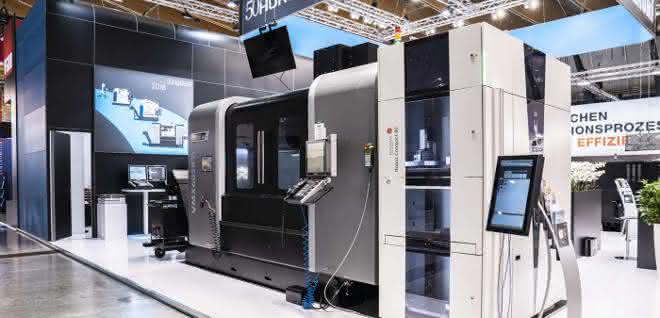
The topic of Industry 4.0 is currently dominating the manufacturing sector like no other. However, medium-sized companies and contract manufacturers should not be intimidated by the associated challenges. Individual digitalization and automation measures are already ensuring greater efficiency in production. Step by step, the path leads to the implementation of unmanned production processes, data management or remote maintenance. On the machine tool side, a simple CNC control system, an international interface standard and a Windows-based operating system facilitate the necessary conversions.
3 stages on the road to automation
We can distinguish three stages on the path to automation: The first stage is the cobot as the operator's "third arm". It is used whenever simple processes that can be programmed in a short space of time need to run parallel to the operator's work. At the EMO in Hanover, for example, Hurco showcased different versions of automated assistance. These included the "ProFeeder" loading cobot. It translates the movement performed manually with the robot arm into a program and then executes it independently.
In the second stage, data on the workpieces to be handled is transferred directly from the machining center to the robot via an I/O interface, thus extending machine runtimes to a second or third shift without the need for an operator to stand directly at the machine. This is made possible by pre-fitting a pallet or part loading system. An example: For automated pallet handling on the VMX 60 SRTi 5-axis machining center, the WinMax controller from Hurco transmits predefined commands to the robot via an I/O interface. The robot interprets the data based on its programming and inserts the pallet with the desired workpieces into the machine. This solution consists of a machine and automation. For example, with Hurco machines with the "Joblist" option, varying processing programs can be bundled without additional programming effort and then executed one after the other. The option automatically loads the data associated with a workpiece via a simple numerical assignment.
The quality of so-called "robot teaching" is important for contract manufacturers. Without customer-specific knowledge about the parts and pallet handling, a robot is completely helpless. An efficient automation solution is only created through the combination of machine and teaching. If suppliers of automation solutions offer a comprehensive teaching concept for the machines or operators in order to create future processes in the robot's directory, this is a sign of quality.
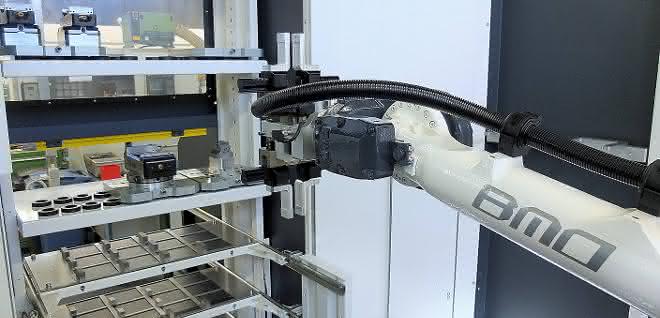
The implementation variant with the WinMax controller as the master makes handling simple and user-friendly. Hurco is thus focusing on the needs of small and medium-sized manufacturing companies, as they have to manage the transformation to Industry 4.0 with limited personnel resources. In this way, competitive advantages can be developed simply and systematically, while at the same time making production fit for the future. The operator only needs to master the controls for this solution. Extensive training is not required, a short briefing is sufficient. Even when handling pallets, with this type of automation the user only has to pay attention to the correct pallet numbers or part numbers.
Process control system, network and interface architecture
In the case of multiple automation, a comprehensive solution via the DNC interface is recommended. In this case, a higher-level process control system takes over control. As the master, the system coordinates all machines and robots integrated into the automated production process. It triggers programs and robotic processes, monitors and documents the production sequence and informs operators or the customer according to their specifications. Hurco showcased this variant at EMO 2019 with the "Job Manager" from Erowa. Such solutions are an entry into unmanned production. Process control systems also take on planning tasks, such as the sequencing of production steps.
Hurco machining centers can be combined with almost all loading systems for machine tools to create individual automation solutions and production chains. A common constellation is as follows: A robot operates two CNC machining centers that are docked to the right and left of the loading system. Automated loading and unloading of the CNC machine enables an increase in capacity in single-part and small-batch production without the need for additional personnel to operate the machine. The loading robot flexibly changes tools and grippers during this process. The machining centers can be integrated into company networks via the Windows Embedded interface. The MT-Connect software interface handles the transfer of machine and operating data. Network-supported DNC interfaces are used for communication between the machines. This network and interface architecture enables individual adaptations of the systems to customer requirements and the creation of integrated overall production systems as well as blockchain solutions between contract manufacturers and their customers. It is a prerequisite for the fast and application-oriented implementation of automation solutions, data management or remote maintenance.
This brings us to the third level of automation: all production steps are carried out directly at the machine without an operator.
A YouTube video(youtu.be/39Gw_v-ESOs) shows what such a process could already look like: Here, an operator controls a processing portal remotely using the Alexa voice assistant. Mobile assistants still play a subordinate role - if any - in the current day-to-day production of most contract manufacturers, but many use machine control to implement individual Industry 4.0 processes in their production.
Hurco equips its machines with an operating data acquisition system at the factory on request. This allows all machine and operating data to be evaluated. Using the MT-Connect option and an Extended Shop Floor Manager, users can access their machines in real time. This works independently of the operating system and via any Internet browser from a smartphone or tablet. The Extended Shop Floor Manager provides a complete control architecture and can therefore also be used by Hurco service and application technicians for external maintenance.
Sebastian Herr, Head of Application Technology at Hurco / ag


You might also be interested in
Robotics and autonomous order picking
Locus Robotics acquires Nexera Robotics and expands autonomous warehouse logistics
Locus Robotics takes over Nexera Robotics and may have taken a decisive step towards truly universal warehouse automation. A new gripping technology should now make possible what was previously considered difficult to automate.
 read more...
Gentle wheel handling
The newly founded Eisenmann Robotics division develops new robotics concepts to increase the level of automation in modern production facilities.
read more...Gripping systems and vacuum generators
Schmalz is presenting new gripping systems and vacuum generators at Automatica. Exoskeletons, which allow employees to move heavy workpieces effortlessly, will also be on display.
read more...Smart universal gripper for power electronics
The power electronics manufacturer Semikron Danfoss uses the EGU 50 mechatronic parallel gripper from Schunk in a robotic cell. It handles different components and feeds them to a measuring line. With its functionalities, it meets all requirements...
read more...Schmalz takes over finger gripper from Soft Robotics
The vacuum specialist Schmalz is expanding its gripper portfolio and acquiring the mGrip product family from the US company Soft Robotics (SRI), including all finger gripper configurations, patents and the associated know-how.
read more...Soldering with special gripper
In order to make the mini wave soldering of large panels stable and reproducible, Eutect developed a special gripper that prevents the panel from bending, among other things.
read more...Loading and unloading machines
Artificial intelligence and ergonomic lifting
Loading and unloading machines ergonomically and efficiently - Schmalz supports metalworking companies in this. At Euroblech, the company will be presenting solutions for intelligent and ergonomic handling with vacuum.
read more...Reliable end effector for cobots
Collaborative robots are now widely used for a wide range of handling tasks. SMC offers three versions of the RMH pneumatic gripper for this purpose; it is compatible with cobots from a total of twelve companies.
read more...Making access as easy as possible
Responsibility and technological progress go hand in hand - in the form of resource-saving and efficient processes in a healthy working environment. At Hannover Messe 2024, Schunk will be showcasing automated solutions that pave the way for this...
read more...