

AMB 2018
Successfully adapting trends
The manufacturing industry is changing. Not only trends such as digitalization are influencing the industry, but also new manufacturing processes and the electrification of the drive train. The upcoming AMB will show how machining technology is responding to trends and turning them into opportunities.
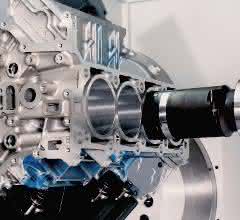
On September 18, more than 1,500 exhibitors will be showcasing their innovations and further developments at AMB - whether cutting and metal-removing machine tools, precision tools, measuring technology and quality assurance, robots, workpiece and tool handling technology, industrial software & engineering, components, assemblies or accessories. The trade fair program is also diverse: For the first time, the special show "Digital Way" will take place alongside the already established supporting events, with an associated two-day congress. It will provide information on how industrial companies can exploit the potential of digitalization with the help of the latest information technology.
However, digitalization is not the only challenge that companies face on an almost daily basis. Despite this, or perhaps because of it, the industry's ability to adapt means that forecasts for the sector continue to rise. Dr. Wilfried Schäfer, Executive Director of the VDW German Machine Tool Builders' Association, expects production volumes to increase by 7% to over EUR 17 billion, as in 2017. This development is also having a positive effect on employment, which stood at around 72,400 employees (+3.4 percent) at the end of last year. Capacities are almost fully utilized. Dr. Schäfer cites the good economic situation as one of the reasons: "The global economy continues to grow strongly. According to experts, gross domestic product is set to rise even more strongly in 2018 than in the previous year. Industrial production is an important driver. This is also having an impact on international machine tool consumption, which is set to increase by 5.9% in 2018."
An industry and its trends
Digitization, networking and Industry 4.0 will also be a topic at almost every trade fair stand. The VDW is also driving the topic forward with its industry initiative "Industry 4.0". The aim is to develop a standard and implement it in software in order to be able to connect a wide variety of machine control systems to higher-level IT systems using a common interface. Renowned machine tool manufacturers, all exhibitors at AMB, have come together for the initiative and overcome their competitive thinking.
One of them is the Heller Group. Klaus Winkler, Chairman of the Management Board and CEO, explains his company's reasons for the cooperation: "Conventional potential for increasing productivity is considered to be almost exhausted. In 'Industry 4.0', we see an approach to making the condition of machine tools transparent at all times and evaluating the information obtained with existing data for targeted diagnostics."
All major control system manufacturers are now also on board - which ensures widespread use. This benefits small and medium-sized companies in particular, paving their way into the digital future. At AMB, the VDW will be presenting initial implementations for data exchange on machine tools on its own stand as part of the Digital Way special show and the associated congress. All VDW members will be brought up to date at an information event.
New trends, new markets
There is also a trend in classic workpiece machining, namely towards complete machining. For Professor Berend Denkena, Head of the Institute of Production Engineering and Machine Tools (IFW) at the University of Hanover and current President of the Scientific Society for Production Engineering (WGP), there is an emerging trend towards complete machining. "If possible, components should be finished in one machine and from six sides."
According to Prof. Denkena, grinding technologies, for example, are increasingly finding their way into traditional turning and milling machines in order to be able to produce certain qualities at all. This is also leading to the increased use of zero-point clamping systems if a machine change cannot be avoided.
Additive processes are increasingly being integrated into conventional machine tools as an additional tool in order to be able to apply and remove material in a single clamping operation. As automation progresses, robots are taking over simple processing steps such as deburring in addition to their main handling tasks. All these technologies can come together in the control system, which increasingly speaks all the necessary languages.
Or machine tool manufacturer Starrag: it is already using the extended possibilities of the latest generation of robots. They are not only increasingly being used for automation purposes, but also "to carry out auxiliary tasks in our projects", as Managing Director Dr. Marcus Otto explains. Otto continues: "As the robots' field of activity is becoming ever larger, we can streamline machining in individual cases and offer our customers the necessary efficiency gains by running auxiliary processes in parallel." Other tasks for robots could include a wide range of reworking, cleaning and testing workpieces.
The electrification of the drivetrain initially led to real horror scenarios for the machining industry. Compared to gasoline engines, electric motors consisted of only a few, comparatively simple parts. On closer inspection, the situation has eased. Apart from the fact that experts expect petrol engines to be used for decades to come, the hybridization of many vehicles, i.e. equipping them with two types of drive, actually requires more machined parts. And in the case of purely electric vehicles, the decreasing noise level means that the remaining parts have to be machined all the more precisely to avoid being unpleasantly conspicuous. As a result, the machine tools have to be able to produce even tighter tolerances. A clear victory for manufacturers of high-tech machines. Mapal Managing Director Dr. Jochen Kress also confirmed this in an interview with SCOPE.


You might also be interested in
AI automation specialist reorganizes...
Generation change at Insiders Technologies
After almost 30 years at the helm, Werner Weiss is handing over the management of Insiders Technologies. Andree Albrecht takes over the management after a transition phase.
 read more...
Intelligent brownfield networking
Many industrial companies are struggling with established plant structures and proprietary interfaces. Stefan Klaus' presentation will show in a practical way how brownfield environments can be efficiently networked with open technologies and made...
read more...Factory-X in practice
How can set-up processes in highly variant production be automated efficiently? Markus Benndorff from soffico shows how Factory-X, industrial data rooms and modular architectures create new possibilities for flexible production concepts.
read more...Quality controls in production
Robots check car floor pans fully automatically
How can complex components in automotive production be inspected fully automatically and in real time with the help of machine vision and robotics? The case study shows how floor pans are measured and inspected fully automatically.
read more...Measurement software with integrated calibration wizard
The WinControl measurement software from Ahlborn is designed for the acquisition and processing of measurement data with Almemo measuring devices and offers functions for complex calibration tasks. A graphical user interface and context-sensitive...
read more...New platform facilitates chip design
Siemens opens access to EDA software in Europe
Siemens is cooperating with the Chips JU within the framework of EuroCDP and is facilitating access to modern EDA software for chip design, development and innovation for European companies. The aim is to strengthen start-ups, SMEs and research...
read more...AI and virtual twins for the industry
Dassault Systèmes confirms annual forecast after solid start to 2026
The French software group Dassault Systèmes has made a solid start to 2026 and is continuing to focus on artificial intelligence, cloud applications and virtual twins as growth drivers in its industrial business.
read more...Use data consistently and uniformly
New connectors and an app solution for the IIoT framework from PLCnext Technology make it easier to collect data from controllers, sensors and field devices - especially in existing systems.
read more...How companies can prevent cyberattacks
Instead of using traditional malware, attackers use legitimate programs and system tools within their victims' IT environments. Malicious behavior can hardly be distinguished from normal user behavior. For companies, this means that security...
read more...