

Vacuum supply
Windshield handling
Fuyao completes ready-to-install glass panes for the automotive industry at its production plant in Leingarten. A central vacuum supply from Busch Vacuum Solutions is used in the production of windscreens to hold the finishing process.
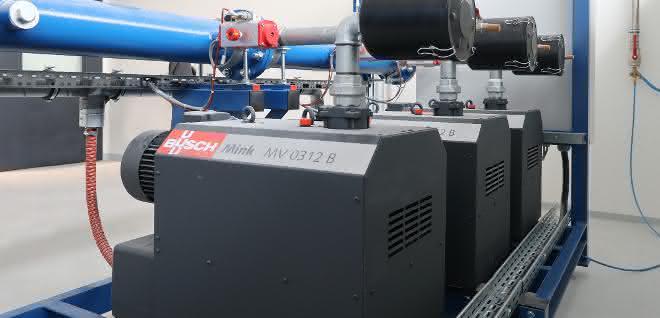
This supplies the vacuum for safe handling for the eight production lines for windscreens. Fuyao Europe is the European subsidiary of the Fuyao Glass Industry Group. The company was founded in China in 1987 and manufactures automotive glass. These are processed to such an extent that they can be fitted directly into vehicles by car manufacturers.
With a total of 25,000 employees, the Fuyao Group has now become one of the largest manufacturers of automotive glass. The production plant in Leingarten, Baden-Württemberg, which was inaugurated in 2017, is equipped with the latest production technologies. European car manufacturers are supplied from there, including the VW Group, BMW, Audi, Ford and Opel. Production at this site runs around the clock in three shifts.
CTO Torben Ludwig is always on the lookout for new technical solutions to further optimize production. For example, he was also looking for a way to reduce set-up times in the production of windscreens. Windscreens are manufactured on eight production lines. These each contain a holding and assembly device that holds the inserted windshield in the correct position. The EPDM (ethylene propylene diene rubber) sealing profile is then glued onto these fixtures. In addition, the water box profile is attached to the underside of the windshield, which ensures that rainwater is drained away in the desired paths.
Windscreens have different geometries depending on the make and series of car. This means that a special holding and mounting device must be used for each make and type, which is then replaced each time the product is changed. Until now, each of these fixtures was equipped with an individual vacuum pump that had to be connected when the fixture was changed.
To speed up this process, the vacuum specialists at Busch suggested using a central vacuum supply. This supplies all eight devices via pipes, which can be easily connected using quick-release fasteners. In addition, the central vacuum supply enables significant energy savings to be achieved. Torben Ludwig opted for this solution, which was installed and went into operation in September 2019.
In addition to a significant reduction in set-up time, further advantages quickly became apparent. Whereas eight oil-lubricated vacuum pumps, each with a rated current of 2.2 kW, were previously in use around the clock, a central vacuum supply now operates as required with three Mink claw vacuum pumps. The claw vacuum pumps have been generously dimensioned because additional holding and handling devices may also need to be supplied in the future. At the moment, only one of the three vacuum pumps is usually in operation, with a second claw vacuum pump being switched on briefly at times of peak consumption. Demand-dependent operation means that only as much power is required as is actually needed. An intermediate vacuum buffer ensures that the required vacuum level is applied directly to the devices as soon as it is needed.
Each of the three Mink claw vacuum pumps is driven by a 5.5 kW nominal current motor. In practice, however, only one of the three vacuum pumps is in constant operation. A second vacuum pump runs for a maximum of half the operating time. Compared to the original eight vacuum pumps, each with a 2.2 kW drive, which were in constant use during the three-shift operation, this results in energy savings of over 50 percent.
Another advantage is that the central vacuum supply is located in a separate room. This eliminates noise and heat emissions at the workstations.
Mink claw vacuum pumps from Busch operate completely dry. This means that there is no oil or other operating fluid in the compression chamber. This makes them largely maintenance-free. Compared to oil-lubricated vacuum pumps, all maintenance work associated with oil, such as oil, filter and seal changes, as well as the costs for the procurement of operating fluids and their disposal, are eliminated.
The vacuum system operates redundantly. This means maximum operational reliability on the one hand and sufficient power reserves to connect additional vacuum consumers on the other. The system can also be expanded at any time. The demand-based control system is designed in such a way that all three pumps achieve the same number of operating hours.


You might also be interested in
Atlas Copco takes over long-standing sales partner
Atlas Copco has taken over Heide-Pumpen. The specialist for mobile pumps has been working closely with Atlas Copco in sales and service for a long time, especially for surface pumps for construction site dewatering and wastewater detour or in the...
 read more...
Lutz Pumpen at the Achema 2024
New mobile drum pump with battery drive
The new B3 Battery from Lutz Pumpen promises mobile and safe working with aggressive liquids without having to compromise on pumping performance compared to wired versions. The battery-powered drum pump will be on display at Achema, the world's...
read more...Maintenance and Pumps&Valves in February
Final preparations are underway in Dortmund: On February 21, 2024, maintenance will start as the leading trade fair for industrial maintenance and with it Pumps&Valves as the trade fair for industrial pumps, fittings and valves.
read more...Liquid separator keeps pumps dry
Vacuum clamping minimizes distortion and enables five sides to be machined in one clamping operation. The use of cooling lubricants poses a challenge: If they get into the vacuum generator, they can cause serious damage.
read more...Spring clutches for construction machinery
Spring clutches from Torsion Control Products (TCP) are ideal for use in construction machinery where modern diesel engines are used.
read more...Protection against cooling lubricant
Liquid separator from Schmalz keeps pumps dry
Anyone clamping with a vacuum during CNC machining must protect the pump from cooling lubricant. The NLS liquid separator from Schmalz separates the cooling lubricant and returns it to the running process - without interrupting the vacuum.
read more...Which clutch for what?
Mechanical engineering and its applications are multifaceted. Every application is special and requires a perfect machine design. Individual components in the system must also be optimally designed.
read more...Energy efficiency needs electrical engineering and IT
The energy crisis makes one thing clear: it is not enough to simply screw a photovoltaic system onto your roof or purchase green electricity. Industry is faced with the challenge of reducing consumption in order to counter the rise in energy prices,...
read more...Solutions for a networked and climate-neutral industry
At the world's leading trade fair for industry, around 4,000 companies from the mechanical engineering, electrical and digital industries as well as the energy sector will be showcasing solutions for the production and energy supply of the future.
read more...