

Screw cap locking system
It all comes down to sensitivity
Getecha supplies fully automatic solutions for closing canisters. When canisters are mechanically sealed with screw caps, accuracy and flexibility are as important as "sensitivity".
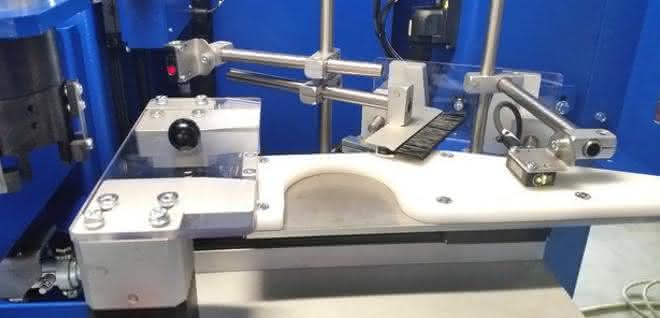
Plant manufacturer Getecha has developed an automatic screwing machine that does both and can be used at two key process-related positions: behind the blow molding line for loosely screwing the caps into the thread of the empty canisters or behind the filling machine for liquid-tight sealing of the full containers. Both blow molding companies and liquid fillers are likely to be interested in this new development.
Empty canisters, full canisters
The technological hallmark of the fully automated system is the combination of modern control and sensor technology with precisely controllable servo drives. This ensures sensitivity and accuracy when handling the screw caps and canisters. Because the torque, tightening torque, rotational speed and number of revolutions of the motors can be programmed, the capping process can be carried out with high precision, repeat accuracy, "force-dosed" and gently. This also plays a major role in maintaining the function of the PE sealing rings inside the caps.
For both applications, Getecha supplies a fully equipped system solution that can be integrated into existing processes. While the canisters enter via a short conveyor belt, the caps are separated via an ascending and a spiral conveyor and fed to the screwdriving module. Each individual canister is pneumatically fixed in the defined position and approached from above by the screwdriving module, which moves along a linear vertical axis. Screwing is fast and repeatable. Depending on the size of the canister, the total cycle time is between ten and 15 seconds. A self-monitoring system monitors the screwing process and detects defective threads. A leak test can be integrated as an option.
Changing sizes can be processed
The system can process different canisters without conversion and can be adapted to different cap types with little set-up effort. In practice, a single screw cap closing machine is able to process canisters with varying heights of 300 to 600 millimetres and widths of 150 to 300 millimetres, which come from several blow moulding or filling lines. Different process parameters can be used, for example for the screwing process. Only the footprint of the canisters is a fixed size and must be identical. An average throughput of 330 containers per hour can be calculated.
With a footprint of just under 2,000 x 3,500 millimetres, including conveyor technology, the machine is compact and can be easily integrated into the blow moulding and filling lines. The system can be connected to the customer's host computer or network and can therefore be synchronized with the cycle time of the preceding production line. The user can archive the process data of different capping scenarios in the machine's control system or in its higher-level IT system. pb


You might also be interested in
Motors, gearboxes and encoders: Faulhaber expands Ø 16 mm portfolio
Faulhaber is expanding its portfolio with new DC motors from the SXR and GXR family, a 16 mm planetary gearbox and the IEX3 magnetic encoder for compact drive solutions.
 read more...
New drive solutions for industrial automation and robotics
Faulhaber presents drive solutions with the new GXR and SXR motor family, which offer high efficiency and flexibility in combination with powerful gearboxes and encoders. These optimized components open up new possibilities for applications in...
read more...Marco Altherr becomes new Chief Financial Officer
The Supervisory Board of Ziehl-Abegg has appointed Marco Altherr as the company's new Chief Financial Officer (CFO). Altherr will take up his post in May 2025.
read more...Hydrogen storage in metal hydride
With its focus on storage systems for green hydrogen in solid form (metal hydride), GKN Hydrogen presents itself as a pioneer in safety and efficiency for the industry. GKN Hydrogen offers safe storage systems for green hydrogen and focuses on two...
read more...INDUSTRIAL Production Products of the year...
2nd place, Robotics category: EGS Automation
The SUMO automation systems from EGS Automation - economical standard solutions for automating a wide range of processes in plastics and metalworking - took second place in the robotics category in the competition for Product of the Year 2024.
read more...More productivity with Drive Intelligence
The trends in automation are productivity, sustainability and connectivity. Baumüller is launching new products on the market that address these trends, including new tools for smart energy monitoring, condition monitoring in the drive and new...
read more...Intelligence in Motion
At SPS, Koco Motion will be showcasing its expertise in customized drive solutions based on DC and BLDC motors, stepper motors, servo motors, linear drives and controllers.
read more...Nomination Products of the Year 2024
EGS Automation: SUMO automation systems
The SUMO automation systems from EGS Automation, economical standard solutions for automating a wide range of processes in plastics and metalworking, have been nominated in the Robotics category in the competition for Product of the Year 2024.
read more...Transport technology from the modular system
Many transport tasks can be realized with the help of linear technology. Pre-configured solutions are available to simplify the interaction between the linear unit, motor, gearbox and controller. This minimizes the effort required for research and...
read more...