

Flexible EOAT
Holds what's coming
Until now, when handling components with different shapes, the EOAT solution had to be used to match the geometry. Gimatic has designed the suspensions and ball joints for suction cups so flexibly that components with different shapes can be moved with just one EOAT.
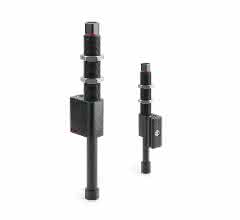
The new VSF series was designed in particular for robotic applications in which various components with different geometries need to be moved quickly, safely and precisely. Such applications can be found primarily in the automotive industry and also in the packaging industry, for example in palletizing.
The VSF series includes various suspensions that ensure firmly fixed gripping elements at all times, depending on the application. The correct positioning of the gripper parts of the EOAT to the component to be handled is achieved via a clamping mechanism in the suspension, which is adjusted when the first part is gripped. Once this has been configured, the EOAT works completely rigidly. It can be reconfigured at any time if required.
Non-rotating or rotating design
The clampable plunger holders can be designed to be secured against rotation or rotatable. A non-rotating version is used when the gripper is not round and needs to be fixed in a certain position. If the gripper, such as a vacuum suction cup, is round and works in any position, a rotatable version is used. The plungers can be attached using a separate clamping element or a thread. The user can find suitable fastening elements in the Gimatic modular system.
The following suspensions are available according to the designs described: the non-rotating suspension with smooth body and clamp VSNF, the non-rotating suspension with thread and clamp VSNTF, the rotating suspension with smooth body and clamp VSRF and the rotating suspension with thread and clamp VSRTF.
Thin automotive sheet metal
The mode of operation is illustrated using a car body part in the automotive industry: For example, the EOAT is moved up to a concave or convex sheet metal part for the removal process. The spring in the suspension is compressed. The spring-loaded position is fixed with the clamp. The clamping force is quite high at 200 newtons. The clamping status "OPEN" or "CLOSED" is queried via magnetic sensors. Once the component has been set down, the clamp is released and the plunger extends fully again.
Thanks to the rigid fixation, the handling unit can be moved with high accelerations and positioned very precisely. Clamping the suspension after elastic compensation and gripping the component prevents damage caused by uncontrolled elastic springback. Even a component as thin as a car roof is therefore not deformed.
Patented ball joint with suction cup and clamping
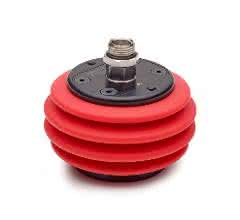
The suspensions are primarily designed for use with vacuum cups, but other components such as parallel grippers from the Gimatic range can also be attached. With the VAB series, new ball joints with suction cups have been developed for vacuum suction technology, which also have a clamping system. The pneumatically operated joint is equipped with a locking and unlocking device. Because the pivot point of the joint is very close to the suction cup level, the suction cup is prevented from "floating" and thus the transported goods are securely fixed. as


You might also be interested in
Humanoid robotics from Germany
Igus launches service robots for everyday industrial use
Humanoid robotics: With the Iggy Rob Home, igus presents a service robot for industry and everyday life. What's behind it.
 read more...
New sales and service unit in Gurugram
Yamaha Motor expands robotics business in India
Yamaha Motor is opening a new Robotics Business Support Division in India to strengthen sales and service in the growing robotics market. The unit will support SMT systems and industrial robots, among other things, and will be complemented by a...
read more...Robotics and autonomous order picking
Locus Robotics acquires Nexera Robotics and expands autonomous warehouse logistics
Locus Robotics takes over Nexera Robotics and may have taken a decisive step towards truly universal warehouse automation. A new gripping technology should now make possible what was previously considered difficult to automate.
read more...Factory planning without compressed air...
How vacuum becomes mobile
Modular factories, mobile robotics and rising energy prices are fundamentally changing automation. One solution: into the future without compressed air. Electric vacuum systems reduce costs, save energy and support flexible manufacturing and...
read more...A robot for all occasions
Industrial robots take on many tasks. Even milling with accuracies in the sub-millimeter range is now possible.
read more...Why stator and rotor laminations are becoming a performance factor
Why the future of robotics depends not only on software, but also on high-precision stator and rotor laminations inside the motor.
read more...Infineon Startup Challenge 2026
Focus on humanoid robotics
Infineon brings together young deep-tech companies worldwide to drive innovation in humanoid robotics. The focus is on hardware and system solutions from sensor technology to motor control. Applications are still possible until May 27, 2026.
read more...Synergy in the special machine
Highly automated production line for scaffolding standpipes sets standards in efficiency and process reliability
How is one of the most modern scaffolding tube production lines in Europe created? At MJ-Gerüst, a fully networked high-tech line produces six finished standpipes every 60 seconds. With automation, robotics and precision technology from Schunk. How...
read more...Quality controls in production
Robots check car floor pans fully automatically
How can complex components in automotive production be inspected fully automatically and in real time with the help of machine vision and robotics? The case study shows how floor pans are measured and inspected fully automatically.
read more...