

Transfer press simulation
Tool commissioning in one hour
Feinwerktechnik Hago has been using Schuler's DigiSim software to simulate part throughput for two years.
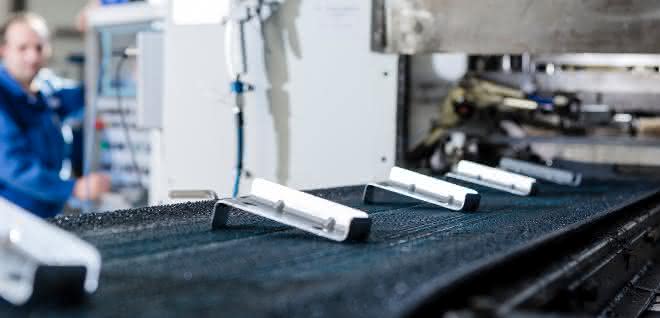
In 2006, Feinwerktechnik Hago invested in a 1,250-ton transfer press from Müller Weingarten. Schuler took over the press manufacturer a year later and has supplied many more systems since then. The hardware was joined in 2019 by the "DigiSim" software, which can be used to simulate and optimize the parts throughput in the machines. This not only increases output, but also the availability and service life of the presses and tools.
"We have been a supplier to the automotive industry for over 50 years now," says Dierk Knoblauch, who has been working at Hago for more than three decades. When he started, the largest forming system had a pressing force of just 160 tons. Today, the authorized signatory heads up the equipment construction department, which includes toolmaking - "from order entry to series production", as he says himself. The tools are used to produce complex structural parts for well-known car manufacturers and their suppliers: "It's a shame that you hardly ever see them in the vehicles themselves," regrets Knoblauch.
Employee Patrice Domigall knows from his twelve years of experience at Hago that not only tool design, but also the simulation of the part cycle on the computer is useful: "Once we only realized at the start of production that a guide pillar was in the way of a gripper." Fortunately, there was no collision, but reprogramming the movement curve caused the stroke rate to plummet. The result: "We had high reworking costs and could no longer produce the part at a profit."
Press used to be occupied for half a day
The Schuler DigiSim software would have recognized the so-called interference contour immediately, the die designer knows: "In addition, the commissioning of new dies is noticeably faster." A press used to take at least half a day to program the movement curves: "Today, the machine operator has perhaps an hour's work after receiving the data sheet from us and entering the values." His task is now just to run everything once and check for possible collisions: "We've become a lot better at that."
His design colleague Matthias Vonderach, who, like Patrice Domigall, trained as a technical draughtsman at Hago and has now been with the company for 20 years, also remembers the time before DigiSim well: "If the tool room wasn't perfectly lit, six people had to stand around the press and keep an eye on it during commissioning." As soon as the gripper and tool came dangerously close to each other, someone had to raise their hand: "Because otherwise it would simply be expensive."
The safety distances are already taken into account in the simulation with DigiSim: "The machine operator only has to do the finishing touches. Theoretically, however, he can also press the start button straight away." This also applies to the 630-ton servo press that Hago operates at its Iuka site in Mississippi, USA, says Matthias Vonderach: "We simply send the data sheet over."
"The last two strokes are crucial"
Division Manager Dierk Knoblauch also wants to use DigiSim more in future when preparing quotations: "The last two strokes compared to the competition are decisive in whether we get an order or not." However, it is also possible to misjudge a quotation - with serious consequences: "If you have sold twelve strokes per minute and can't make it past ten, you have to live with the result."
Over the past three years, Hago has also optimized the majority of the existing tools. "We deliberately went back to the drawing board to improve performance," explains design engineer Matthias Vonderach. "The advantage of DigiSim is that I can check the optimization in advance. This allows me to weigh up whether it's worth investing the money."
Best used right from the design stage
Patrice Domigall gives an example of a case in which the software made it possible to reduce production costs within a few hours: "We were able to achieve an increase of three strokes without doing much." With other smaller measures - such as the use of magnets for a quieter part placement - the output could be further increased. However, it is best to design the tool from scratch with the help of DigiSim: "Reworking is always more expensive, laborious and time-consuming."
Matthias Vonderach emphasizes that there is also a significant increase in safety when running in new tools: "We go there with a better feeling." Because the tools cost a lot of money, there is always a little nervousness involved: "But with DigiSim, I know that the press is running, even when things get tight. That's incredibly reassuring." And it takes the pressure off the machine operator, who otherwise has to program the press in a noisy environment and often under time pressure. "Safety is paramount," says Dierk Knoblauch. "If only one in ten tools crashes, that's already one too many."
Fully automatic optimization in preparation
However, the system also has its limits, adds Matthias Vonderach: "The reality of steel and iron is sometimes different." Factors such as mass inertia and vibrations of the parts - which are definitely noticeable even with smaller dimensions - are not yet taken into account in the software. Schuler is currently developing DigiSim further with the aim of automating the individual optimization steps.
The question of which gripper is best suited to which part also depends on the experience of the designers. "The chain is only as strong as its weakest link," says Dierk Knoblauch. It is often also important to get the material into the first forming stage properly. A slight embossing of the blank can reduce the vibration: "But no system will show you that, it needs the practical experience of the designer."
Harmonious and smooth transitions
"We try to get the maximum out of the theory," says Matthias Vonderach, describing his work. "The machine operator enters the values and then slowly ramps up." "Even if he then only reaches 20 instead of 25 strokes, for example, experience has shown that the movement curves run more smoothly than if he had programmed them manually," adds Patrice Domigall. The software automatically calculates harmonious and smooth transitions, says Dierk Knoblauch enthusiastically: "You can really see that when you stand in front of it."
"This not only protects the machine, but also saves energy," says Matthias Vonderach, listing further advantages. "The constant acceleration and braking consumes a lot of it." All three therefore draw an all-round positive conclusion after two years of experience with DigiSim: "It's simply a professional way to operate a transfer press," concludes Patrice Domigall.


You might also be interested in
Robotics and autonomous order picking
Locus Robotics acquires Nexera Robotics and expands autonomous warehouse logistics
Locus Robotics takes over Nexera Robotics and may have taken a decisive step towards truly universal warehouse automation. A new gripping technology should now make possible what was previously considered difficult to automate.
 read more...
Gentle wheel handling
The newly founded Eisenmann Robotics division develops new robotics concepts to increase the level of automation in modern production facilities.
read more...Gripping systems and vacuum generators
Schmalz is presenting new gripping systems and vacuum generators at Automatica. Exoskeletons, which allow employees to move heavy workpieces effortlessly, will also be on display.
read more...Smart universal gripper for power electronics
The power electronics manufacturer Semikron Danfoss uses the EGU 50 mechatronic parallel gripper from Schunk in a robotic cell. It handles different components and feeds them to a measuring line. With its functionalities, it meets all requirements...
read more...Schmalz takes over finger gripper from Soft Robotics
The vacuum specialist Schmalz is expanding its gripper portfolio and acquiring the mGrip product family from the US company Soft Robotics (SRI), including all finger gripper configurations, patents and the associated know-how.
read more...Soldering with special gripper
In order to make the mini wave soldering of large panels stable and reproducible, Eutect developed a special gripper that prevents the panel from bending, among other things.
read more...Loading and unloading machines
Artificial intelligence and ergonomic lifting
Loading and unloading machines ergonomically and efficiently - Schmalz supports metalworking companies in this. At Euroblech, the company will be presenting solutions for intelligent and ergonomic handling with vacuum.
read more...Reliable end effector for cobots
Collaborative robots are now widely used for a wide range of handling tasks. SMC offers three versions of the RMH pneumatic gripper for this purpose; it is compatible with cobots from a total of twelve companies.
read more...Making access as easy as possible
Responsibility and technological progress go hand in hand - in the form of resource-saving and efficient processes in a healthy working environment. At Hannover Messe 2024, Schunk will be showcasing automated solutions that pave the way for this...
read more...