

MRK in education and training
Virtual training for human-robot collaboration
The University of Bremen is developing a virtual training environment that allows students to experience the potential and challenges associated with human-robot collaboration (HRC) up close at the training and further education locations.
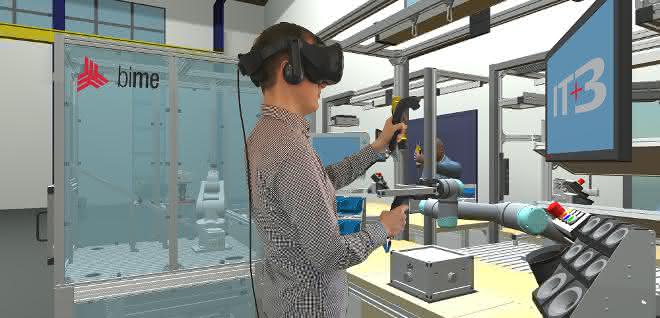
Despite the increasing importance of human-robot collaboration (HRC) in industry, the topic has so far received little attention in education and training. In particular, topics such as occupational safety and the design of HRC are highly relevant in practice. However, for the majority of trainees, the topic of HRC will be of great importance for their future careers. The fact that the topic is not part of the training is partly due to a lack of teaching materials, but also to the high cost of procuring the appropriate robots. The Bremen Institute of Structural Mechanics and Production Systems (bime) is therefore developing a virtual training environment together with the Institute of Technology and Education (ITB) in order to anchor these topics in vocational education and training.
A virtual training environment offers vocational schools and training workshops the advantage that training can be carried out in a production environment with relatively little effort. Compared to the procurement of collaborative robots, these can also be easily expanded with new modules or additional models in the virtual environment. This enables training with a variety of models from different manufacturers. To implement the project, the bime and ITB are cooperating with the company Salt and Pepper Software, which is involved in the implementation of the virtual training environment.
The training environment designed at bime particularly addresses the challenges of occupational safety, the optimization of work processes and economic evaluation. Other research projects have shown that these are the greatest challenges when implementing HRC in the production process. Various learning tasks are designed for the virtual training environment. These can be individually adapted to the performance level of the trainees. These learning tasks are based on real work processes from the field of HRC. They were recorded at various associated partner companies and supplemented with future processes from the field of research. Learning and work tasks are created on the basis of the learning tasks in combination with the practice-oriented work processes. These combine the teaching of theory with the work processes and are therefore suitable for the process orientation aimed for in vocational school teaching.
A virtual training environment offers the advantage that training can be carried out in a production environment with little effort.
A frequent disadvantage of purely virtual environments in the field of HRC is the lack of haptic feedback and thus tactile perception. Integrating haptic feedback into the application increases the benefits of virtual training and further education concepts. Numerous studies have already been carried out in the field of medicine. They have shown that haptic feedback increases learning success, particularly when training surgical procedures. The integration of such feedback into a virtual training environment is possible, but sometimes requires a great deal of effort. It is therefore necessary to weigh up the costs and benefits individually for each learning scenario.
The aim of further studies is therefore to investigate in which learning situation and for which group of people the integration of haptic feedback significantly increases learning success. The findings will be used to design the learning software and tested in extensive evaluation projects. An initial prototype of the virtual training environment will be presented to the project consortium in summer 2020 and will then be discussed with interested experts at the automatica trade fair. The project is funded by the BMBF as part of the "Virtual and Augmented Reality (VR/AR) in Vocational Education and Training" funding line with the funding code 01PV18009A. T. Sievers/as


You might also be interested in
AI automation specialist reorganizes...
Generation change at Insiders Technologies
After almost 30 years at the helm, Werner Weiss is handing over the management of Insiders Technologies. Andree Albrecht takes over the management after a transition phase.
 read more...
Intelligent brownfield networking
Many industrial companies are struggling with established plant structures and proprietary interfaces. Stefan Klaus' presentation will show in a practical way how brownfield environments can be efficiently networked with open technologies and made...
read more...Factory-X in practice
How can set-up processes in highly variant production be automated efficiently? Markus Benndorff from soffico shows how Factory-X, industrial data rooms and modular architectures create new possibilities for flexible production concepts.
read more...Quality controls in production
Robots check car floor pans fully automatically
How can complex components in automotive production be inspected fully automatically and in real time with the help of machine vision and robotics? The case study shows how floor pans are measured and inspected fully automatically.
read more...Measurement software with integrated calibration wizard
The WinControl measurement software from Ahlborn is designed for the acquisition and processing of measurement data with Almemo measuring devices and offers functions for complex calibration tasks. A graphical user interface and context-sensitive...
read more...New platform facilitates chip design
Siemens opens access to EDA software in Europe
Siemens is cooperating with the Chips JU within the framework of EuroCDP and is facilitating access to modern EDA software for chip design, development and innovation for European companies. The aim is to strengthen start-ups, SMEs and research...
read more...AI and virtual twins for the industry
Dassault Systèmes confirms annual forecast after solid start to 2026
The French software group Dassault Systèmes has made a solid start to 2026 and is continuing to focus on artificial intelligence, cloud applications and virtual twins as growth drivers in its industrial business.
read more...Use data consistently and uniformly
New connectors and an app solution for the IIoT framework from PLCnext Technology make it easier to collect data from controllers, sensors and field devices - especially in existing systems.
read more...How companies can prevent cyberattacks
Instead of using traditional malware, attackers use legitimate programs and system tools within their victims' IT environments. Malicious behavior can hardly be distinguished from normal user behavior. For companies, this means that security...
read more...