
Weidmüller
Double-digit sales growth expected for 2018
Weidmüller expects total sales of over 820 million euros for 2018. "Looking back, our investments in building up expertise in automation and digitalization, in the buyback of our sales companies in North America and in other important growth regions have paid off," explains Weidmüller CEO Jörg Timmermann.
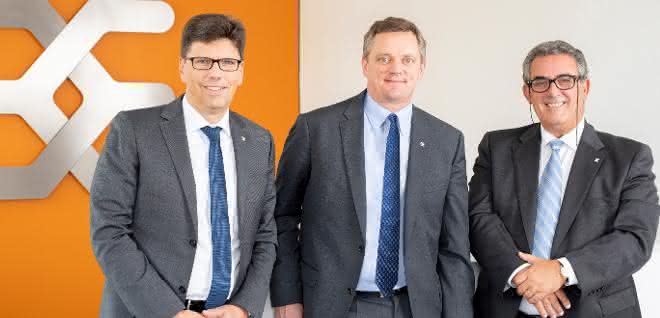
With the expansion of the "u-mation" automation system, the acquisition of a majority stake in the visualizer GTI and the cooperation with the Austrian specialist Keba, Weidmüller has continued on its chosen path. "We want to continuously expand our market position in the areas of automation and IoT and are developing our portfolio accordingly," says Volker Bibelhausen, Weidmüller's new Chief Technology Officer since September 1, 2018. As in previous years, Weidmüller will present its final annual financial statements at the Hannover Messe in April.
The company now offers a wide range of communication-capable components for the provision and processing of process data. "We have noticed that many customers no longer associate Weidmüller solely with passive components, but also with digitalization topics such as industrial analytics. Customers also value our solution expertise in control cabinet construction," says Weidmüller's Chief Sales Officer José Carlos Álvarez Tobar. This is also reflected in sales. With growth of more than 25 percent, the Automation Products and Solutions division is making an ever greater contribution.
Cautious outlook for 2019
Despite numerous uncertainty factors, the Executive Board of the Weidmüller Group is confident overall for 2019, but expects a significant decline in growth momentum. The German Electrical and Electronic Manufacturers' Association (ZVEI) expects growth of 4 percent in 2019, while the German Engineering Federation (VDMA) anticipates growth of 2 percent. "There are many uncertainties that make us cautious about the future. In addition to currency effects, these are primarily rising material costs and uncertainties due to increasingly protectionist trade and economic policies, the impact of the Brexit negotiations and political developments worldwide," says Timmermann.


You might also be interested in
RS expands partnership with Phoenix Contact
RS Components has significantly expanded its range of products from Phoenix Contact. The distributor now supplies more than 45,000 products from the manufacturer of products, solutions and digitalization expertise for the electrification, networking...
 read more...
Component design via online tool
mbo Osswald aims to set new standards in the world of fastening technology with its new sleeve configurator. This tool was developed to design individual components for different industries precisely and in line with requirements.
read more...Competitive advantages with large machines
Whether 3D-printed components for machines and systems, prototypes or aids for design: additive manufacturing is almost indispensable for modern companies in mechanical and plant engineering and automation if they want to play in the premier league.
read more...Networking event at Schunk: Expert Days on...
Expert exchange at the highest level
On October 25 and 26, 2023, SCHUNK is once again organizing the Expert Days: an annual international and cross-industry event on the topic of "Robotic Material Removal". 70 specialists from Europe and North America will meet in Brackenheim-Hausen to...
read more...Transport technology from the modular system
Many transport tasks can be realized with the help of linear technology. Pre-configured solutions are available to simplify the interaction between the linear unit, motor, gearbox and controller. This minimizes the effort required for research and...
read more...Purchasing optimization for rolling bearing...
Best choice thanks to pre-classification
With the ABEG method, Findling Wälzlager has created a transparent and calculable decision-making basis for avoiding oversizing and undersizing of rolling bearings. This purchasing optimization helps customers to always select the technically and...
read more...Predictive maintenance on the smart drive
Baumüller offers a drive-based software solution to diagnose the machine status. The Smart Condition Monitoring tool runs on the PLC integrated in the drive controllers and uses the drive to record signals. Sebastian Maul, application engineer at...
read more...Siemens: continued profitable growth and...
Result April to June 2023: strong momentum
Siemens continued its profitable growth trajectory in the third quarter of fiscal year 2023 (ending June 30, 2023). All industrial businesses achieved strong revenue growth. The company also recorded strong order momentum for major projects and in...
read more...How production can benefit from AI
Together with AI technology, IIoT networking makes it possible to better control machine parameters and optimize quality with predictive quality. Downtimes and set-up times can also be further minimized. Cloud platforms also make these technologies...
read more...