
VDMA
Downturn in mechanical engineering slows down
According to the VDMA, the downturn in the German mechanical and plant engineering sector slowed in June. Job losses also remain moderate.
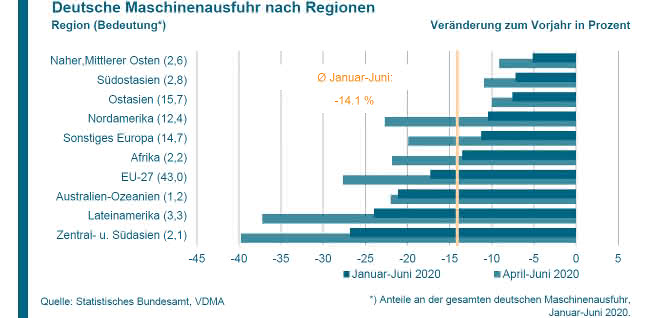
The VDMA reports that machinery exports were also hit hard by the coronavirus pandemic in the second quarter. Between April and June 2020, they fell by 22.9% year-on-year to €35.2 billion; in Q1/2020, exports were still 5% below the previous year's figure, resulting in a cumulative decline in exports of 14.1% for the first six months.
April and May proved to be particularly weak months due to the global travel and transportation restrictions: Exports fell short of the previous year's figure by around 28% in each case. At 12% year-on-year, machinery exports from Germany fell less drastically in June than in the two previous months of April and May due to the easing of restrictions. There is also likely to have been a catch-up effect due to the easing of supply chains.
The 2008/2009 financial and economic crisis was worse
"Companies have recently been able to breathe a little easier in the export business. But it will still be a bumpy road back to normality. This is because many mechanical engineering customer countries will first have to get a better grip on the consequences of the pandemic and develop more confidence for new investments before export business can return to normal," says VDMA Chief Economist Dr. Ralph Wiechers. Nevertheless, a comparison of the export figures from the corona crisis with the figures from the 2008/2009 financial and economic crisis shows that the decline was not more drastic, at least in the first half of the year. "In the first six months of 2009, machinery exports from Germany fell by just under 23%," explains Wiechers.
Russia strong, Great Britain weak
In the second quarter of this year, machinery exports from Germany to the EU-27 were 27.7% below the previous year's level. As expected, the export business with countries heavily affected by the coronavirus, such as France (-28.2%), Italy (-31%), Spain (-32.1%) and the UK (-36.4%), was particularly poor during this period. Cumulatively, exports to the EU-27 partner countries fell by 17.3% in the first six months of 2020.
In the same period, 11.3% fewer machines were delivered to the rest of Europe. Russia stands out in particular, as it was the only top customer country to record an increase in exports of 4.5% in the first half of the year. "The increase is largely due to major orders for the Russian process industry, which were realized in June," explains Wiechers. "This latest growth trend in machinery exports from Germany to Russia is unlikely to continue."
Nevertheless, Russia has now moved back up to ninth place among the most important customer countries for machinery exporters from Germany, displacing Switzerland to tenth place.
China outstrips the USA
Export trends to the two most important individual markets, the USA and China, differ significantly: 23% fewer machines were delivered to the USA in the second quarter than in the previous year. Although business in China declined between April and June, this was only by 7.9%. According to the VDMA, China is therefore on its way to catching up with the USA in the ranking of the most important individual markets. "In the People's Republic, we are observing an extremely robust economic recovery, especially in industry. This in turn is benefiting a number of mechanical engineering sectors, which are recording significant growth in exports to the People's Republic. These include machine and component manufacturers for the construction and infrastructure industries as well as the electronics sector," Wiechers analyzes.
Moderate job cuts
The number of employees thus amounted to around 1.03 million at the end of June. "In view of the immense pressures facing our industry, this remains a moderate reduction," Wiechers comments on the figure.
The reduced labor market momentum was already apparent in the results of the regular Corona flash surveys conducted by the VDMA. 17% of the companies last surveyed at the beginning of July stated that they were adjusting their underutilized production capacities by reducing permanent staff. Significantly more (68 percent of companies) are using short-time work. "As in 2009, short-time work secures numerous jobs and is proving to be a reliable, job-securing instrument in this crisis too," explains the VDMA Chief Economist. "For this reason, Federal Finance Minister Olaf Scholz is on the right track when he wants to extend the duration of the short-time working allowance to 24 months."
Plea for extended short-time work
In July, a good third of employees in the mechanical engineering sector were on short-time work. However, the increase from an estimated 354,000 short-time workers in June to 378,000 in July was significantly lower than in previous months.
Many mechanical engineering companies currently have to walk a tightrope between hiring freezes and the search for skilled workers for the tasks ahead, particularly in the area of digitalization. Caution currently prevails: "The number of registered jobs in mechanical engineering has almost halved compared to the previous year," says Wiechers. Demand for engineering staff fell by 14.5 percent in the first quarter and by 23.7 percent in the second quarter.


You might also be interested in
RS expands partnership with Phoenix Contact
RS Components has significantly expanded its range of products from Phoenix Contact. The distributor now supplies more than 45,000 products from the manufacturer of products, solutions and digitalization expertise for the electrification, networking...
 read more...
Component design via online tool
mbo Osswald aims to set new standards in the world of fastening technology with its new sleeve configurator. This tool was developed to design individual components for different industries precisely and in line with requirements.
read more...Competitive advantages with large machines
Whether 3D-printed components for machines and systems, prototypes or aids for design: additive manufacturing is almost indispensable for modern companies in mechanical and plant engineering and automation if they want to play in the premier league.
read more...Networking event at Schunk: Expert Days on...
Expert exchange at the highest level
On October 25 and 26, 2023, SCHUNK is once again organizing the Expert Days: an annual international and cross-industry event on the topic of "Robotic Material Removal". 70 specialists from Europe and North America will meet in Brackenheim-Hausen to...
read more...Transport technology from the modular system
Many transport tasks can be realized with the help of linear technology. Pre-configured solutions are available to simplify the interaction between the linear unit, motor, gearbox and controller. This minimizes the effort required for research and...
read more...Purchasing optimization for rolling bearing...
Best choice thanks to pre-classification
With the ABEG method, Findling Wälzlager has created a transparent and calculable decision-making basis for avoiding oversizing and undersizing of rolling bearings. This purchasing optimization helps customers to always select the technically and...
read more...Predictive maintenance on the smart drive
Baumüller offers a drive-based software solution to diagnose the machine status. The Smart Condition Monitoring tool runs on the PLC integrated in the drive controllers and uses the drive to record signals. Sebastian Maul, application engineer at...
read more...Siemens: continued profitable growth and...
Result April to June 2023: strong momentum
Siemens continued its profitable growth trajectory in the third quarter of fiscal year 2023 (ending June 30, 2023). All industrial businesses achieved strong revenue growth. The company also recorded strong order momentum for major projects and in...
read more...How production can benefit from AI
Together with AI technology, IIoT networking makes it possible to better control machine parameters and optimize quality with predictive quality. Downtimes and set-up times can also be further minimized. Cloud platforms also make these technologies...
read more...