

Hanover Fair 2019
VDE: Is Germany losing its pioneering role?
The VDE warns of a loss of Germany's pioneering role. VDE Managing Director Hinz calls the self-assessment of companies and universities in Germany with regard to AI and Industry 4.0 "a fundamental misjudgement".

You rarely hear such clear words from the VDE. At his press conference at the Hannover Messe, Ansgar Hinz, CEO of the Association for Electrical, Electronic & Information Technologies, warns that Germany's technological leadership is not as secure as many believe. "We are obviously doing too well in Germany at the moment to realize that the swan song for Germany as an industrial location has already begun. Especially when we talk about decisive future technologies, methods and cross-sectional competencies such as this year's core theme of the Hannover Messe, we are at best mediocre in a global comparison," said Hinz.
Although a survey conducted by the VDE among its members on the development of the electrical industry in 2019/20 paints a positive picture (44% of respondents want to significantly increase their R&D expenditure this year), the mood in industry and universities on topics such as artificial intelligence and Industry 4.0 is different. "In a nutshell: the competitive position compared to Asia and the USA is modest," says Hinz.
Germany lagging behind in artificial intelligence

"In the AI innovation ranking, Germany's gap to the world leaders seems unassailable. 56 percent rate Germany's level of innovation in AI as mediocre, only 1 percent see Germany in a pioneering position, 0 percent from universities," says Hinz. The larger the company, the more pessimistic the assessment. Hinz often sees the reason for this in their global positioning and opportunities for comparison.
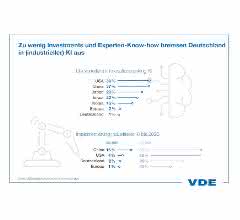
The USA and China lead the way in artificial intelligence, followed by Japan. "Israel and Korea are ahead of Germany, which brings up the rear with Europe," says Hinz. This is not surprising, as 60 percent of all patent applications in AI come from the USA, followed by China and South Korea. According to a study by the Swiss economic research institute Econ Sight, Siemens was the 16th most successful German company in an international comparison.
Germany is losing out on Industry 4.0
"It gets even more dramatic: even in the market segment that was and still is a pillar of the success story of Germany as a technology location, industrial production and automation technology in the application fields of mechanical engineering, automotive and co., Germany does not perform much better in the Industry 4.0 innovation ranking," Hinz paints a sobering picture. The result of the ranking sees China (28%), Japan (20%) and then Germany with 18% followed by Korea (17%) as the frontrunners. The EU is lagging behind in the ranking with 4%.
Hinz goes on to say that only 2 percent in Germany expect industrial AI to be implemented by 2020, while 39 percent see this happening by 2025. Hinz uses China and the USA as a comparison: in China, 15 percent expect industrial AI to be used by 2020, 61 percent by 2015. The figures are similar for the United States. "The self-assessment of our companies and universities is a fundamental misjudgement and a risk for Germany as a business location. The self-assessment is evidence of the shock paralysis that I warned about in this room last year," said Hinz.
Who is to blame and who is doing better?
In his speech, Hinz also analyzed the reasons for the development: "Germany (and Europe) failed to recognize the dimensions for years, rested on its prosperity and status quo and slept through the development. This applies above all to politics and large areas of industry. Those who recognized it in time strategically globalized their company locations years ago in order to be able to cushion fluctuations today and in the future."
The competition is also being monitored. Hinz cites the clear strategic goals of the USA and China and the associated strategic investments as reasons for their leading position. US President Trump, for example, is investing 1.3 billion dollars a year in AI research. According to various reports, the US Department of Defense already made 6.7 billion dollars available two years ago. However, numerous technology companies such as Amazon, Alphabet, Microsoft, Apple and Facebook are also involved.
In China, President Xi Jinping has set the goal of making the Middle Kingdom a leader in artificial intelligence by 20130 and is investing billions in research into it.
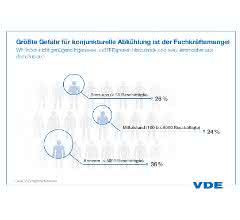
We also need to be aware that Germany is suffering from a shortage of skilled workers. Due to the size of the population alone, it is utopian to believe that we can keep up with highly populated countries such as China. For every highly talented student in Germany, there would be a whole academic year in China.
Not everything is bad
Investment in infrastructure is also an indicator of the pioneering roles. For example, 229 supercomputers/data centers/cloud servers were installed in China, 108 in the United States, 39 in Japan, 20 in the United Kingdom, 18 in France and 17 in Germany in order to cope with the volume of data generated.
"In the US and China, data is being used for research without restraint and we are discussing morality and data protection. I am not saying that this is right. But what we need is a healthy balance between security, interoperability and business models based on standards. While we are having discussions about risks, which incidentally don't even take place outside Europe, the rest of the world is happily carrying on with its research," explains Hinz.
Hinz concludes that Germany is lagging behind "in the supreme discipline of AI" and is therefore missing out on a market worth billions. The reasons for this are "too little money, inadequate infrastructure, too few experts and therefore too little know-how". Germany's current economic position is a consequence of past investments. "However, anyone who anticipates an automatic extrapolation into the future is making a fundamental misjudgement," says Hinz.
The solution: Focus on core competence
According to Hinz, one solution is to focus on "what we know how to do". For example, 66% of small and medium-sized enterprises and 73% of universities see Industry 4.0 as an opportunity to re-establish the "Made in Germany" brand and thus secure Germany's competitiveness and jobs. "As a recipe for success, they recommend concentrating German expertise in the fields of industry + AI and IT security + AI and advancing to the top of the AI world league with a clear focus and its very own priorities. Our strength lies in combining our industrial process and automation expertise with a modern AI methodology toolkit. This may be our only opportunity - combining AI and our expertise in industrial production and automation in the relevant fields of application," emphasizes Hinz.
The VDE therefore demands:
- Strategic, targeted support for research and innovative start-ups,
- Manpower, i.e. attracting more young people for training in electrical engineering and information technology, mechanical engineering and IT, as well as relying on the expertise of current employees and making them fit for the digital transformation with modern further training measures,
- Stop the migration of experts to the international Silicon Valleys and bring them back,
- a massive improvement in education at all levels, from elementary school to university and further vocational training,
- Industry convergence and globalization; mechanical engineering, electrical engineering and IT must move closer together.
The VDE also suggests making artificial intelligence a compulsory subject in engineering courses.


You might also be interested in
ESTIA aims to strengthen Europe's cloud
New tech alliance for EU sovereignty
Twelve companies, including Dassault Systèmes, are founding the European Sovereign Tech Industry Alliance (ESTIA). The initiative aims to strengthen Europe's technological independence and define requirements for sovereign cloud services. The start...
 read more...
Deutsche Telekom and Nvidia launch one of Europe's largest AI factories
With the Industrial AI Cloud in Munich, Deutsche Telekom and NVIDIA are creating one of the largest AI factories in Europe. Companies can train AI models, carry out simulations and access 10,000 GPUs.
read more...Leveraging data potential with AI and streaming
Huge data treasures are still lying dormant in many manufacturing companies. And yet it is high time that these treasures were unlocked. There is often a lack of resources and capacity to make data usable in real time. Streaming production data can...
read more...More awareness of noise
Dematic offers solutions that are tailored to different cloud environments and reduce environmental impact through reduced material consumption and improved energy efficiency.
read more...Generative AI in the automation environment
The mechanical engineering and automation industry is undergoing profound change. This transformation is being driven by more volatile global trade, geopolitical crises and increasing market pressure, which demands greater agility, technological...
read more...Rigid data structures have had their day
The traditional data center is no longer the center of data. A hybrid cloud storage approach enables manufacturing companies to both meet the current requirements of data-intensive processes and future-proof their infrastructure.
read more...Software as a service in three stages
CIM Database Cloud is a new out-of-the-box solution from Contact for end-to-end digital product development.
read more...How production can benefit from AI
Together with AI technology, IIoT networking makes it possible to better control machine parameters and optimize quality with predictive quality. Downtimes and set-up times can also be further minimized. Cloud platforms also make these technologies...
read more...More expertise for digital engineering
Altair, a computational science and artificial intelligence (AI) company, has acquired OmniV, a technology from Michigan, USA-based software company XLDyn.
read more...